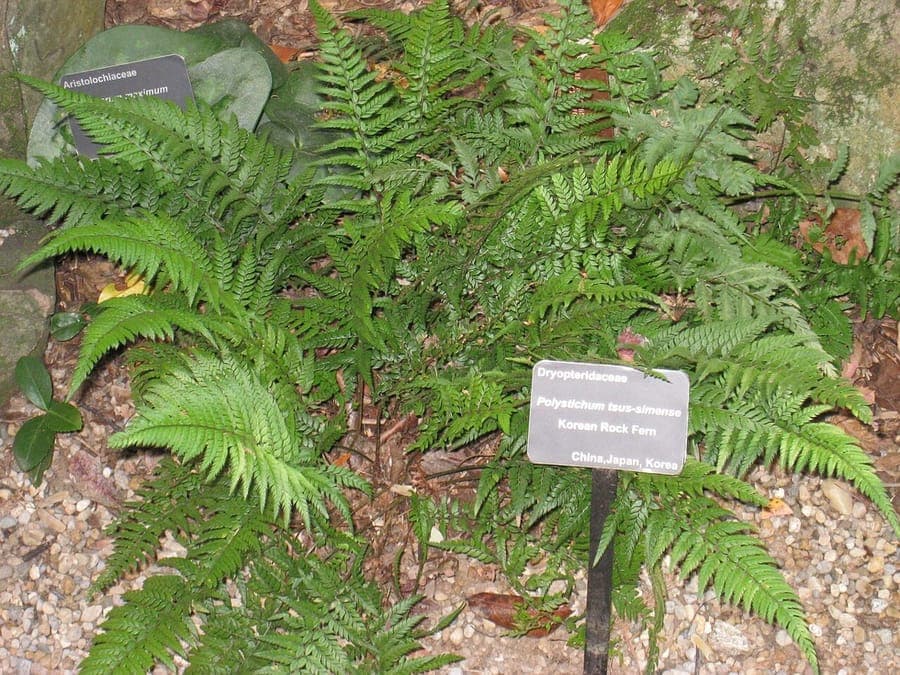
Daderot / CC BY-SA 4.0, via Wikimedia Commons
Korean rock fern: complete guide
Polystichum tsus-simense
Want to see Korean rock fern: complete guide in your garden?
Full design in HD: €7.99
Look after your Korean rock fern with the GardenWorld app
Identify plants with your camera and get a care calendar with reminders for this plant.


Overview
The Korean rock fern (Polystichum tsus-simense) is a small evergreen fern from East Asia that earns its place in gardens of every size. It grows wild in Japan, Korea, China and Taiwan, among rocks, on shaded slopes and along woodland edges. The species name refers to Tsushima, an island in the strait between Korea and Japan. It belongs to the shield ferns (Polystichum), the same genus as our native soft shield fern and hard shield fern.
What makes this fern so appealing is its size. Where many garden ferns easily reach a metre, Polystichum tsus-simense stays compact at 25 to 45 cm tall and roughly as wide. It grows slowly and neatly in a loose rosette, without runners. That means it fits the smallest town garden, a shady corner of a rockery, the front of a raised bed beside a path or a pot on a north-facing patio. In Japan and the United States it is also widely grown as a houseplant and in terrariums.
Its greatest asset is the evergreen foliage. While hostas and other shade plants vanish in autumn, this fern stays dark green all year round, giving structure to the winter garden, especially in spots you can see from the window. If you are unsure where such a small focal point would work best, you can have a garden design made on gardenworld.app in which even the shady corners are given a clear role.
Appearance and foliage
Ferns do not flower, so everything revolves around the foliage. The fronds of Polystichum tsus-simense are lance-shaped, bipinnate and finely toothed: each small leaflet ends in tiny bristle-like points, a hallmark of the shield ferns. The colour is a deep, dark green with a slight sheen, so the plant looks fresh and healthy even in midwinter.
The stalks are dark, almost purplish black at the base, and clothed in small dark scales. That contrast between dark stems and green blades gives the plant a refined, almost graphic look. In spring the new fronds unfurl in a lighter, brighter green, so for a few weeks you see a lovely difference between young and old growth.
In summer, round spore clusters appear on the undersides in neat rows along the midrib of each leaflet. Each is covered by a small, round, shield-shaped flap. Later in the season they turn brown and release their spores. This is perfectly normal and not a sign of disease.
Ideal location
Give this fern a place in partial to full shade. Morning sun or dappled light beneath trees is ideal; strong afternoon sun quickly scorches the dark fronds. A spot on the north or east side of a wall, between larger shrubs or in the lee of a fence works well.
Because it grows among rocks in the wild, it appreciates a position where the roots stay cool but water drains away quickly. A pocket on the shady side of a rockery, a bed between boulders or the edge of a raised bed are excellent. Keep its small size in mind and plant it at the front of the border, where larger perennials cannot swamp it. Spacing of 30 to 40 cm is enough.
It thrives in containers. Choose a pot at least 25 cm across with drainage holes and keep it in the shade. Indoors it does best in a cool, bright spot out of direct sun, such as a north-facing window or an unheated conservatory. It dislikes the dry air of a warm, centrally heated room.
Soil requirements
The ideal soil is humus-rich, open and well-drained. Think of a woodland floor: plenty of leaf mould, lightly moist but never waterlogged. On heavy clay, add generous amounts of compost plus some grit or fine gravel to improve drainage. On sandy soil, concentrate on working in extra organic matter to hold moisture.
Soil pH is less critical than for many ferns. Slightly acidic to neutral (pH 5.5 to 7) is best, but slightly limy soil is generally tolerated. For containers, use good multipurpose compost with about a third leaf mould or fine bark and a handful of perlite. Feeding is hardly necessary. A thin layer of compost in spring or, for pot plants, a very dilute liquid feed a few times a season is plenty.
Free preview
Want to see Korean rock fern: complete guide in your garden? Make a free preview of your design.
Watering
Keep the soil evenly and lightly moist, especially in the first year. In dry weather water once or twice a week, preferably in the morning and at the base of the plant. Once established, Polystichum tsus-simense copes with short dry spells, but prolonged summer drought leads to brown frond tips.
Wet feet in winter are more dangerous than drought. If the plant is in a pot, make sure water can always drain away and never leave it standing in a saucer of water over winter. Indoors, water when the top centimetre of compost feels dry. A light misting with tepid water on warm days helps against overly dry air.
Pruning
This fern needs almost no pruning. Because it is evergreen, simply leave the fronds in place. In March, just before the new fronds appear, cut out any damaged, faded or frost-scorched fronds at the base. Healthy old fronds can stay; they fade naturally once the new growth has matured.
Take care while cutting: the young, coiled shoots sit in the crown and snap easily, so work slowly with small scissors. If you would like more plants, carefully divide older clumps with several crowns in April. Each piece needs its own crown and a good share of roots.
Maintenance calendar
January-February: Leave the evergreen fronds standing. Protect container plants from prolonged frost and waterlogging.
March: Remove damaged fronds before new growth begins. Scatter a thin layer of leaf mould around the plant.
April-May: New fronds unfurl. A good time to plant, repot or divide older clumps.
June-August: Water during dry spells, especially container plants. Spore clusters appear on the undersides of the fronds.
September-October: Another good planting window. Leave fallen leaves around the plant as a natural mulch.
November-December: Dormant season. The plant stays green and gives the winter garden structure.
If you would like to see month by month which jobs are waiting in your garden, the planting calendar on gardenworld.app helps you remember even this small fern.
Winter hardiness
Polystichum tsus-simense is reliably hardy in the ground across most of Britain and north-west Europe. The RHS rates it H6, which corresponds to temperatures down to around -15 to -20 °C. It therefore usually overwinters without protection, particularly in a sheltered spot with well-drained soil.
In severe winters the fronds may brown somewhat, but the crown sprouts again in spring. A layer of dry leaves or a few conifer branches over the plant helps during long frosty spells. Containers are more vulnerable because the root ball can freeze. Move them against a wall in winter, wrap them in hessian or bubble wrap, or move small pots into a cool garage or greenhouse for a while.
Little is known about toxicity for this species, and it does not appear on the usual lists of plants poisonous to people or pets. As a general rule, though, ferns are not for eating, and it is wise to keep children and small pets from nibbling them.
Companion plants
Thanks to its small size and dark foliage, this fern is an excellent partner for other compact shade plants. Coral bells (Heuchera micrantha and its many hybrids) add colour with red, amber or silver-marbled leaves. Barrenwort (Epimedium grandiflorum) flowers in April with dainty, spurred blooms and also has attractive autumn foliage.
Small hostas such as Hosta sieboldii fill the space around the fern in summer, while the fern takes over the bare patch in winter. Ivy-leaved cyclamen (Cyclamen hederifolium) flowers in September and carries marbled leaves through winter, which look superb beside the dark green fronds. Japanese sedge (Carex morrowii) contrasts nicely in form with its narrow, evergreen leaves. Snowdrops and other small spring bulbs are also lovely between the ferns.
Final thoughts
Polystichum tsus-simense is a fern for gardeners with little space who still want greenery all year round. It is compact, evergreen, hardy and undemanding: a shady spot, humus-rich soil that does not dry out and a tidy-up in March are all it needs. In a rockery, at the front of a shady border or in a handsome pot on the patio, it brings calm and structure even in the months when the rest of the garden is asleep.
Frequently asked questions about Korean rock fern
Is Korean rock fern winter hardy?
Polystichum tsus-simense is reliably hardy in the ground across most of Britain and north-west Europe. The RHS rates it H6, which corresponds to temperatures down to around -15 to -20 °C.
When and how do you prune Korean rock fern?
This fern needs almost no pruning. Because it is evergreen, simply leave the fronds in place.
How much water does Korean rock fern need?
Keep the soil evenly and lightly moist, especially in the first year. In dry weather water once or twice a week, preferably in the morning and at the base of the plant.
Where does Korean rock fern grow best?
Give this fern a place in partial to full shade. Morning sun or dappled light beneath trees is ideal; strong afternoon sun quickly scorches the dark fronds.
What soil does Korean rock fern need?
The ideal soil is humus-rich, open and well-drained. Think of a woodland floor: plenty of leaf mould, lightly moist but never waterlogged.

See it in your garden
See Korean rock fern in your garden
One photo of your garden and a few questions. You see the result in about a minute.
Try it with a photoIdentify this plant in your own garden. Identify a plant
Similar plants
Alumroot: complete guide
Heuchera micrantha
Discover how to grow and care for Heuchera micrantha: ideal light, soil, watering, and seasonal maintenance for thriving plants in your garden.
Barrenwort: complete guide for shade plants
Epimedium grandiflorum C.Morren
Discover Barrenwort, a fascinating shade plant with elegant foliage and beautiful flowers. Perfect groundcover for moist shade.
Hosta sieboldii: complete guide
Hosta sieboldii
Narrow-leafed Hosta brings elegant foliage value to shaded corners. Discover how to grow this Japanese plant with this comprehensive care guide.
