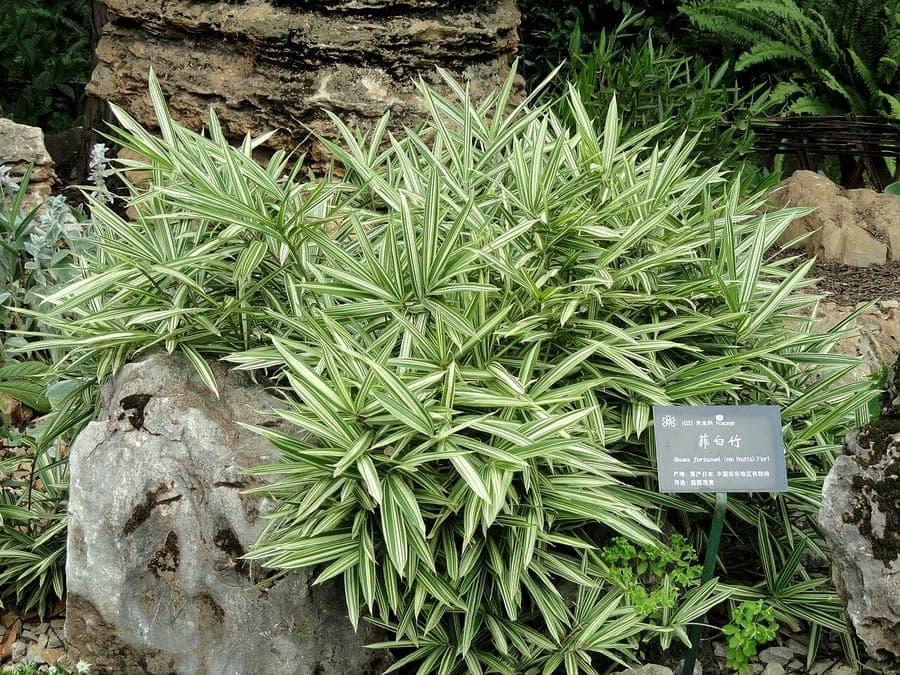
Daderot / Public domain, via Wikimedia Commons
Dwarf white-stripe bamboo: complete guide
Pleioblastus fortunei
Want to see Dwarf white-stripe bamboo: complete guide in your garden?
Full design in HD: €7.99
Look after your Dwarf white-stripe bamboo with the GardenWorld app
Identify plants with your camera and get a care calendar with reminders for this plant.


Overview
The dwarf white-stripe bamboo (Pleioblastus fortunei) is an elegant, compact bamboo species native to Japan. This bamboo reaches only 60-90 cm in height and forms dense, attractive clumps with fine green foliage, often with white striping. It is a perfect bamboo for smaller gardens and containers where larger bamboo species would be too massive.
Appearance and growth
Pleioblastus fortunei grows as a compact, multi-stemmed clump. The fine, linear leaves are 10-15 cm long and have a grass-like appearance. Many cultivars feature golden-yellow or white stripes in the foliage, adding extra visual interest. The foliage remains green year-round. Plants reach only 60-90 cm in height, making them ideal for small spaces.
Ideal location
Dwarf bamboo thrives in full sun to partial shade. Full sun is recommended for more intensely colored stripes. In full shade it grows green and healthy, but foliage coloring may be less intense. The plant is very suitable for sheltered positions between buildings. Protection from strong cold wind helps prevent leaf damage.
Soil
Pleioblastus fortunei grows in virtually all soil types but thrives best in fertile, well-draining soil rich in humus. The plant tolerates sandy to clay soils. Slightly acidic to neutral pH (6.0-7.0) is ideal. In containers use well-draining potting mix with added compost.
Watering
Keep soil moist but not waterlogged. During the growing season (May-September) water regularly. Foliage shows clear signs of water stress if too dry. In container culture more attention needed than in garden. In winter less water required. In dry winters placing under dry roof helps prevent frost damage.
Free preview
Want to see Dwarf white-stripe bamboo: complete guide in your garden? Make a free preview of your design.
Pruning
Pruning is not necessary for healthy growth, but you can shape foliage as desired. Remove completely dead culms in spring. Some gardeners cut dwarf bamboo short in spring for denser, more compact growth. Remove severely damaged foliage.
Maintenance calendar
- March-April: Remove dead culms, optionally cut back short
- May-September: Regular watering, growth period
- June-July: Check for insects (rare)
- October: Gradually reduce watering
- November-February: Minimal care, frost protection
Winter hardiness
Pleioblastus fortunei is hardy to about -15C, suitable for outdoor cultivation in the Netherlands and Belgium. Foliage may show some damage in severe winters, especially in bright winter sun after frost. Shade from intense winter sunlight helps prevent this damage. In very severe winters leaf loss may occur, but the plant recovers.
Companion plants
Dwarf bamboo combines well with other Japanese elements like Japanese maple, bamboo-split fencing, dwarf shrubs, and stone lanterns. Also with other foliage plants like Hosta, Helleborus, Liriope, and dark-foliaged Heuchera it creates beautiful combinations. In borders it works well with conifers and silvery foliage companions.
Conclusion
The dwarf white-stripe bamboo is a refined choice for Japanese-inspired gardens and modern landscapes. With its compact form and attractive foliage color, it brings subtle structure and year-round interest. For more information on bamboo and Japanese plants, visit gardenworld.app/en.
Want to design a Japanese-style garden? Discover gardenworld.app/en for garden design inspiration!
Frequently asked questions about Dwarf white-stripe bamboo
Is Dwarf white-stripe bamboo winter hardy?
Pleioblastus fortunei is hardy to about -15C, suitable for outdoor cultivation in the Netherlands and Belgium. Foliage may show some damage in severe winters, especially in bright winter sun after frost.
When and how do you prune Dwarf white-stripe bamboo?
Pruning is not necessary for healthy growth, but you can shape foliage as desired. Remove completely dead culms in spring.
How much water does Dwarf white-stripe bamboo need?
Keep soil moist but not waterlogged. During the growing season (May-September) water regularly.
Where does Dwarf white-stripe bamboo grow best?
Dwarf bamboo thrives in full sun to partial shade. Full sun is recommended for more intensely colored stripes.
What soil does Dwarf white-stripe bamboo need?
Pleioblastus fortunei grows in virtually all soil types but thrives best in fertile, well-draining soil rich in humus. The plant tolerates sandy to clay soils.

See it in your garden
See Dwarf white-stripe bamboo in your garden
One photo of your garden and a few questions. You see the result in about a minute.
Try it with a photoIdentify this plant in your own garden. Identify a plant
Similar plants
Pheasant's tail grass (Anemanthele lessoniana): a guide
Anemanthele lessoniana
Pheasant's tail grass (Anemanthele lessoniana) is an evergreen New Zealand grass with orange-streaked leaves and airy summer flower heads. Siting, soil, care and hardiness.
Korean feather reed grass (Calamagrostis brachytricha): guide
Calamagrostis brachytricha
Everything about Korean feather reed grass (Calamagrostis brachytricha): position, soil, cutting back and planting partners for its glistening autumn plumes.
Northern sea oats (Chasmanthium latifolium): growing guide
Chasmanthium latifolium
Northern sea oats (Chasmanthium latifolium) carries flat, dangling spikelets and thrives in part shade. Learn how to site, water, cut back and partner it.
