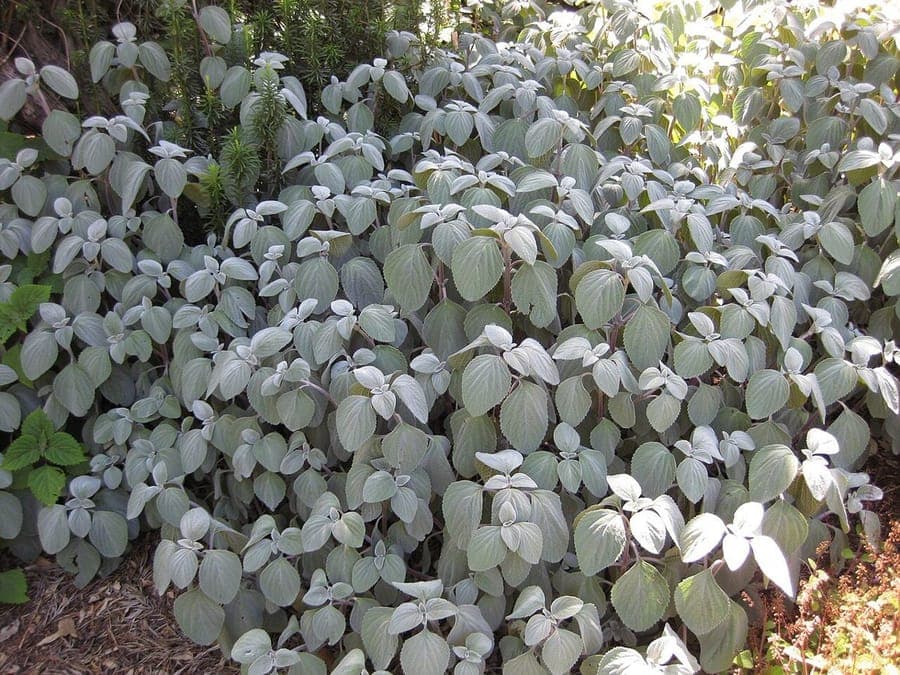
Raffi Kojian / CC BY-SA 3.0, via Wikimedia Commons
Silver spurflower (Plectranthus argentatus): care guide
Plectranthus argentatus
Want to see Silver spurflower (Plectranthus argentatus): care guide in your garden?
Full design in HD: €7.99
Look after your Silver spurflower with the GardenWorld app
Identify plants with your camera and get a care calendar with reminders for this plant.


Overview
Plectranthus argentatus, known as silver spurflower, is one of the finest silver-leaved plants for containers, pots and summer bedding. The leaves are broad, soft and covered in a felt of fine hairs that gives them a silvery-grey sheen. While many silver plants stay small and fine-textured, this species forms a loose, full shrub 60 to 100 cm tall and wide in a single season. That makes it an ideal filler that brings calm between brightly coloured flowers.
The species comes from eastern Australia, from a small area on the border of Queensland and New South Wales, where it grows on rocky sites at the edge of rainforest. It was only described in 1971. As with coleus, its name has recently been on the move: since DNA research published in 2019, many botanists place it in the genus Coleus, as Coleus argentatus. In the trade and on labels, Plectranthus argentatus remains the usual name for now, sometimes with the cultivar name 'Silver Shield'.
Plectranthus argentatus belongs to the mint family. It holds the Award of Garden Merit from the Royal Horticultural Society, a sign that it performs reliably in real gardens. If you want to see how silver foliage can calm down a patio or border, you can have a garden design made on gardenworld.app in which colours and leaf shapes are matched to each other.
Appearance and bloom cycle
The leaves are oval, 5 to 12 cm long, with a scalloped edge and a soft, felted surface. The silver sheen is strongest on young leaves; older leaves turn grey-green. The stems are square, as in all members of the mint family, and often tinted purple beneath the silvery felt. The plant grows upright at first and then spreads widely.
The photo shows how a group of plants in a border forms one continuous carpet of silver-grey leaves, with the youngest, palest leaves at the top of each shoot. That is exactly the effect that makes the species so useful as a backdrop.
In late summer and autumn, upright spikes of small, pale bluish-white to lilac flowers appear. They are modest but attract bees and hoverflies. If you grow the plant mainly for its foliage, you can remove the spikes to keep it more compact.
Ideal location
Silver foliage is an adaptation to sun and drought, and it shows. Plectranthus argentatus colours best in full sun to light partial shade. In shade the leaves turn greener and the plant becomes floppy. A sunny patio, a south- or west-facing balcony or a sunny bed are ideal.
The plant copes reasonably well with wind, but the branches are somewhat brittle, so avoid draughty corners for large specimens. It can go outdoors from mid-May, once night frosts are over. In a container in a sheltered spot it keeps looking good well into autumn.
Soil and containers
Good drainage matters more than rich soil. In pots, use compost for balcony plants mixed with about a fifth perlite or fine grit. A pot at least 25 cm across gives the roots room; in a large trough you can combine the plant with other summer flowers.
In beds it grows in any ordinary garden soil that does not stay wet for long. Feed moderately: a liquid feed every two to three weeks in summer is enough. Too much feed produces large, greener leaves and long, weak shoots.
Watering
Once established, Plectranthus argentatus is fairly drought tolerant. In beds, water only during longer dry spells. In pots the compost dries out faster; water when the top 2 to 3 cm feels dry, daily or every other day in warm weather.
The plant shows clearly when it is thirsty: the leaves hang limp. They recover quickly after watering. A permanently wet pot is more dangerous than a dry one, because the roots rot. Water the soil rather than the felted leaves.
Free preview
Want to see Silver spurflower (Plectranthus argentatus): care guide in your garden? Make a free preview of your design.
Pruning
Pruning is simple. Pinch young plants once or twice in spring for a fuller shape. If the plant grows too large or open in summer, cut the longest shoots back to just above a pair of leaves. It regrows quickly.
You can remove spent flower spikes in autumn. Cut overwintered plants back by half in March or April so they grow compact again. Trimmed shoots of 8 to 10 cm root easily in moist cutting compost or in water.
Maintenance calendar
March to April: Cut back and repot overwintered plants. Take cuttings. Pinch young plants.
May: After mid-May, move outside or plant out.
June to August: Water as needed and feed every two to three weeks. Shorten overlong shoots.
August to September: Take cuttings for overwintering. Flowering begins.
October: Bring plants or cuttings indoors before the first frost. Clear bedding plants.
November to February: Overwinter in a light, cool place and water sparingly.
Overwintering
Plectranthus argentatus is not hardy. A brief, light night frost around 0 °C is sometimes survived with damage, but harder frost is fatal. In our climate it is therefore treated as an annual or as a container plant that spends the winter indoors.
Large plants overwinter in a light place that stays above freezing, ideally 5 to 12 °C, such as a cold greenhouse or a cool landing with a window. Give little water, just enough to stop the root ball drying out completely. In a dark spot the leaves drop and the shoots become long and pale.
An easier route is to take a few cuttings in August or September and overwinter them as small plants on a bright windowsill. In spring you then have young, compact plants. The plant calendar at gardenworld.app shows month by month when to take cuttings, bring plants in and move them back outside.
Toxicity to pets
Little specific information is available on Plectranthus argentatus. The species does not appear on the well-known poison lists, and no cases of poisoning in dogs or cats are known to us. That is not the same as being proven harmless.
Related species such as coleus and Coleus amboinicus contain essential oils and are listed as toxic to dogs, cats and horses, with vomiting and diarrhoea as the main symptoms. Because Plectranthus argentatus belongs to the same group, caution makes sense. Indoors, keep the plant away from a cat that likes to chew leaves, and call your vet if your pet has eaten a lot or shows symptoms. The felted leaves can cause mild skin irritation in sensitive people.
Companion plants
Silver foliage acts as a go-between for colours. Next to the violet-blue spikes of Salvia farinacea and the airy purple heads of Verbena bonariensis, Plectranthus argentatus creates a cool, Mediterranean picture. With red or pink geraniums (Pelargonium zonale) in a trough, you get a classic, fresh combination.
For movement and height, the fountain grass Cenchrus setaceus works well, especially its red-leaved form. For an entirely silver corner, combine it with Jacobaea maritima, whose finely cut leaves contrast nicely with the broad leaves of the plectranthus.
Final thoughts
Plectranthus argentatus is a fast-growing, dependable plant for anyone who loves silver foliage and calm colours. Give it sun, well-drained soil and not too much water or feed. Trim it when it gets too big, take a few cuttings in late summer and overwinter them somewhere light and cool. That way you will have a soft, silvery filler for your containers and beds year after year.
Frequently asked questions about Silver spurflower
When and how do you prune Silver spurflower?
Pruning is simple. Pinch young plants once or twice in spring for a fuller shape.
How much water does Silver spurflower need?
Once established, Plectranthus argentatus is fairly drought tolerant. In beds, water only during longer dry spells.
Where does Silver spurflower grow best?
Silver foliage is an adaptation to sun and drought, and it shows. Plectranthus argentatus colours best in full sun to light partial shade.
What soil does Silver spurflower need?
Good drainage matters more than rich soil. In pots, use compost for balcony plants mixed with about a fifth perlite or fine grit.

See it in your garden
See Silver spurflower in your garden
One photo of your garden and a few questions. You see the result in about a minute.
Try it with a photoIdentify this plant in your own garden. Identify a plant
Similar plants
Mealy sage (Salvia farinacea): complete guide
Salvia farinacea
Discover the beautiful mealy sage (Salvia farinacea). Elegant plant with purple-blue flowers. Perfect for sunny borders, cut flowers and long-blooming displays in temperate gardens.
Argentine vervain: complete guide
Verbena bonariensis
Discover how to grow Verbena bonariensis: ideal conditions, pruning tips, hardiness and plant partners. Perfect for wildlife gardens in USDA zones 7-11.
Fountain grass: complete guide
Cenchrus setaceus
Fountain grass (Cenchrus setaceus) is a spectacular ornamental grass with silky plumes. Learn about cultivation, winter protection, and plant pairings.
