
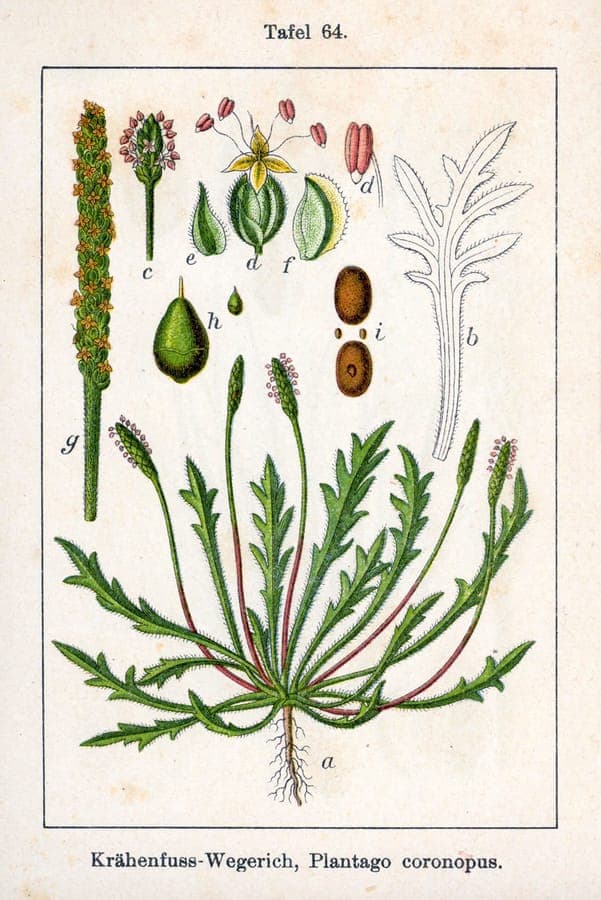
Johann Georg Sturm (Painter: Jacob Sturm) / Public domain, via Wikimedia Commons
Plantago coronopus: complete guide
Plantago coronopus
Want to see Plantago coronopus: complete guide in your garden?
1 minute, no credit card
Overview
Plantago coronopus, commonly known as Buck's-horn plantain or Coronopus, is a delightful annual plant native to Europe and Western Asia. The plant owes its name to the prominently toothed leaves which truly resemble deer antlers. This charming wildflower fits perfectly into ecological gardens and dry, neglected corners.
As a historical human food and medicinal plant, it is still used in some regions, though less commonly nowadays. The plant provides food for many insect species and birds, making it valuable for biodiversity.
Appearance and Bloom
Plantago coronopus grows as a compact rosette reaching approximately 10-25 cm in height. The most characteristic feature is the deeply toothed leaves that are linear and radiate from the base. Foliage is green to greyish-green with fine, tooth-like lobes along the margins - hence "coronopus" (crown feet).
Flowers appear from April through August in short to medium-length spikes. The flowers themselves are very small and inconspicuous - usually white or greenish. The real beauty lies in the geometric plant form and fine texture of the foliage.
Ideal Location
Buck's-horn plantain grows best in fully sunny locations. Minimum 5-6 hours direct sun daily is required. However, the plant tolerates partial shade sites, though it grows less compactly there.
The plant is very tolerant of windy spots. This makes it ideal for coastal or exposed gardens. Woodland edges and other semi-shaded habitats are also suitable growing sites.
Soil
Plantago coronopus is very undemanding regarding soil. It grows excellently in sandy, gravelly, even impoverished soils. The plant tolerates acidic to neutral pH and grows even in soils other plants reject.
Actually, the plant performs best on poor soil - rich compost could overstimulate growth. Drainage is less critical than for its relative Plantago afra, though well-draining is preferred.
Free design
Want to see Plantago coronopus: complete guide in your garden? Make a free design now.
Watering
Once established, Buck's-horn plantain is extremely drought-tolerant. This is actually one of the most drought-resistant native plants available. Water only during the first growing season after planting.
Under normal rainfall, the plant grows without supplementary watering. Even in very dry summers, this plant needs virtually no additional water. Actually, the plant feels more comfortable in dry than wet conditions.
Pruning
Pruning is not required. The plant naturally forms a neat, compact shape. If you want self-seeding to occur (which usually does), leave some flowers standing. This provides free seedlings next year.
Maintenance Calendar
April-June: Plant grows actively, allow seeds to drop. July-September: Drought monitoring, but normally no watering needed. October-November: Self-sown seedlings emerge from earlier seeds. December-March: Plant dies back; new seedlings grow in spring. April-May: Cycle repeats.
Winter Hardiness
Buck's-horn plantain is an annual plant, so winter hardiness does not directly apply. The plant dies back in autumn as temperatures drop. However, in milder climates it can grow as a winter annual and bloom in early spring before dying.
In cooler regions it typically grows as a summer annual.
Companion Plants
Buck's-horn plantain combines beautifully with other native wildflowers and annuals: Tanacetum, Centaurea, various Brassica species and other native weeds. Also good with Helichrysum, Gazania, and other Mediterranean annuals.
The plant also fits in formal borders with other geometrically interesting plants such as ornamental grasses.
Conclusion
Plantago coronopus is a native plant that has evolved over billions of years to grow perfectly in rough European conditions. From an ecological perspective it is wonderful for biodiversity. From an aesthetic perspective it offers interesting leaf shapes and fine texture.
For purchase: seek seed from native plant specialists or wildflower growers. Gardenworld.app helps you design ecological borders with native species. Gardenworld.app supports creating sustainable, biodiverse gardens.
Want to see Plantago coronopus: complete guide in your garden? Make a free design now.
Upload a photo, pick a style, and get a photorealistic design with plant list in under a minute.
No credit card required


Similar plants
White Beardtongue: complete guide
Penstemon albidus
Discover white beardtongue (Penstemon albidus) - elegant perennial with white to cream flowers. Drought-resistant, perfect for prairie and dry gardens.
Longsepal Beardtongue: complete guide
Penstemon calycosus
Discover longsepal beardtongue (Penstemon calycosus) - beautiful perennial with lilac-blue flowers. For partial shade and moist soil. Ideal for naturalized.
Penstemon cusickii: complete guide
Penstemon cusickii
Discover Cusick's beardtongue, a compact alpine flowering plant with violet-pink blooms. Perfect choice for rock gardens and water-wise landscaping.