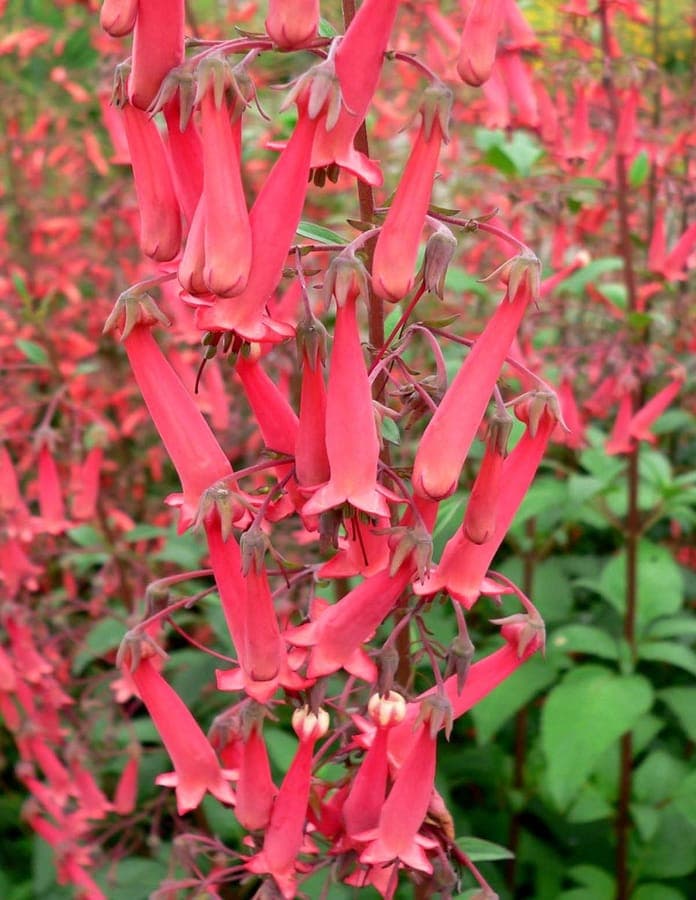
User:Stan Shebs / CC BY-SA 3.0, via Wikimedia Commons
Cape fuchsia (Phygelius capensis): growing guide
Phygelius capensis
Want to see Cape fuchsia (Phygelius capensis): growing guide in your garden?
Full design in HD: €7.99
Look after your Cape fuchsia with the GardenWorld app
Identify plants with your camera and get a care calendar with reminders for this plant.


Overview
Cape fuchsia (Phygelius capensis) is a sub-shrub from southern Africa that flowers from July into October with hanging, tubular blooms in coral to orange-red. In the wild it grows in the mountains of South Africa, Lesotho and Eswatini, often along streams and on damp slopes at high altitude. It belongs to the figwort family, Scrophulariaceae, which explains its other common name, Cape figwort. The fuchsia comparison comes from the dangling flowers, but the two plants are not related at all.
It grows 1 to 1.5 metres tall, sometimes 2 metres against a warm wall, and slowly spreads by underground runners into a broad clump. In mild winters some foliage stays on the plant; after hard frost the top growth dies back and the plant shoots again from the base in spring, much like a herbaceous perennial. The Royal Horticultural Society has given it the Award of Garden Merit.
On gardenworld.app you can have a garden design created that gives Phygelius capensis a place in a warm, sunny border with other late performers, so the garden keeps its colour well into autumn.
Appearance and flowering season
The flowers are slightly curved tubes 4 to 6 cm long, hanging from slender stalks. They are coral to scarlet with a yellow throat, and the five short lobes at the mouth curl back a little. A hallmark of Phygelius capensis is that the flowers are held all round the stem in loose, pyramid-shaped panicles, with their mouths turned back towards the stem. The photograph shows this well: a stem crowded with pendent red tubes, with many more flowering stems behind.
This sets it apart from its relative Phygelius aequalis, whose straight tubes all hang to one side. Many garden forms on sale are hybrids between the two species, grouped as Phygelius × rectus, in shades from cream and yellow to pink and deep red. If you want the true species, check the label.
The leaves are opposite, oval to triangular, up to about 8 cm long, dark green and finely toothed. Flowering usually starts in July and continues until the first frosts. Bumblebees and bees visit the flowers; in South Africa the main pollinators are sunbirds, small long-billed birds.
Ideal position
Phygelius capensis wants full sun. In a warm, sunny position it flowers most freely and the stems stay sturdy. It will grow in partial shade, but flowers less generously there. A spot in front of a south- or west-facing wall is ideal, especially in colder areas, as the wall provides warmth and winter shelter.
Bear the runners in mind. In a small border the plant can take up more room than planned after a few years. That is easily solved by slicing off the edges of the clump with a spade in spring. A spacing of 60 to 90 cm is enough.
Soil requirements
It likes fertile, humus-rich soil that stays moist in summer but drains well. Sandy loam and light loam are ideal. On heavy clay, improve the structure with compost and some coarse grit, because wet soil in winter is the plant's greatest enemy. Soil pH matters little: both slightly acid and alkaline soils are tolerated.
Plant in spring, in April or May, so the plant has a full season to root before its first winter. Work some compost into the soil when planting and water in generously.
Watering
In the wild, Phygelius capensis often grows beside running water, and it shows: in summer it appreciates consistently moist soil. In dry spells, water thoroughly once or twice a week, around 10 litres per plant. A mulch of compost helps hold moisture in the soil.
In winter it is the other way round: the roots must not sit in wet ground. On a free-draining site it comes through the winter far better. In a container, water more often in summer and move it to a dry, sheltered spot for winter.
Free preview
Want to see Cape fuchsia (Phygelius capensis): growing guide in your garden? Make a free preview of your design.
Pruning
Prune Phygelius capensis in March or April, once the worst frosts are over. After a hard winter, cut all stems down to just above ground level; the plant will shoot again from the base. After a mild winter you can cut the stems back to just above a few healthy buds, leaving a taller, woodier framework. Against a wall, this is how you train a plant up to 2 metres.
Leave the dead stems standing over winter, as they protect the crown from frost. During summer, remove spent flower panicles to prolong flowering. Take out unwanted runners in spring; they are easy to pot up and give away. Summer cuttings from young shoots also root readily.
In a large pot, Cape fuchsia makes a cheerful patio plant for a sunny terrace. Use a container of at least 40 litres with a loam-based compost and a generous drainage layer, feed every two weeks from June to August and move the pot against a sheltered wall or into a cool, frost-free shed for the winter. Containers freeze through far faster than open ground, so the roots are more at risk there.
Maintenance calendar
March to April: Cut back old stems. Slice off runners or divide large clumps. Scatter some compost around the base.
May to June: New shoots grow quickly. Plant new specimens. Watch for aphids and capsid bugs on the young tips.
July to September: Full flower. Water in dry spells and remove spent panicles. Take cuttings if you like.
October to November: Flowering draws to a close. Leave the stems in place and cover the crown with a thick layer of leaves or straw.
December to February: Dormant. Keep the soil around the plant as dry as possible.
Winter hardiness
Phygelius capensis is the hardiest species in the genus. Below ground it survives temperatures down to about -15 °C, particularly with a protective mulch. The top growth is killed by a few degrees of frost, but that is no cause for worry: the plant regrows from the roots in spring. In most of Britain and the Low Countries it comes through the majority of winters, especially in a dry, sheltered spot.
As for toxicity, there are no known reports of poisoning in people or pets. That does not make it edible, so keep young children from nibbling it. In the garden it spreads by runners, but this remains easy to manage. There are no reports of invasive spread in Europe.
Pests are few. Capsid bugs can damage the young tips, leaving leaves with small holes and distortions. In Britain, figwort weevil larvae sometimes graze the foliage.
Companion plants
With its warm colours, Phygelius capensis is a natural partner for other summer and autumn flowers in red, orange, yellow and blue. Red hot poker (Kniphofia uvaria) shares its colours and exotic look. African lily (Agapanthus africanus) adds contrast with its blue flower heads. Salvia microphylla also flowers for months in red and pink and enjoys the same warm spot.
Orange daylily (Hemerocallis fulva) fills the border with trumpet-shaped flowers, and the airy purple heads of Verbena bonariensis float beautifully among the red tubes. The planting calendar on gardenworld.app helps you combine these plants so the border stays in flower from June to October.
Final thoughts
Phygelius capensis is a rewarding plant for anyone looking for long-lasting colour in warm shades. With full sun, soil that stays moist in summer but drains well, a dry spot in winter and a prune in spring, it flowers for months on end. Even when frost cuts it to the ground, it comes back each spring, ready for another season of red flowers.
Frequently asked questions about Cape fuchsia
Is Cape fuchsia winter hardy?
Phygelius capensis is the hardiest species in the genus. Below ground it survives temperatures down to about -15 °C, particularly with a protective mulch.
When and how do you prune Cape fuchsia?
Prune Phygelius capensis in March or April, once the worst frosts are over. After a hard winter, cut all stems down to just above ground level; the plant will shoot again from the base.
How much water does Cape fuchsia need?
In the wild, Phygelius capensis often grows beside running water, and it shows: in summer it appreciates consistently moist soil. In dry spells, water thoroughly once or twice a week, around 10 litres per plant.
What soil does Cape fuchsia need?
It likes fertile, humus-rich soil that stays moist in summer but drains well. Sandy loam and light loam are ideal.

See it in your garden
See Cape fuchsia in your garden
One photo of your garden and a few questions. You see the result in about a minute.
Try it with a photoIdentify this plant in your own garden. Identify a plant
Similar plants
Kniphofia uvaria: complete guide
Kniphofia uvaria
Learn about red-hot poker (pokerplant) - exotic summer bloomer, full sun requirements, drainage, frost protection, and vibrant color.
Lily-of-the-Nile: complete guide
Agapanthus africanus
Everything you need to grow Agapanthus africanus: ideal conditions, watering, winter care, and companion planting for UK and US gardens.
Baby sage: complete guide
Salvia microphylla
Grow Salvia microphylla with confidence. This drought-tolerant shrub blooms from June to November and thrives in full sun with minimal care.
