Raulsintes / CC BY-SA 3.0, via Wikimedia Commons
Balearic Island sage (Phlomis italica): complete guide
Phlomis italica
Want to see Balearic Island sage (Phlomis italica): complete guide in your garden?
Full design in HD: €7.99
Look after your Balearic Island sage with the GardenWorld app
Identify plants with your camera and get a care calendar with reminders for this plant.


Overview
Balearic Island sage (Phlomis italica) is a small evergreen shrub with silvery-white, felted leaves and whorls of soft pink hooded flowers in summer. Despite its name it does not come from Italy at all, but only from the Balearic Islands, mainly Mallorca and Menorca. There it grows in dry scrub, on limestone rocks and along sunny roadsides. On Mallorca it is known by Catalan names such as estepa blenera. It belongs to the genus Phlomis, the Jerusalem sages, although it is not a true sage.
If you garden on dry, sunny ground, Phlomis italica makes a fine addition to lavender, rock roses and other Mediterranean shrubs. The foliage stays silver-grey all year, and the flowering is softer and more refined than that of the better-known, yellow-flowered Jerusalem sage, Phlomis fruticosa. You can have a garden design made on gardenworld.app in which this shrub joins other drought-tolerant plants to fill a gravel garden or a sunny bank.
The plant usually grows 40 to 60 cm tall and 60 to 90 cm wide, forming a loose, spreading shrub. In favourable conditions it can approach 1 metre. It grows fairly quickly and often flowers in the year after planting.
Appearance and bloom cycle
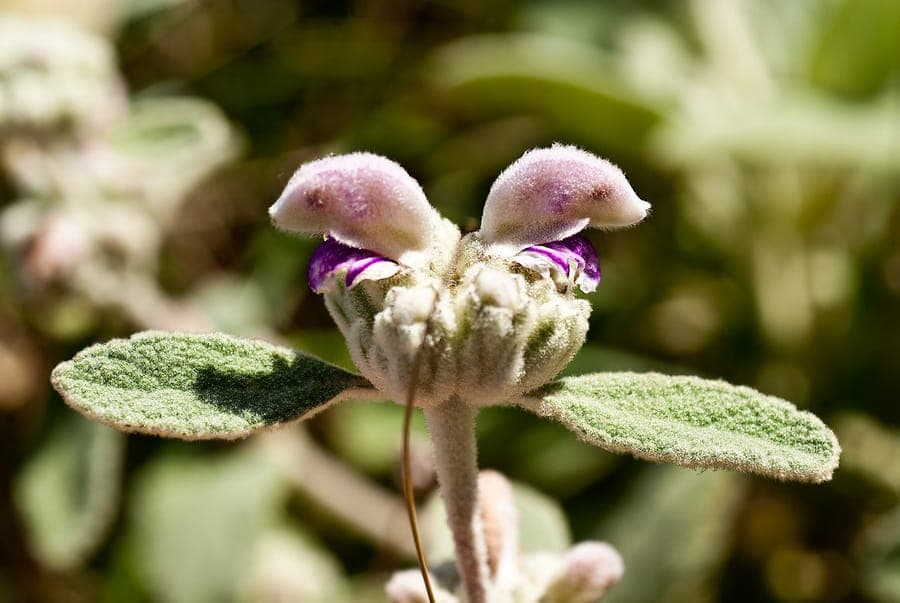
What makes Phlomis italica instantly recognisable is its dense covering of hairs. Stems, leaves and calyces are clothed in a layer of fine, star-shaped hairs, so the whole plant looks greyish-white to silver-green and feels soft as felt. The leaves are oblong to lance-shaped, 3 to 8 cm long, with slightly scalloped edges. This hairy coat protects the plant from sun and desiccation in its dry homeland.
Flowering runs from June to August. The flowers sit in whorls around the upper parts of the stems, a few at a time. Each bloom is 2 to 2.5 cm long and two-lipped, with a hooded, hairy upper lip and a smaller lower lip. The colour is pale pink to lilac, sometimes with a slightly darker lower lip. The photo shows this well: a single whorl with two soft pink, woolly hoods and a purple lower lip, above a pair of grey-green, felted leaves.
Bees and bumblebees visit the flowers readily. After flowering the woolly calyces remain as small rounded clusters around the stems, which still look decorative in autumn and winter.
Ideal location
Give Balearic Island sage the sunniest spot you have. A south-facing slope, a gravel garden, a raised bed against a south wall or a place beside a patio all work well. The more sun and warmth, the more compact it stays and the more freely it flowers. In shade it becomes leggy and loses its silvery sheen.
Because this species is less hardy than Phlomis fruticosa, a sheltered position matters in colder parts of Britain and north-west Europe. Against a warm wall or in the lee of other shrubs it suffers less from cold easterly winds. A large pot or trough on a sunny terrace is also a good choice, as you can move it in a severe winter. Space plants 60 to 80 cm apart.
Soil requirements
This shrub needs dry, free-draining soil. Sandy, gritty or stony ground is ideal, and lime is no problem at all; in its homeland it often grows on limestone. On heavy clay that stays wet in winter the plant soon dies.
On heavier soil work coarse sand and grit into the top 30 cm, or plant on a mound. Do not add manure or compost: poor soil keeps the plant compact and sturdy, while rich soil makes it floppy and more vulnerable to frost. A gravel mulch around the base keeps the crown dry. In containers use a mix of garden soil, coarse sand and grit, with a generous drainage layer at the bottom.
Watering
After planting, water once a week in dry spells during the first summer until the roots are established. From then on Phlomis italica is markedly drought tolerant and seldom needs water in open ground. Only during an exceptionally long, hot drought will a thorough soaking help.
Do not water in winter. Excess moisture, especially combined with cold, is far more dangerous than drought. In containers check every few days in summer and water only when the compost has dried out properly. Water at the base rather than over the woolly leaves, which dry slowly.
Free preview
Want to see Balearic Island sage (Phlomis italica): complete guide in your garden? Make a free preview of your design.
Pruning
Prune lightly straight after flowering in August. Cut back the spent stems and take a third of the young growth with them. This keeps the shrub compact and encourages bushy branching. If you would like to enjoy the decorative calyx clusters in winter, you can leave the stems and cut them back in spring instead.
Avoid pruning in late autumn, as freshly cut plants are more vulnerable to frost. In April, once the hardest frosts have passed, remove frosted or dead twigs. If the plant has been killed to the ground by a hard winter, wait until late May: it often reshoots from the base. The fine hairs can irritate skin and eyes when you prune, so gloves are a sensible precaution.
Cuttings root well. Take semi-ripe cuttings 8 to 10 cm long in summer and root them in a gritty mix. That way you always have a spare plant in case a hard winter strikes.
Maintenance calendar
March: Check for frost damage, but do not prune yet. Remove winter fleece on mild days.
April: Cut away dead and frosted twigs. A good month for planting, with grit in the planting hole.
May: New growth. Water young plants in dry spells. Give frosted plants time to reshoot.
June to August: Flowering. After flowering, a light trim by a third. Take cuttings.
September: Last chance to plant, so roots establish before winter.
October to November: Refresh the gravel mulch. Move pots against a warm wall under cover.
December to February: Protect with fleece during hard frost. Keep the base dry.
The planting calendar on gardenworld.app will remind you at the right time to prune, take cuttings and put on winter protection.
Winter hardiness
Phlomis italica is moderately hardy. The Royal Horticultural Society rates it H4, which corresponds to frost down to about -10 °C. In a dry, sheltered spot it survives most winters in southern and western Britain and in the milder parts of the Low Countries. In harder frost the top growth can die back, but the plant often reshoots from the base.
When frost below -8 °C is forecast, cover the shrub with horticultural fleece or conifer branches and spread grit or straw around the base. Above all, keep the soil dry. In severe winters move pot-grown plants to a cold, bright, frost-free place such as an unheated greenhouse or a garage with a window, and keep them fairly dry there.
Toxicity: Phlomis italica is not known to be toxic to people or pets. The fine hairs can, however, mildly irritate skin or eyes. As with any ornamental plant, it is sensible not to eat it.
Companion plants
Phlomis italica fits perfectly into a Mediterranean or gravel garden. English lavender (Lavandula angustifolia) flowers at the same time, its purple spikes contrasting nicely with the soft pink whorls. Gum rock rose (Cistus ladanifer) brings large white flowers and dark, sticky leaves, and cotton lavender (Santolina chamaecyparissus) adds silver-grey mounds studded with yellow buttons.
For a taller backdrop choose shrubby germander (Teucrium fruticans) with blue-grey leaves and pale blue flowers, or Mediterranean spurge (Euphorbia characias) with its striking yellow-green flower heads. Rosemary, sage, thyme and grasses such as feather grass also suit it well. Avoid plants that need plenty of water or rich soil.
Final thoughts
Balearic Island sage is a quiet beauty for anyone with a sunny, dry garden. The silvery-white felt looks good all year, the soft pink flowers are a summer surprise and the plant needs barely any water. Give it a sheltered spot and dry feet in winter, and you will enjoy it for years.
Plant it alongside lavender and rock roses, and with very little effort you will bring a corner of Mallorca into your garden.
Frequently asked questions about Balearic Island sage
Is Balearic Island sage winter hardy?
Phlomis italica is moderately hardy. The Royal Horticultural Society rates it H4, which corresponds to frost down to about -10 °C.
When and how do you prune Balearic Island sage?
Prune lightly straight after flowering in August. Cut back the spent stems and take a third of the young growth with them.
How much water does Balearic Island sage need?
After planting, water once a week in dry spells during the first summer until the roots are established. From then on Phlomis italica is markedly drought tolerant and seldom needs water in open ground.
Where does Balearic Island sage grow best?
Give Balearic Island sage the sunniest spot you have. A south-facing slope, a gravel garden, a raised bed against a south wall or a place beside a patio all work well.
What soil does Balearic Island sage need?
This shrub needs dry, free-draining soil. Sandy, gritty or stony ground is ideal, and lime is no problem at all; in its homeland it often grows on limestone.

See it in your garden
See Balearic Island sage in your garden
One photo of your garden and a few questions. You see the result in about a minute.
Try it with a photoIdentify this plant in your own garden. Identify a plant
Similar plants
English Lavender: complete guide
Lavandula angustifolia
Everything about English Lavender (Lavandula angustifolia): planting, pruning, care and overwintering. Practical tips for lush purple blooms.
Cistus ladanifer: complete guide
Cistus ladanifer
Discover the stunning gum rock-rose with white flowers and aromatic foliage. Perfect for Mediterranean gardens and dry locations. Read our comprehensive care guide now.
Lavender cotton: complete guide
Santolina chamaecyparissus
Lavender cotton (Santolina chamaecyparissus) is a beautiful gray-green shrub from the Asteraceae family. This Mediterranean plant offers fragrance and refined appearance for dry gardens.
