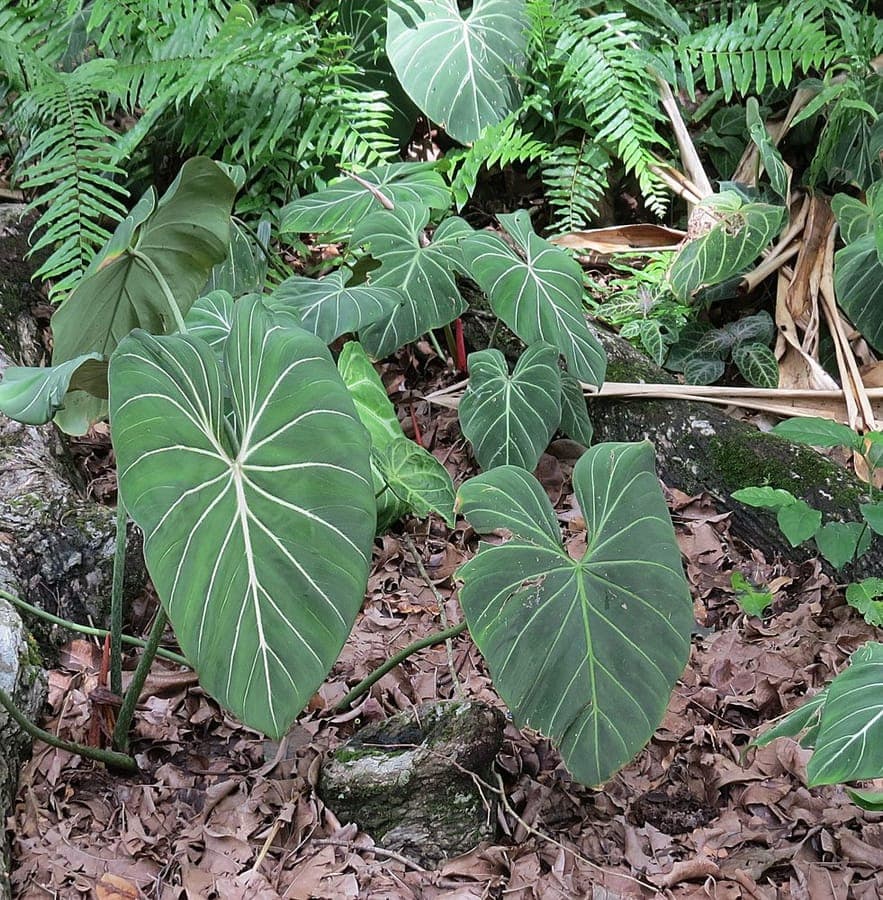
Dick Culbert from Gibsons, B.C., Canada / CC BY 2.0, via Wikimedia Commons
Philodendron gloriosum: growing the crawling velvet-leaved aroid
Philodendron gloriosum
Want to see Philodendron gloriosum: growing the crawling velvet-leaved aroid in your garden?
Full design in HD: €7.99
Look after your Philodendron gloriosum with the GardenWorld app
Identify plants with your camera and get a care calendar with reminders for this plant.


Overview
Philodendron gloriosum is one of the most sought-after philodendrons among foliage enthusiasts, and it is easy to see why. It produces large, heart-shaped leaves with a velvety, dark green surface crossed by bright white to pale pink veins. In the light from a window the leaf almost shimmers like fabric.
The species belongs to the arum family (Araceae) and is native to Colombia, where it grows on the floor of humid, shady forest. That is where it differs from most philodendrons you will know: it does not climb trees, it crawls. A thick rhizome edges slowly across the forest floor, among fallen leaves and moss, sending up a single new leaf every few weeks. Older leaves die off behind the growing tip, so the plant effectively walks across the ground.
That habit shapes almost every aspect of its care. Treat it like an ordinary climbing philodendron, with a moss pole and a deep pot, and you end up with a plant that never really settles. Give it room to crawl and it grows into a striking specimen.
Appearance and growth
Indoors the leaves usually reach 20 to 50 cm in length; in the wild they can grow considerably larger. They sit on long, straight leaf stalks and have a deeply notched heart shape at the base. A narrow pink to pale margin around the leaf is a distinctive feature. New leaves emerge from a papery sheath (cataphyll) that turns brown and drops after the leaf opens. A young leaf is often bronze or pale green and only becomes dark and velvety after a few weeks.
The rhizome is green to brown, about as thick as a thumb, and grows a few centimetres a year. It lies partly on top of the compost, with roots running down into the pot. A healthy plant typically carries four to eight leaves at a time. Flowers are rare indoors and are not why anyone grows it.
Position in the home
Choose a warm, sheltered spot with a steady temperature of 20 to 27 °C. Below 15 °C growth stops and the plant becomes prone to rot. It dislikes cold windows in winter and draughts, and the dry heat directly above a radiator is too much as well.
Because the leaves fan out widely and the velvety surface marks easily, it is best placed where people are not constantly brushing past. A low cabinet, a plant table or, for those with a growing collection, a glass growing cabinet are all ideal.
Light
Philodendron gloriosum wants bright, filtered light, like the light that reaches a forest floor through the canopy. A spot close to an east-facing window, or further back from a south or west-facing window behind a sheer curtain, works well. Plants under a grow light also do very well, at a distance of 40 to 60 cm.
Direct sunlight does the dark, velvety leaf no good and causes yellow or brown patches. Too little light, on the other hand, gives long, weak stalks and smaller leaves.
Watering
Keep the compost lightly moist but never wet. Water as soon as the top 2 cm feels dry and always let the excess drain away. Pour around the rhizome rather than over it so that it stays dry. Use water at room temperature that is low in lime, such as rainwater or filtered water.
In winter, when growth slows, the plant needs noticeably less water. A soft, rotting rhizome is the biggest danger with this species, and it is almost always caused by compost that is too wet combined with cold.
Humidity
This philodendron looks its best at humidity of 60 % or more. It will grow in drier air too, but new leaves may then get stuck as they unfurl or develop brown edges. A humidifier nearby is the most reliable solution, and grouping plants together also helps. Do not mist the velvety leaves: water droplets leave limescale marks.
Free preview
Want to see Philodendron gloriosum: growing the crawling velvet-leaved aroid in your garden? Make a free preview of your design.
Compost and repotting
Choose a wide, shallow pot, ideally rectangular, so the rhizome can keep growing lengthways. Position the plant with the growing tip facing the long side and the back of the rhizome against the rim. The rhizome should not disappear under the compost: set it on top or at most half buried.
A good mix consists of equal parts peat-free houseplant compost, fine orchid bark and perlite, with a little coir or sphagnum moss if you like. It should hold moisture yet stay airy. Repot only when the growing tip reaches the edge of the pot, usually every two to three years, in spring. Feed from April to September every three to four weeks with a liquid fertiliser at half strength.
Division and cuttings
Propagation works best by dividing the rhizome. With a sharp, clean knife, cut off a section with at least two nodes and a few roots, preferably with a leaf as well. Let the cut dry for a few hours, then lay the piece on damp sphagnum moss or an airy compost in a closed box or under a clear cover. At 22 to 25 °C the dormant buds break after a few weeks. The rear part of the original plant, without a growing tip, also often produces new shoots.
Care calendar
March and April: repot or divide if the plant has reached the edge of the pot. Start feeding again.
May to August: growing season. Water regularly, keep lightly moist and feed every three to four weeks.
September: last feed. Check for thrips and spider mite.
October to February: water less, stop feeding, keep humidity high and move the plant away from cold glass.
Put your repotting and feeding dates into the plant calendar on gardenworld.app and nothing will slip.
Common problems
A soft, brown or glassy patch on the rhizome is the first sign of rot. Cut the affected part back to healthy, firm tissue, let the wound dry and replant in fresh, more open compost. Yellowing old leaves at the back of the rhizome are normal as long as new ones keep appearing at the front. If a new leaf stays stuck in its sheath, raise the humidity rather than pulling at it. Silvery flecks and black dots on the leaves point to thrips; rinse the plant and treat them promptly.
Toxicity to pets
Like all philodendrons, Philodendron gloriosum contains needle-shaped calcium oxalate crystals in every part. A cat or dog that bites a leaf will feel a burning pain in the mouth and throat, start drooling, may vomit and will find swallowing difficult. Usually it goes no further, but if the mouth or throat swells or the animal has trouble breathing, go to the vet immediately. The sap also irritates human skin, so wash your hands after dividing. Keep the plant somewhere pets and small children cannot reach.
Companion plants
This philodendron suits plants from the same shady forest setting. A Begonia rex adds colour and pattern, and the delicate maidenhair fern Adiantum raddianum brings fine, airy foliage beside the big hearts. A bird's nest fern (Asplenium nidus) and a caladium (Caladium bicolor) enjoy the same warm, humid air. If you have room, an Alocasia macrorrhizos behind the group adds height.
On gardenworld.app you can have a garden design made for your garden or patio, with thought given to how it connects with your indoor space.
Final thoughts
Philodendron gloriosum is a plant for people who enjoy watching every new leaf unfold. The key to success is respecting its crawling growth: a wide pot, the rhizome on top of the compost, an airy mix, warmth and high humidity. Give it that and it will reward you year after year with large, velvety leaves that bring real character to any room.

See it in your garden
See Philodendron gloriosum in your garden
One photo of your garden and a few questions. You see the result in about a minute.
Try it with a photoIdentify this plant in your own garden. Identify a plant
Similar plants
Alocasia macrorrhizos: complete guide
Alocasia macrorrhizos
The giant alocasia brings dramatic foliage to shaded gardens and homes. Learn about care, growth conditions, propagation, and why this plant is perfect for moisture-loving gardeners seeking tropical impact.
King Begonia: complete guide
Begonia rex
The painted-leaf begonia, Begonia rex, is a spectacular foliage plant with incredible leaf patterns in silver, red, pink, and purple. Discover everything about care, propagation, and enjoying this prima donna of the plant world.
Asplenium nidus: complete guide
Asplenium nidus
Learn all about the Bird's Nest Fern (Asplenium nidus), a stunning tropical houseplant with glossy green fronds. Expert care tips, light requirements and optimal growing conditions.
