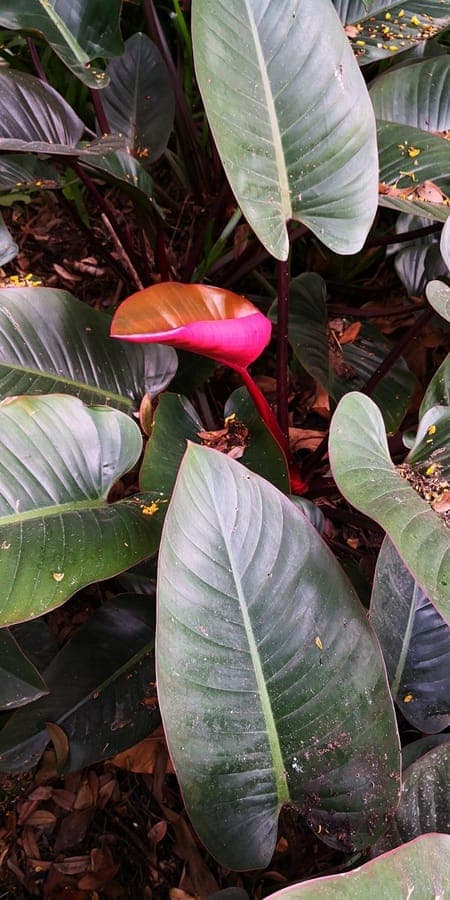
Alialb / CC BY-SA 4.0, via Wikimedia Commons
Blushing Philodendron: care guide
Philodendron erubescens
Want to see Blushing Philodendron: care guide in your garden?
Full design in HD: €7.99
Look after your Blushing Philodendron with the GardenWorld app
Identify plants with your camera and get a care calendar with reminders for this plant.


Overview
Philodendron erubescens is a climbing philodendron from the rainforests of Colombia and one of the parents behind some of today's most popular houseplants. In English it is known as the blushing philodendron or red-leaf philodendron, and the species name erubescens means exactly that, "blushing". You see why straight away: the leaf stalks, the young leaves and above all the sheaths from which each new leaf emerges are flushed red to pink. In shops it usually appears under a cultivar name such as 'Red Emerald', or in derived forms like 'Pink Princess' and 'Imperial Red'.
In the wild Philodendron erubescens is a hemi-epiphyte: it germinates on the forest floor and climbs tree trunks using aerial roots, reaching several metres in height. Indoors it stays far more modest, but with a moss pole it develops into a stately plant of 1.5 to 2 m. It is robust, forgives the odd missed watering and suits any interior with bright, indirect light.
If you like your indoor and outdoor spaces to work together, at gardenworld.app you can have a garden design made for your patio or conservatory, so the feel of your houseplants carries on into the garden.
Appearance and growth habit
The leaves are elongated, arrow- to heart-shaped, glossy dark green and usually 20 to 30 cm long indoors, sometimes 40 cm on older plants. The undersides are often tinged red, as are the long leaf stalks and young stems. Each new leaf develops inside a bright red to pink sheath (a cataphyll), which dries and drops once the leaf has opened. Freshly unfurled leaves can be coppery or reddish brown and turn green within a few weeks.
The photo shows exactly that: large, glossy leaves on dark red stalks, with a vivid pink, newly unrolled young leaf in the centre.
At every node the stem produces aerial roots that the plant uses to cling on. Flowers rarely appear indoors; when they do, they are a typical arum-style bloom, a dark red to purple spathe around a white spadix. As for cultivars: 'Red Emerald' has dark green leaves on red stalks, 'Pink Princess' has irregular pink splashes in the leaf, and 'Burgundy' and 'Imperial Red' are hybrids with erubescens in their ancestry.
Ideal location
Philodendron erubescens likes plenty of light without direct midday sun. A spot 1 to 2 m from an east- or west-facing window is ideal, or right beside a north-facing one. Strong south-facing sun through glass scorches the leaves. In a dark corner it will still grow, but the stems become long and thin, the leaves smaller and the red tones duller. For 'Pink Princess' good light is especially important, otherwise the pink fades and the plant produces mostly green leaves.
Give the plant a moss pole or coir pole to climb. Tie the stem loosely in place and make sure the aerial roots touch the pole; this encourages larger leaves. It prefers humidity of 50 to 60%. In a dry, centrally heated living room it helps to group it with other plants or use a humidifier. Keep it away from radiators and draughts.
Potting mix
Use an airy, well-drained mix such as one made for aroids. A good recipe is roughly 40% houseplant compost, 30% orchid bark and 30% perlite, with a handful of coir if you like. The roots need air: compact, soggy compost quickly leads to root rot. Choose a pot with drainage holes, ideally just one size larger than the previous one.
Repot young plants every spring and older plants every two to three years, when roots start growing out of the pot.
Free preview
Want to see Blushing Philodendron: care guide in your garden? Make a free preview of your design.
Watering
Water when the top 2 to 3 cm of compost feels dry. In summer at room temperature that is roughly once a week, in winter every two to three weeks. Water thoroughly until it runs from the drainage holes, then empty the saucer after fifteen minutes. Yellowing lower leaves and soft stems point to overwatering; limp, drooping leaves and brown edges to underwatering.
Use water at room temperature, ideally rainwater or tap water left to stand overnight. From April to September, feed once a month with a liquid houseplant fertiliser at half strength.
Care and propagation
Wipe the large leaves now and then with a damp cloth: dust reduces photosynthesis and hides pests. Check the undersides in particular for spider mite, thrips and mealybug, especially in winter when the air is dry.
Pruning is only needed to keep the plant in shape. Cut a long stem just above a node and it will reshoot there. The piece you remove makes an instant cutting. A cutting with at least one node, preferably with an aerial root, and one or two leaves will root in a glass of water or in damp sphagnum moss. After three to six weeks you will see new roots and can pot the cutting up in an airy mix. Take cuttings in spring or summer, at 20 to 25 °C.
Maintenance calendar
March–April: The growing season begins. Repot if needed and start feeding.
May–June: Rapid growth. Tie new shoots to the moss pole and take cuttings if you wish.
July–August: Water regularly and check for spider mite. The plant can go outdoors in a sheltered, shady spot as long as nights stay above 15 °C.
September–October: Bring outdoor plants in on time. Reduce feeding.
November–February: Rest period. Less water, no feed, but extra attention to humidity. In the planting calendar on gardenworld.app you can schedule repotting, feeding and pest checks month by month.
Temperature and overwintering
Philodendron erubescens is a tropical plant and is happiest at 18 to 27 °C. Growth stops below 15 °C, and below about 10 °C the leaves and roots are damaged. It simply overwinters in the living room. In winter move it a little closer to the window to make up for the lower light, but not against cold glass. It will not survive a single winter outdoors in north-western Europe.
Toxicity to pets
Philodendron erubescens is toxic to cats and dogs, and to people. Like all philodendrons, every part contains needle-shaped crystals of calcium oxalate. When chewed, they lodge in the lining of the mouth and throat and cause a burning sensation, heavy drooling, vomiting, pawing at the mouth and difficulty swallowing. Serious poisoning is rare because animals usually stop after the first bite, but contact your vet if symptoms appear. The milky sap can also irritate the skin, so wear gloves when pruning. Keep the plant out of reach of cats, dogs and young children, for instance high on a cabinet with a trailing moss pole.
Companion plants
Philodendron erubescens pairs well with other tropical foliage plants with the same needs. The Swiss cheese plant (Monstera deliciosa) and the ZZ plant (Zamioculcas zamiifolia) create a bold green corner with it. An Aglaonema commutatum with silver-marked leaves and the peace lily (Spathiphyllum wallisii) fill the lower layer. An Anthurium andraeanum echoes the red tones of the leaf stalks. Note that all of these plants are also toxic to pets.
Final thoughts
Philodendron erubescens is a strong, decorative climber that will reward you for years with little effort. Give it bright light without harsh sun, an airy potting mix, a moss pole and water as soon as the top layer dries out. Keep it out of reach of pets, and you have a blushing showpiece that unrolls every new leaf like a small surprise.
Frequently asked questions about Blushing Philodendron
How much water does Blushing Philodendron need?
Water when the top 2 to 3 cm of compost feels dry. In summer at room temperature that is roughly once a week, in winter every two to three weeks.
Where does Blushing Philodendron grow best?
Philodendron erubescens likes plenty of light without direct midday sun. A spot 1 to 2 m from an east- or west-facing window is ideal, or right beside a north-facing one.

See it in your garden
See Blushing Philodendron in your garden
One photo of your garden and a few questions. You see the result in about a minute.
Try it with a photoIdentify this plant in your own garden. Identify a plant
Similar plants
Monstera deliciosa: complete guide
Monstera deliciosa
Discover the fruit-salad plant (Monstera deliciosa) - a popular houseplant with characteristic holes in leaves. Professional care and growing tips for success.
ZZ plant: complete guide
Zamioculcas zamiifolia
Discover Zamioculcas zamiifolia, the easy-care money plant from Africa. Growing and care tips for indoors.
Chinese Evergreen: complete guide
Aglaonema commutatum
Chinese Evergreen is a popular houseplant with silver-spotted leaves. This tropical plant grows to 60 centimeters and is perfect for semi-shaded interiors. Very easy to maintain.
