
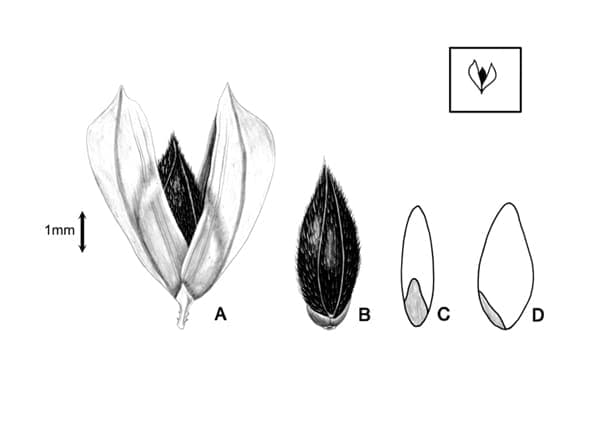
Lynda E. Chandler or Karen Parker / Public domain, via Wikimedia Commons
Phalaris brachystachys: complete guide
Phalaris brachystachys
Want to see Phalaris brachystachys: complete guide in your garden?
1 minute, no credit card
Overview
Phalaris brachystachys, commonly known as confused canary grass or short-spike canary grass, is an annual to winter annual grass from the Poaceae family. The grass is native to the Mediterranean region, Macaronesia, and extends to Iran. This graceful grass species distinguishes itself through its compact, densely growing habit and short, gray-green colored flower spikes that create highly decorative effects. In the Netherlands and Belgium, confused canary grass thrives in full sun and performs especially well in drier soils.
It should be noted: this grass can be considered a weed in some areas because it spreads via self-seeding. Strong growth and spontaneous reproduction are thus characteristics of this species. For gardeners who desire wild, natural forms in their front yards, Phalaris brachystachys offers enormous advantages. On gardenworld.app, we frequently use this grass as a structural plant alongside flowering perennials.
Appearance and Bloom
Phalaris brachystachys grows 30 to 60 centimeters tall and forms dense, compact clumps. The grass blooms from April through July with very characteristic flower spikes. These are approximately 1 to 2 centimeters long, compact and densely packed. The spikes display greenish to gray-green coloring that becomes more brown in late summer. This natural color transition from green to bronze to brown makes the grass visually interesting throughout the season.
The leaves are narrow, approximately 3 to 6 millimeters wide, and have a matte gray-green tint. They grow loosely from the plant's base, creating an airy, almost lush appearance. This contrasts beautifully with more compact flowers in the front garden.
The entire plant has a silky, undulating texture when moving in the wind. This brings much dynamism and movement to garden scenes. The grass maintains good structural integrity well into autumn.
Ideal Location
Phalaris brachystachys blooms and grows best in warm, sunny locations with at least 6 to 8 hours of direct sun daily. The grass is quite hardy to wind and weather conditions, so it can thrive in more open spots.
In partial shade, the grass still grows reasonably well but becomes less compact and produces fewer flower spikes. Too much shade results in leggy growth and poor spike formation.
The grass also tolerates dryness well and can thus be used wonderfully on dry locations where many other plants struggle. This makes it invaluable for water-conserving gardens.
Soil Type
Phalaris brachystachys grows best in well-draining soils that are not overly fertile. Heavy, wet clay soils are not suitable; the grass prefers sandy, well-draining soil. pH should be around 7.0 to 7.5 (neutral to slightly alkaline).
That said: the grass is quite tolerant and grows in diverse soils as long as waterlogging does not occur. Adding extra sand and grass potting soil for improvement is always good.
Single seed treatment requires minimal fertilization. Add some organic matter when planting or sowing, and beyond that the grass grows wonderfully without supplementary feeding.
Free design
Want to see Phalaris brachystachys: complete guide in your garden? Make a free design now.
Watering
Once established, Phalaris brachystachys requires very little water. In normal summers, rainfall alone is completely sufficient. In extremely dry periods (no rain for several weeks), supplemental watering may be welcome, but this is rarely needed.
Young plants should be kept consistently moist for the first 4 to 6 weeks until they are well established. After this period, you can reduce watering.
In container culture, you must be slightly more careful with dryness. Check regularly whether the pot is drying out.
Pruning
Phalaris brachystachys requires minimal pruning. In early spring (February to March), you can remove dead leaves and stems and give the plant a thorough cleaning.
If you want to prevent seed set (because the grass can spread vigorously), cut off the spikes just before they produce ripe seed (August). This also saves much follow-up work.
In autumn, you can cut the plant back completely to just above ground level. This makes room for spring growers and simplifies maintenance.
Maintenance Calendar
March to May: Water young plants, possible wind protection might be needed. May to August: Water only during dry periods, allow spikes to mature fully. August-October: Either allow seed to ripen or cut spikes, autumn cleanup. November-February: Hard cutback, dormancy. March: Encourage new growth.
Winter Hardiness
Phalaris brachystachys is treated as an annual to winter annual grass in Europe. In strict frost zones it does not survive outdoors, but in temperate winters (Benelux) the grass may be able to overwinter, especially on sheltered, drier locations.
Treat the grass as an annual for certainty. Sow new seed in May or buy young plants.
Companion Plants
Phalaris brachystachys combines beautifully with:
- Poppies (red/pink contrasts)
- Agapanthus (blue flowers, airy)
- Cosmos (pink, purple flowers)
- Borage (blue flowers, wild look)
- Lavender (purple flowers, fragrance)
- Catananche (blue flowers)
- Gaura (pink, white flowers)
Mixtures of other grasses also combine nicely with Phalaris brachystachys.
Conclusion
Phalaris brachystachys is a versatile ornamental grass that adds movement and texture to front garden designs. Drought-tolerant, compact, and naturally stylish, it is ideal for modern and wild gardens. For gardenworld.app designs, this grass is a favorite structural plant that contributes seasonal dynamics. Transform your front yard into a flowing, living landscape on gardenworld.app.
Want to see Phalaris brachystachys: complete guide in your garden? Make a free design now.
Upload a photo, pick a style, and get a photorealistic design with plant list in under a minute.
No credit card required


Similar plants
Sporobolus pungens: complete guide
Sporobolus pungens
Sporobolus pungens is a stoloniferous Mediterranean coastal grass with outstanding salt and drought tolerance, perfect for seaside and dry gardens.
Mediterranean aegilops: complete guide
Aegilops biuncialis
Everything about Aegilops biuncialis, a Mediterranean annual grass with ornamental spikes and outstanding drought tolerance for dry gardens.
Silver bluestem: complete guide
Bothriochloa saccharoides
Full guide to Bothriochloa saccharoides (silver bluestem): site, soil, watering, winter hardiness, pruning, and garden companions.