
Hayden Soloviev / CC BY 4.0, via Wikimedia Commons
Phacelia: complete guide
Phacelia tanacetifolia
Want to see Phacelia: complete guide in your garden?
1 minute, no credit card
Overview
Phacelia tanacetifolia, commonly called Fiddleneck, is an annual plant from the Boraginaceae family. This flower is native to California through Mexico and thrives in temperate gardens. The plant is renowned for its powerful attraction to pollinators, particularly bees and bumblebees. Phacelia grows quickly and blooms abundantly from June through September. Despite being an annual, it often self-seeds freely.
Appearance and bloom
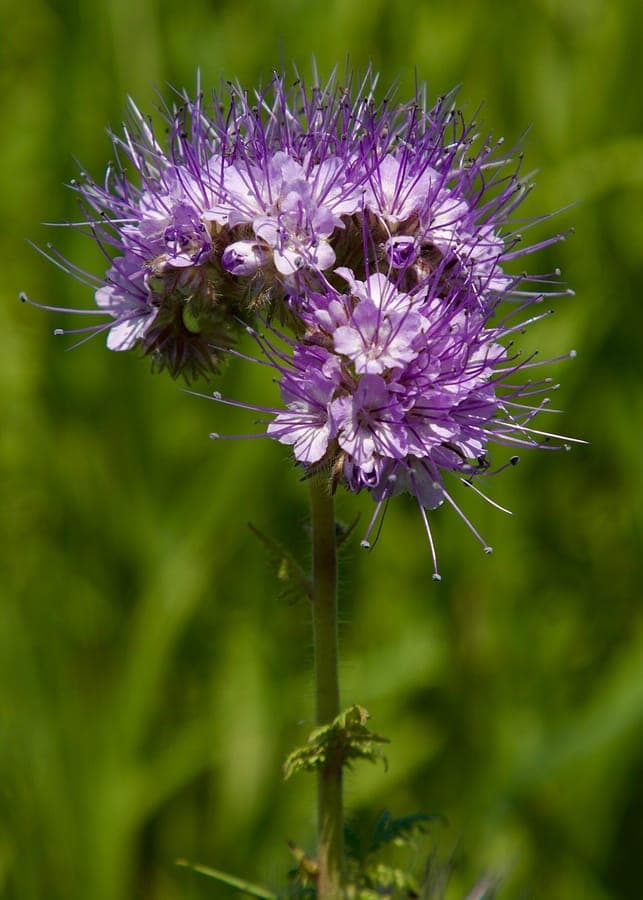
Phacelia reaches heights of 30 to 70 centimeters. The plant displays finely divided, hairy leaves resembling raspberry foliage. The flowers are sky-blue to violet and grow in densely packed clusters. Each tiny flower measures about 8 millimeters across. Blooming begins in June and continues until the first frost arrives. Bees and bumblebees feast on the nectar-rich flowers throughout the season.
Ideal location
Phacelia performs best in sunny locations. The plant tolerates partial shade, though blooming will be less prolific. Ensure good air circulation to prevent diseases. In coastal gardens, phacelia withstands wind well. Avoid spots where water pools after rainfall. Full sun encourages the densest flowering.
Soil
Phacelia is not particular about soil type. The plant thrives in virtually all soils, from sandy to clay. The ideal pH range is 5.5 to 7.5. Ensure the soil drains well. Heavy clay soils can be problematic. For best results, work compost or garden soil into the planting area before sowing.
Watering
Phacelia has moderate moisture needs. Directly after sowing, keep the soil consistently moist. Once the plant is growing, water less frequently. Established phacelia tolerates drought well. Water must not pool, as this encourages rot. Water preferably in early morning or late evening.
Free design
Want to see Phacelia: complete guide in your garden? Make a free design now.
Maintenance
Phacelia is low maintenance. No pruning, pinching, or staking is needed. Spent flowers drop themselves. The plant requires no fertilization, even organic matter. This is phacelia's advantage: it enriches the soil with organic material naturally. Hand remove weeds around the plant as needed.
Maintenance calendar
March to April: Sow directly into the garden or indoors. May: Prick out seedlings and transplant them. June to October: Plant blooms abundantly. November: Harvest seeds or let the plant die back.
Winter hardiness
Phacelia is not winter hardy. It is an annual that dies at the first frost. This is no problem since you can save seed for next year. Allow several plants to self-seed in fall, and you'll have blooms next year without extra effort.
Companion plants
Phacelia grows well alongside cornflowers, sunflowers and daisies. The plant works perfectly as a green manure crop between vegetables. Phacelia attracts beneficial insects that help control pests. Plant phacelia near tomatoes, beans and squash.
Closing thoughts
Phacelia tanacetifolia is an easy, rewarding plant for any garden. Whether you want to attract bees, improve your soil, or simply enjoy beautiful flowers, phacelia delivers. Find plants and seeds at local nurseries. Try phacelia this season and enjoy the many bees and bumblebees it attracts. Learn more about sustainable garden design at gardenworld.app. Let gardenworld.app inspire you and design your perfect pollinator-friendly garden today.
Want to see Phacelia: complete guide in your garden? Make a free design now.
Upload a photo, pick a style, and get a photorealistic design with plant list in under a minute.
No credit card required


Similar plants
Western waterleaf: complete guide
Hydrophyllum occidentale
Full growing guide for western waterleaf (Hydrophyllum occidentale): shade tolerance, soil needs, watering, winter hardiness and naturalistic garden use.
Limestone phacelia (Phacelia affinis): complete guide
Phacelia affinis
Full guide to Phacelia affinis, the limestone phacelia: sowing tips, purple-blue bee flowers, drought tolerance and uses in dry or wildlife gardens.
Pyrenean viper's bugloss: complete guide
Echium asperrimum
Echium asperrimum is a striking biennial from the western Mediterranean with rough bristly stems and vivid blue flowers. A magnet for bees and a bold border plant.