
Wikimedia Commons / Public domain, via Wikimedia Commons
Western waterleaf: complete guide
Hydrophyllum occidentale
Want to see Western waterleaf: complete guide in your garden?
1 minute, no credit card
Overview
Western waterleaf (Hydrophyllum occidentale) is a delicate but characterful herbaceous perennial belonging to the Boraginaceae family (previously treated as Hydrophyllaceae). Native to the western United States, it occurs naturally in Arizona, California, Idaho, Nevada, Oregon, and Utah, growing in moist, shaded forests, along mountain streams, and on cool, humus-rich slopes. The genus name 'Hydrophyllum' is derived from the Greek words for water and leaf, a reference to the pale, water-stain-like markings visible on the leaves of young plants. In Swedish, the species goes by the name 'vastlig indiankal'. Although little known outside North America, western waterleaf is a rewarding subject for naturalistic shade gardens and woodland plantings. Discover garden designs that use plants like this on gardenworld.app.
Appearance and bloom cycle
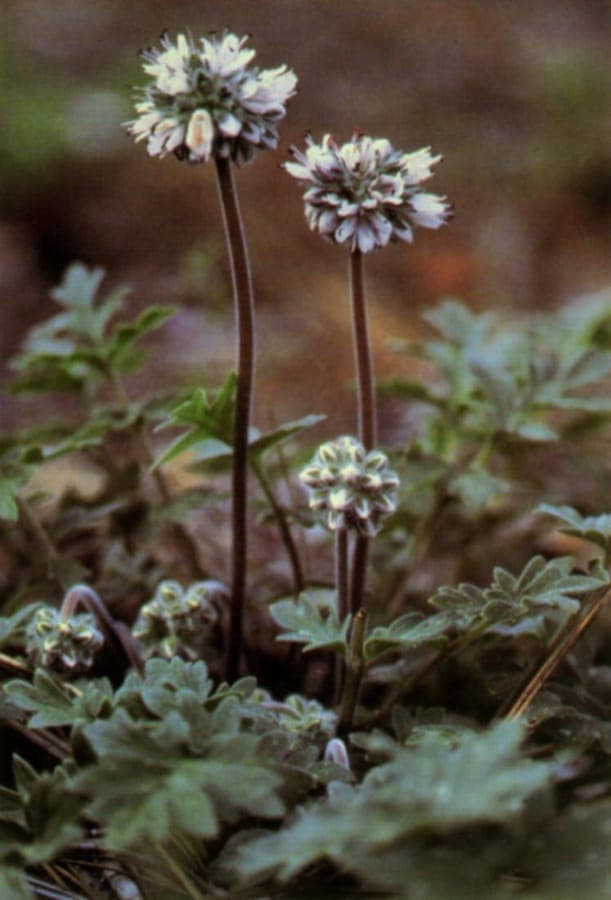
Western waterleaf is a low to mid-height perennial reaching 30 to 60 cm in height during spring and early summer. The leaves are deeply pinnate, with five to seven sharply toothed leaflets arranged elegantly along each leaf stem. Young foliage shows characteristic grey-green mottling that resembles water spots - the feature that gives both the common name and the genus its identity. This patterning fades on mature leaves. Stems are softly hairy and somewhat succulent. The flowers are grouped in compact, upward-facing scorpioid cymes. Each individual flower is small - barely a centimetre across - but they are numerous and attractive: whitish to pale lavender-violet, with long protruding stamens that give the whole cluster a feathery, airy quality. In cultivation in temperate regions, flowering occurs primarily in May and June. Small brownish seeds follow. As conditions dry and warm in midsummer, the above-ground parts die back, but the roots survive until the following spring without difficulty.
Ideal location
Western waterleaf requires a shaded or partly shaded position. In its natural range it grows beneath forest canopies, on cool north-facing slopes, and along shaded stream banks. Full sun damages the foliage quickly and forces the plant into early summer dormancy. The ideal placement in a garden is under deciduous trees - oaks, hazels, hornbeams - where the plant receives good light in early spring before the tree canopy closes, then benefits from shade through the hottest months. It works well in woodland gardens, naturalistic borders, and as a ground cover beneath large shrubs. A narrow, shaded strip beside a fence or wall can also work well, as long as the soil remains reliably moist throughout the growing season.
Soil
Western waterleaf has fairly specific soil preferences. The ideal pH range is between 6.2 and 7.5. The plant requires consistently moist, humus-rich soil with good organic content. Woodland soil or a mix of garden loam and leaf mould suits it perfectly. Moderately draining lighter soils are workable provided watering is supplemented in dry spells. Dry, sandy, or nutrient-poor ground is unsuitable: the plant will fail to establish and typically does not return the following year. Before planting, work in a generous layer of well-rotted compost or leaf mould, and mulch annually in autumn with fallen leaves or fine bark chips to maintain organic matter levels. Local garden centres stock suitable woodland planting composts that deliver exactly the soil conditions this species needs.
Free design
Want to see Western waterleaf: complete guide in your garden? Make a free design now.
Watering
The name says it all: western waterleaf wants reliably moist conditions. During spring, when the plant is actively growing, soil moisture is usually adequate in well-prepared ground without supplemental watering. In dry spring periods, water to prevent stress and to avoid shortening the flowering period. After flowering and moving toward summer, water requirements decrease as the plant enters dormancy. Avoid waterlogged conditions during winter, as prolonged wetness around the roots combined with freezing temperatures can cause rot. A mulch layer of 5 to 8 cm is the most effective way to regulate soil moisture through the year and reduce the amount of supplemental irrigation required.
Pruning
Very little intervention is needed. After flowering in June, the spent flower stems can be tidied away, but this is entirely a matter of preference rather than horticultural necessity. If you wish the plant to self-seed and naturalise across an area, allow the seed heads to ripen and drop naturally. In midsummer the plant dies back above ground - this is a normal seasonal adaptation, not a sign of plant death. Clear away the withered material in late summer or early autumn. In late winter, remove any damaged old foliage to give new growth room to emerge freely. There is no need for dividing clumps in the early years; established plants maintain themselves well without intervention.
Maintenance calendar
February and March: new leaf rosettes emerge; remove old dead material. April and May: active growth and bud formation; maintain soil moisture, especially in dry spells. May and June: flowering period; enjoy the delicate white blooms and long stamens. July: plants enter summer dormancy; no extra watering needed except in extreme drought. August and September: tidy away above-ground remains. October and November: apply a mulch layer for winter protection. December and January: no further action required; roots overwinter in well-drained soil without difficulty.
Winter hardiness
Western waterleaf is winter hardy in USDA hardiness zones 5 to 9, corresponding to minimum temperatures of around -28 degrees Celsius for the root system. In most of northern and western Europe it overwinters without difficulty provided the soil drains reasonably well and does not become waterlogged in winter. On heavy, moisture-retentive soils, a protective mulch layer is a worthwhile precaution. The plant is somewhat sensitive to repeated freeze-thaw cycles that penetrate deeply into the soil, so in areas prone to erratic winter temperatures a reliable mulch cover is strongly recommended. Container-grown plants should be brought into a frost-free location for the coldest months.
Companion plants
Given its preference for shade and moisture, western waterleaf pairs naturally with other woodland and shade-tolerant species. Excellent companions include spotted deadnettle (Lamium maculatum), lungwort (Pulmonaria officinalis), wood cranesbill (Geranium sylvaticum), bellflower (Campanula latifolia), and a range of ferns such as lady fern (Athyrium filix-femina) or polypody (Polypodium vulgare). In a larger shade border, its airy, delicate bloom provides a pleasing contrast to the heavier foliage mass of hostas or astilbes. For pollinator-friendly gardens, it provides early pollen and nectar for spring bees and other insects at a time when little else is in bloom.
Closing
Western waterleaf (Hydrophyllum occidentale) may be an unfamiliar name to most European gardeners, but it deserves a place in every naturalistic shade garden. Its elegantly divided leaves, subtle mottling, and delicate white spring flowers contribute a quiet, woodland atmosphere that is difficult to replicate with more commonly grown plants. It asks only for shade, moisture, and a humus-rich soil, and in return provides reliable seasonal interest and real ecological value for early pollinators. For more ideas on incorporating woodland plants into your garden design, visit gardenworld.app and explore professional layouts that make the most of this kind of understated botanical beauty.
Want to see Western waterleaf: complete guide in your garden? Make a free design now.
Upload a photo, pick a style, and get a photorealistic design with plant list in under a minute.
10,000+ gardens designed already
No credit card required


Similar plants
Phacelia: complete guide
Phacelia tanacetifolia
Phacelia tanacetifolia is a stunning bee plant that fills gardens with blue flowers from June to October. Learn how to grow and care for this pollinator magnet.
Breadbutter: complete guide
Borago officinalis
Learn how to grow Breadcrumb (Borago officinalis) in your garden: ideal light, soil pH, bloom time and care tips for UK and US climates.