James Steakley / CC BY-SA 3.0, via Wikimedia Commons
Trailing jade (Peperomia rotundifolia): care guide
Peperomia rotundifolia
Want to see Trailing jade (Peperomia rotundifolia): care guide in your garden?
Full design in HD: €7.99
Look after your Trailing jade with the GardenWorld app
Identify plants with your camera and get a care calendar with reminders for this plant.


Overview
Peperomia rotundifolia is the peperomia for people who like small things done well. Instead of the upright rosette most peperomias form, it produces thread-thin stems that creep and trail, set with round leaves no bigger than a shirt button. Grown in a hanging pot it slowly becomes a soft green curtain; on a shelf it tumbles over the edge; in an open terrarium it behaves like a miniature ground cover.
It is widely known as trailing jade or creeping buttons, and both names describe it nicely. The plant belongs to the pepper family (Piperaceae) and is native to a broad swathe of tropical America, from Mexico and the Caribbean deep into South America. In the wild it rarely grows in soil. You find it on mossy tree trunks, on rocks and on fallen branches in humid forest, rooting into moss and leaf debris. That makes it an epiphyte or lithophyte with fine, shallow roots and leaves that store water for dry spells. Keep those two facts in mind and most of its care follows naturally.
It is easy to mix up with two other trailers. Peperomia prostrata, sold as string of turtles, has patterned leaves that look like tiny shells. Pilea nummulariifolia, often called creeping Charlie, has thin, quilted, slightly hairy leaves. Trailing jade's leaves are thick, smooth and almost rubbery to the touch.
If you are planning a conservatory or want your indoor plants to tie in with the terrace outside, you can have a garden design made at gardenworld.app that treats the space by the window as part of the whole.
Appearance and growth
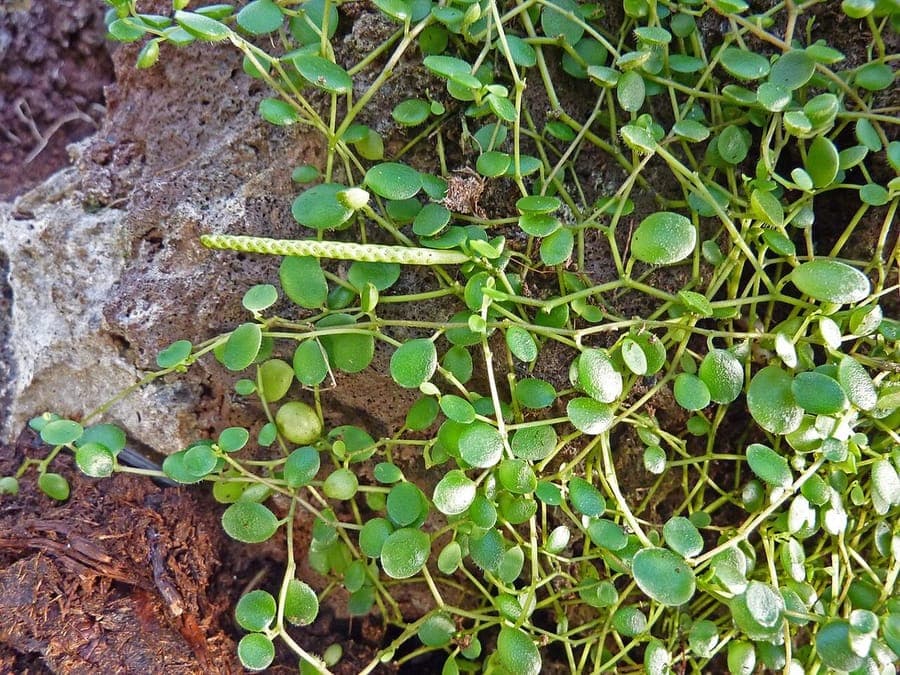
The stems are wiry, green to reddish and can reach 30 to 50 cm in a hanging basket. Leaves sit along them at regular intervals: round to slightly oval, roughly 0.5 to 1.5 cm across, fleshy and fresh to mid-green. Some plants in the trade have finely hairy leaves with faint silvery veins, occasionally labelled var. pilosior. The photo shows the wild type: a tangle of slender green stems covered in glossy round leaves, sprawling over porous volcanic rock.
Growth is slow to moderate. Wherever a stem touches compost it tends to root at the nodes, so the plant gradually knits itself into a mat. It does flower, though nobody would call it showy. Like every peperomia it sends up narrow green to cream spikes a few centimetres long, made of hundreds of minute flowers without petals. You can see one lying among the leaves in the photo, like a thin green rod.
Position in the home
Because it hangs or creeps, think about height first. A hanging pot in front of an east or west window, a small shelf beside the glass or the top of a bookcase all work well, as long as you can still reach it easily to check the compost.
Avoid spots directly above a radiator or in the draught of a door that opens often in winter. The fine stems dry out quickly in warm, dry air, and cold draughts make the leaves drop. A bathroom with a window often suits it very well, provided it is not too dim.
Light
Trailing jade wants bright, indirect light. It is happy with morning sun or the weaker sun of late afternoon, and in winter it can sit right by the window. Strong midday sun through glass in summer is too much: the leaves bleach, turn yellowish or develop brown patches.
Too little light shows as long, bare lengths of stem between the leaves and leaves that get smaller. On a north-facing sill it can still manage if it hangs close to the glass, and under a grow light it stays pleasingly compact.
Humidity
Ordinary room air is usually enough for this species. Humidity of 40 to 60% is ideal, and during the heating season it grows a little better if the air is not too dry. A tray of wet pebbles nearby or a group of plants together is plenty; there is no need for a humidifier. Misting the leaves is unnecessary and in a cool room can even encourage rot at the base of the stems.
It does well in an open terrarium or a ventilated glass cloche. A fully sealed terrarium tends to be too wet, and the fleshy leaves will rot.
Free preview
Want to see Trailing jade (Peperomia rotundifolia): care guide in your garden? Make a free preview of your design.
Compost and repotting
Remember that in nature it grows on moss and bark. Standard multipurpose compost is too heavy and stays wet too long. Mix roughly two parts houseplant compost with one part perlite and one part fine orchid bark or coir. The result is airy, holds a little moisture and lets excess water drain quickly.
Choose a shallow, wide pot or a hanging basket with a drainage hole. A deep pot full of wet compost under a small root system is the fastest route to root rot. Repotting is rarely needed: every two to three years in spring, and only one size up.
Watering
Those thick leaves are a water store. Water only once the top two to three centimetres of compost feel dry, then water thoroughly until a little runs out of the bottom. Never leave water standing in the outer pot or saucer.
In summer that often means once a week; in winter it can be every two to three weeks. A good sign of thirst is that the leaves feel slightly softer and lose some of their shine, firming up again within a day of watering. Yellow, glassy leaves and stems blackening at the base point the other way: too much water.
Care and propagation
Feeding needs are modest. From April to September, a half-strength liquid houseplant feed every four to six weeks is ample. Stop in autumn and winter.
Pruning is mainly about shaping. Cut leggy or bare stems back to just above a leaf; the plant branches there and fills out. The trimmings are ready-made cuttings. Lay a 5 to 8 cm length with a few nodes flat on moist, airy compost or push the lower end in lightly, and roots usually form within two to four weeks. Rooting in water works too. Pests are rare, though it is worth checking now and then for mealybug among the stems.
Care calendar
March to April: resume feeding at half strength. Repot if needed and trim back bare stems.
May to June: the best time to take cuttings. Move the plant back from a south window once the sun gets stronger.
July to August: watch for drying out in hot spells, but do not water out of habit. Check for mealybug.
September to October: gradually reduce watering and stop feeding. Move the plant closer to the light.
November to February: rest period. Little water, no feed, away from radiators and cold draughts.
If you would rather not keep all this in your head, add the tasks to the plant calendar at gardenworld.app and get a reminder when it is time to feed or take cuttings.
Temperature
Peperomia rotundifolia is a true houseplant and not hardy. It grows best between 18 and 24°C. Below 12 to 15°C growth stops and leaves soon start to drop, especially if the compost is still wet. It will not survive frost.
In summer it can go out on a sheltered, bright balcony or patio, out of strong sun and rain. Bring it back in as soon as nights fall below 12°C, usually some time in September.
Toxicity to pets
Good news for cat and dog owners: the ASPCA, the American animal welfare charity that runs its own poison control centre, lists Peperomia rotundifolia as non-toxic to dogs, cats and horses. That makes it a sensible hanging plant for a home with animals. A cat that eats a lot of leaves may still get a mild upset stomach, and a cat that tugs at dangling stems can pull the pot down, so hang it securely.
Companion plants
Pair this peperomia with plants that ask for the same moderate care. A spider plant (Chlorophytum comosum) and a Tradescantia zebrina in a hanging pot alongside give a lovely contrast in leaf shape. In an open terrarium or on a shelf it goes well with Pilea nummulariifolia and mind-your-own-business (Soleirolia soleirolii), both of which stay small. A fern such as Phlebodium aureum likes a little more moisture but sits happily beside it in a bright bathroom.
Final thoughts
Trailing jade is a modest plant that adds a soft green touch without taking up much room. Give it bright light without harsh sun, airy compost, a shallow pot and plenty of restraint with the watering can. Treat it that way and you will have a hanging plant that lasts for years and can be multiplied endlessly from a handful of cuttings. Hang one by a window and watch it creep a little further over the rim each month.

See it in your garden
See Trailing jade in your garden
One photo of your garden and a few questions. You see the result in about a minute.
Try it with a photoIdentify this plant in your own garden. Identify a plant
Similar plants
Chlorophytum comosum: complete guide
Chlorophytum comosum
Discover everything about Chlorophytum comosum (spider plant). Learn care requirements, propagation, location and maintenance for thriving indoor plants.
Tradescantia zebrina (Inchplant): complete guide
Tradescantia zebrina
Master Inchplant cultivation: colors, growth habits and stunning displays. Complete care guide for this tropical beauty.
Creeping Charlie: complete guide
Pilea nummulariifolia
Discover Creeping Charlie (Pilea nummulariifolia), a tropical trailing plant with coin-shaped leaves. Perfect for indoors and protected outdoor spaces.
