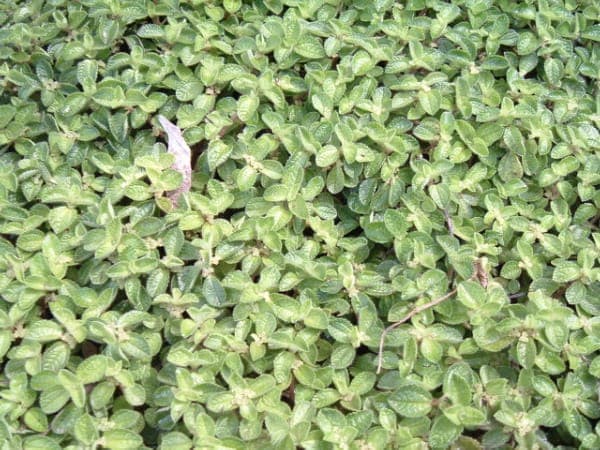
Wikimedia Commons / CC BY-SA 3.0, via Wikimedia Commons
Creeping Charlie: complete guide
Pilea nummulariifolia
Want to see Creeping Charlie: complete guide in your garden?
Full design in HD: €7.99
Look after your Creeping Charlie with the GardenWorld app
Identify plants with your camera and get a care calendar with reminders for this plant.


Overview
Creeping Charlie (Pilea nummulariifolia), also known as Coin Plant, is a trailing tropical plant from the Urticaceae family, native to Central America through Venezuela and Peru. This lover of moist, semi-shaded environments is renowned for its delicate, trailing stems adorned with numerous small, round, coin-shaped leaves in bright to dark green.
While this plant is primarily cultivated indoors in pots and hanging baskets in Europe, it can also thrive outdoors in warm, protected settings during warm months. With its uncomplicated growth and minimal maintenance requirements, it is suitable for beginners.
Via gardenworld.app, we help you optimally integrate this charming plant into your interior (or protected outdoor space).
Appearance and bloom
Creeping Charlie develops long, trailing stems that quickly expand and soon cascade via hanging baskets or plant stands. Side stems appear regularly, creating a dense, luxuriant canopy.
The leaves are tiny (approximately 5-10 mm), round to kidney-shaped, smooth and glossy, and bright green. They are arranged oppositely along thin stems.
The flowers are minute, inconspicuous, yellowish-white, appearing in tiny, umbel-like clusters in the leaf axils. They are not prominent and are often overlooked, especially when the plant receives weak light.
Ideal location
Provide Creeping Charlie with plenty of indirect light, but not direct sunlight. A spot away from the window with north or east orientation is ideal. Too much direct sun causes leaves to brown or yellow.
Indoors: Place in a hanging basket or on a high shelf where its trailing growth is showcased. Also suitable for terrariums or glass gardens with elevated humidity.
Outdoors (warm climate): In protected loggias or under verandas where temperature remains above 15 degrees Celsius.
Soil
Creeping Charlie grows better in light, moisture-retaining potting soil than in standard potting mix. Preference for mixture with abundant organic matter:
- 60% potting soil
- 20% sphagnum peat or coco-fiber
- 20% garden peat or leaf mold
The plant enjoys moisture but not waterlogging. Good drainage is essential.
Free preview
Want to see Creeping Charlie: complete guide in your garden? Make a free preview of your design.
Watering
Keep soil continuously lightly moist, but not soggy. As a rule of thumb: water when the top 1 cm of soil feels dry.
Summer: daily watering (possibly twice daily in very warm periods) Winter: reduce watering substantially, but ensure soil never dries completely
High humidity is essential. Spray regularly with a fine mist or place the pot on a tray with moist gravel.
Pruning
Creeping Charlie responds well to pruning. This promotes dense, bushy growth:
- Regularly pinch tips to encourage branching
- Remove long, bare stems
- Prune in late winter when new growth begins (March)
Propagation: Pinched stems easily root in water or moist soil for easy propagation.
Maintenance calendar
January-March: Minimal light, careful watering April-May: Growth accelerates, increase water June-August: Peak growth, daily watering, high humidity September-October: Growth rate slowing November-December: Dormancy, minimal water and light
Winter hardiness
Creeping Charlie is not winter-hardy outdoors above 10 degrees Celsius. This is a tropical plant for indoors or heated conservatories.
Temperatures below 10 degrees Celsius cause leaf drop and stem death. Ideal growth temperature: 18-25 degrees Celsius.
Companion plants
Creeping Charlie harmonizes beautifully with:
- Peperomia for leaf size contrast
- Fittonia for fine red-white foliage
- Afzelia (African Oil Bean) for dignified growth
- Scindapsus pictus for silver-spotted leaves
- Hoya carnosa for waxy flowers
In group containers: Combine with other trailing/creeping tropical plants for lush effect.
Closing remarks
Creeping Charlie brings tropical, moisture-loving charm to your living room. For those seeking undemanding, trailing plants with minimal maintenance, this plant is an excellent choice.
Widely available at plant shops and garden centers. Discover how to position this plant in your living room on gardenworld.app, including tips on propagation and cultivation.
Frequently asked questions about Creeping Charlie
Is Creeping Charlie winter hardy?
Creeping Charlie is not winter-hardy outdoors above 10 degrees Celsius. This is a tropical plant for indoors or heated conservatories.
How much water does Creeping Charlie need?
Keep soil continuously lightly moist, but not soggy. As a rule of thumb: water when the top 1 cm of soil feels dry.
Where does Creeping Charlie grow best?
Provide Creeping Charlie with plenty of indirect light, but not direct sunlight. A spot away from the window with north or east orientation is ideal.

See it in your garden
See Creeping Charlie in your garden
One photo of your garden and a few questions. You see the result in about a minute.
Try it with a photoIdentify this plant in your own garden. Identify a plant
Similar plants
Baby rubber plant (Peperomia obtusifolia): complete guide
Peperomia obtusifolia
Everything about the baby rubber plant (Peperomia obtusifolia): bright position, careful watering, repotting, cuttings and winter care for a compact, glossy houseplant.
Wax plant (Hoya carnosa): complete guide
Hoya carnosa
Everything about the wax plant (Hoya carnosa): light, watering, flowering spurs, a cool winter rest, cuttings and toxicity. Not toxic to cats and dogs.
Satin pothos (Scindapsus pictus): a practical care guide
Scindapsus pictus
How to grow satin pothos (Scindapsus pictus) indoors: light, watering, humidity, compost, cuttings and why it is toxic to cats and dogs.
