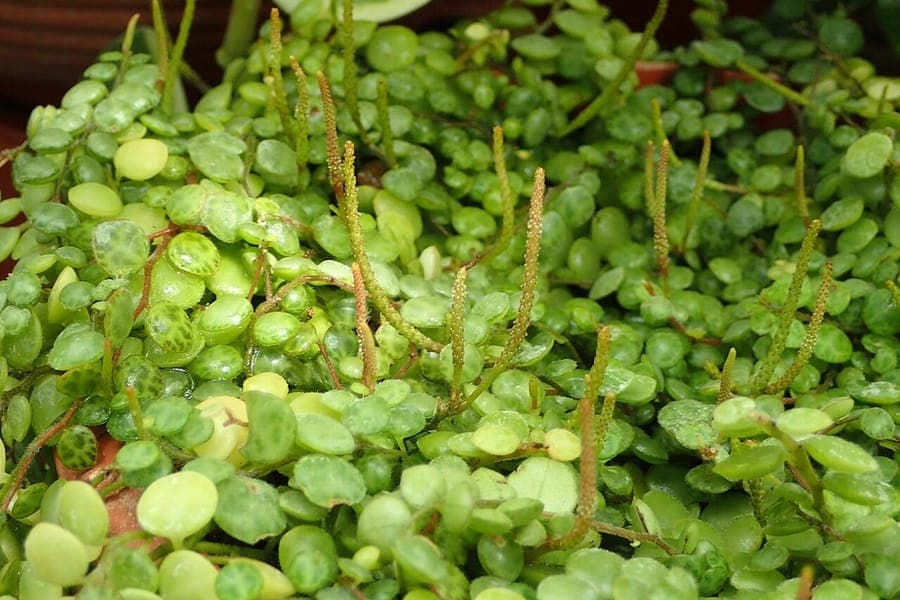
Krzysztof Ziarnek, Kenraiz / CC BY-SA 4.0, via Wikimedia Commons
String of turtles (Peperomia prostrata): a care guide
Peperomia prostrata
Want to see String of turtles (Peperomia prostrata): a care guide in your garden?
Full design in HD: €7.99
Look after your String of turtles with the GardenWorld app
Identify plants with your camera and get a care calendar with reminders for this plant.


Overview
String of turtles (Peperomia prostrata) is a tiny creeping and trailing plant that only reveals its charm when you look closely. Thread-like stems carry round leaves barely a centimetre across, and on many of them a fine network of pale lines runs over a darker background. The pattern looks remarkably like a turtle's shell, which is where the common name comes from.
Accounts of its origin vary. The houseplant trade often describes it as a plant from the Brazilian rainforest, but most botanical sources place Peperomia prostrata in the wet tropical forests of Ecuador. There it grows as a small epiphyte on mossy branches and trunks, or creeps over rocks in the understorey, always in filtered light and moist air. Like other peperomias it belongs to the pepper family (Piperaceae).
What sets this species apart from the familiar upright peperomias is the way it grows. It forms no rosette or clump, but a trailing strand or a mat. In a hanging pot it spills over the rim like a delicate curtain; on a flat surface it creeps into a dense carpet. It is a plant for a shelf, a hanging pot or an open terrarium rather than the middle of a table.
Appearance and flowering
The stems are thin, reddish to green and usually reach 30 to 45 cm indoors. The leaves are alternate, round to slightly oval, 0.8 to 1.5 cm across, thick and juicy, almost like miniature succulents. Their colour ranges from dull grey-green to dark bronze-green with silvery or pale green lines. The more light they get, the sharper the markings. In shade the leaves turn plainer green and larger, and the stems grow longer.
The photo shows a dense mat of small, round, fleshy leaves, some clearly marbled and others plain light green, with thin green flower spikes standing upright among them. Those spikes are typical of the genus: narrow rods 2 to 5 cm long covered in minute flowers without petals. They appear mainly in summer and are more of a curiosity than an ornament.
Position in the home
Hang or place Peperomia prostrata where you can see the trails clearly and where they can hang freely: a high shelf, a small hanging pot in front of a window or the edge of a bookcase. It is small and stays small, so a pot of 8 to 12 cm will do for years. It also thrives in an open terrarium or a glass bowl with a wide opening, where the air stays a little more humid.
Avoid draughts, spots above a radiator and closed bottles without air circulation. In a sealed container the fine stems tend to rot faster than they grow.
Light
Give it plenty of bright, indirect light. A spot by an east or west window, or set back from a south window behind a sheer curtain, is ideal. An hour of morning or evening sun suits it and sharpens the pattern, but harsh midday sun through glass quickly scorches such small leaves. In too little light the stems become long and bare with wide gaps between the leaves. Under an LED grow light it stays very compact and keeps its turtle markings best.
Humidity
Humidity of 50 to 60 % is ideal, though an ordinary room at around 40 % will do, especially if the pot sits among other plants. Air that is too dry shows as leaves browning at the edges and stem tips that shrivel. Misting barely helps; a tray of clay pebbles and water beneath the pot or a spot in a bathroom with natural light works better.
Potting mix and repotting
The roots are extremely fine and dislike heavy, wet compost. Mix houseplant compost with roughly the same amount of perlite, or use a cactus and succulent mix with some coir added. A shallow pot with drainage holes is essential. Terracotta is fine but can dry out too quickly for such a small plant; a plastic pot with good holes is often easier.
Repotting is rarely needed. Only do it in spring when the pot is genuinely full of roots, and choose one just a couple of centimetres wider.
Free preview
Want to see String of turtles (Peperomia prostrata): a care guide in your garden? Make a free preview of your design.
Watering and feeding
This is where the skill lies. String of turtles has thick leaves that store water, but its stems and roots are so fine that it cannot stay dry for long either. Water when the top 1 to 2 cm of compost are dry. In summer that is often once a week, in winter about every two weeks. Bottom watering works well: stand the pot in a little water for ten minutes, then let it drain. That keeps the base of the stems dry.
Too much water gives soft, translucent leaves and blackened stems at soil level. Too little makes the leaves wrinkle and thin out. A wrinkled leaf usually plumps up again within a day of a good drink. Feeding is barely necessary: from April to September a houseplant feed at a quarter of the normal strength every six weeks is ample.
Propagation
Propagation is easy with this species and also useful, as older plants often thin out at the top of the pot. Snip off a trail 5 to 10 cm long with a few nodes. Strip the lowest leaves and lay the stem on moist cutting compost or push it in about a centimetre deep. You can also pin a trail to the surface with a bent paperclip; roots form at every node that touches the compost. Put several cuttings in the same pot for a fuller plant. Rooting in a glass of water works too, but the cuttings are then more delicate when potted up.
Keep the cuttings light and warm, at 20 to 24 °C, and just moist. A clear lid speeds up rooting. New growth usually appears after three to five weeks.
Care calendar
March–April: Trim bare trails and push the tips back into the pot as cuttings. Repot only if it is really necessary.
May–June: The best time for cuttings. Turn the hanging pot now and then for even growth.
July–August: Check the compost more often; a small pot dries out fast in a warm room. Shield from harsh midday sun.
September–October: Stop feeding. Move the plant a little closer to the light.
November–February: Water sparingly and keep it away from cold glass. If you have several small plants, the plant calendar on gardenworld.app is the easiest way to keep track of watering.
Temperature and winter care
Peperomia prostrata grows best between 18 and 24 °C. Below 12 °C it is damaged and frost is fatal, so it stays indoors all year. In winter, watch hanging pots close to single glazing or a cold wall, where night temperatures can drop well below the rest of the room. If you have a conservatory or garden room, you can have a garden design made on gardenworld.app so that the houseplants behind the glass and the garden beyond it form a single picture.
Toxicity to pets
Peperomia prostrata has no entry of its own in the ASPCA plant list. However, several related peperomias, including Peperomia caperata, Peperomia argyreia and Peperomia clusiifolia, are listed there as non-toxic to cats and dogs, and no toxic compounds are known for the genus. The plant is therefore generally regarded as pet-safe. Dangling trails are an open invitation for cats to play, though, and an animal that eats a lot of plant material may get a mild stomach upset. Hang it just out of paw's reach if you can.
Companion plants
Pair Peperomia prostrata with other small plants that have fine leaves or a trailing habit. Mind-your-own-business (Soleirolia soleirolii) forms a similar green carpet and shares a wide terrarium happily. The spikemoss Selaginella kraussiana enjoys the same moist, bright conditions. A Christmas cactus (Schlumbergera truncata) and a spider plant (Chlorophytum comosum) are larger trailing plants that look good alongside it in a row of hanging pots. A moth orchid (Phalaenopsis amabilis) on a shelf below completes the picture. The ASPCA lists mind-your-own-business, Christmas cactus, spider plant and moth orchid as non-toxic to cats and dogs.
Final thoughts
String of turtles is a plant for people who love detail. Its turtle-patterned leaves only stand out when you look at them up close, and that is a large part of its charm. Give it plenty of indirect light, a small pot with airy compost and water as soon as the top centimetres are dry. Snip a trail now and then and root it back in, and you will have a full, delicate trailing plant for years to come.

See it in your garden
See String of turtles in your garden
One photo of your garden and a few questions. You see the result in about a minute.
Try it with a photoIdentify this plant in your own garden. Identify a plant
Similar plants
Soleirolia soleirolii: complete guide
Soleirolia soleirolii
Soleirolia soleirolii, the baby's-tears or Corsican carpet, is a delicate trailing plant with tiny leaves. Learn care requirements and humidity management.
Thanksgiving cactus: complete guide
Schlumbergera truncata
Schlumbergera truncata produces vibrant autumn flowers perfect for indoor cultivation. Learn watering, blooming triggers, and care for this popular houseplant.
Chlorophytum comosum: complete guide
Chlorophytum comosum
Discover everything about Chlorophytum comosum (spider plant). Learn care requirements, propagation, location and maintenance for thriving indoor plants.
