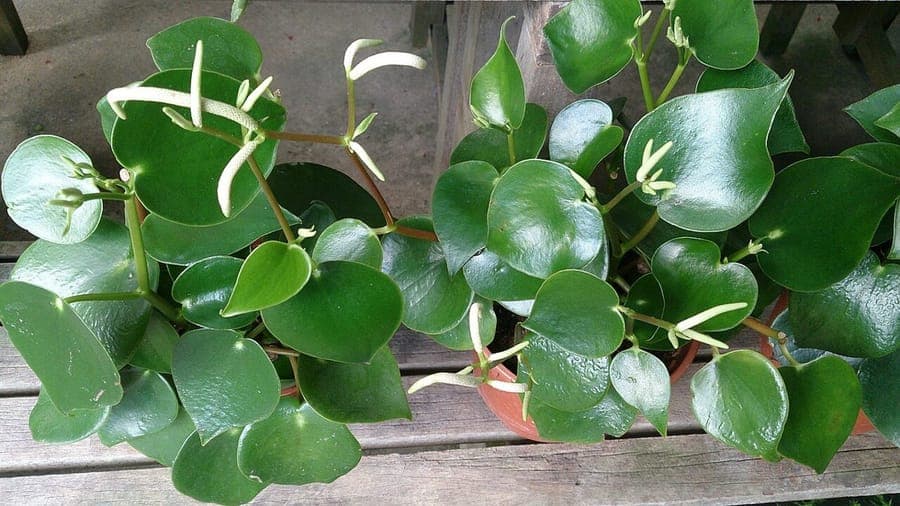
Mokkie / CC BY-SA 3.0, via Wikimedia Commons
Raindrop peperomia (Peperomia polybotrya): a care guide
Peperomia polybotrya
Want to see Raindrop peperomia (Peperomia polybotrya): a care guide in your garden?
Full design in HD: €7.99
Look after your Raindrop peperomia with the GardenWorld app
Identify plants with your camera and get a care calendar with reminders for this plant.


Overview
Raindrop peperomia (Peperomia polybotrya) is the peperomia whose leaves shine as if freshly varnished. They are thick, firm and teardrop-shaped: broad and rounded at the top, narrowing to a short point. That shape gives the plant its common name, and in shops it often carries the cultivar name 'Jayde' or 'Raindrop' on the label. Some growers also call it coin-leaf peperomia.
The species comes from the Andes, from humid forests in Colombia, Ecuador and Peru. There it grows on the forest floor and on rocks, sometimes on mossy branches, in a mild climate with moist air but with roots that drain and dry quickly. Like the other peperomias it belongs to the pepper family (Piperaceae).
The most striking thing about Peperomia polybotrya is how closely it resembles the Chinese money plant (Pilea peperomioides). Both have round, peltate leaves on long stalks, and they are regularly mixed up. The difference is easy to spot once you know: the pilea has thin, matt, perfectly round leaves without a tip, whereas polybotrya has thick, glossy leaves with a distinct point. Their habits differ too: the pilea throws up plenty of offsets from the soil, while the peperomia forms an upright little shrub on juicy stems.
Appearance and flowering
Indoors the plant grows 20 to 40 cm tall and about as wide. The leaves are 5 to 10 cm long and peltate: the stalk joins the underside slightly in from the edge, which leaves a small dimple on the upper surface. They are bright to mid green, firm and fleshy. There is also a variegated form with creamy yellow margins that needs a little more light. The stems are green, thick and succulent, becoming slightly woody at the base on older plants.
The photo shows two pots on a wooden bench, with glossy green teardrop leaves and white flower spikes. Those spikes explain the species name: polybotrya means "with many clusters". Instead of a single spike, the plant produces branched groups of white to cream rods held above the foliage, mainly in spring and summer. Some people find them elegant; others snip them off to keep the plant compact.
Position in the home
Peperomia polybotrya is a sturdy plant that looks at home on a windowsill, a sideboard or a desk. It is less fragile than many peperomias, but older plants can become top-heavy and start to lean. A slightly heavier pot, such as terracotta, keeps it from toppling over.
Avoid draughts and direct heat from a radiator. Turn the pot every few weeks, or the plant will grow lopsided towards the window.
Light
This species wants more light than you might expect from a peperomia. A spot by an east or west window is ideal, and it manages reasonably close to a north window too. A little morning or evening sun is fine and keeps the plant compact, but full midday summer sun through glass can yellow or scorch the leaves. In too little light the stems grow long and floppy, the leaves space out and lose their shine. The variegated form even turns plain green if kept too dark.
Humidity
Ordinary room air at 40 to 50 % humidity is enough. Thanks to its thick, glossy leaf surface the plant loses little water, so it does not need a humidifier and misting is pointless. Do wipe the leaves with a damp cloth now and then, so they keep their shine and their ability to catch the light.
Potting mix and repotting
Choose an airy, free-draining mix, such as three parts houseplant compost to one part perlite and one part fine bark. Cactus compost blended with some ordinary compost also works. The pot needs a drainage hole and should not be too large. Peperomia polybotrya grows a little faster than the small creeping species and usually wants a slightly bigger pot every two years. Repot in spring and set the plant back at the same depth.
Free preview
Want to see Raindrop peperomia (Peperomia polybotrya): a care guide in your garden? Make a free preview of your design.
Watering and feeding
The leaves and stems store water, so the plant copes well with a missed watering. It copes much less well with too much. Let at least the top half of the compost dry out between waterings. In summer that means roughly once every seven to ten days, in winter every two to three weeks. Then water thoroughly until it runs from the drainage hole, and never leave the pot standing in a full saucer.
Drooping, soft stems and leaves that yellow and drop usually point to wet roots. Wrinkled, duller leaves mean the plant is thirsty. From April to September feed once a month with houseplant fertiliser at half strength.
Pinching out and cuttings
If the plant becomes leggy or open, cut back the tips of the longest stems in spring to just above a leaf. One or two new shoots will break from that point, making the plant bushier. The tips you remove can go straight into use as cuttings.
A tip cutting 8 to 10 cm long with two or three leaves is the quickest way to raise new plants. Remove the lowest leaf, let the cut end dry for a few hours and insert it into moist cutting compost or perlite. Rooting in water also works well: white roots appear after two to four weeks. A single leaf with a piece of stalk can root too, though it takes longer. Keep cuttings warm, at 20 to 25 °C, and bright but out of full sun.
Care calendar
March–April: Cut back long stems and use the tips as cuttings. Repot if needed and start feeding.
May–June: Flower spikes appear. A good time for more cuttings.
July–August: Water once half the pot has dried out. Shield from harsh midday sun.
September–October: Stop feeding. Give the plant the brightest spot you can for winter.
November–February: A rest period with little water. If you would rather have a reminder than guess when to water, add the plant to the plant calendar on gardenworld.app.
Temperature and winter care
The ideal range is 18 to 26 °C. Below 10 °C the plant is damaged and it will not survive frost. Peperomia polybotrya therefore stays indoors all year, although in a warm summer it can go out onto a covered, sheltered patio as long as nights stay above 15 °C. Bring it back in well before the first chilly nights. If you want your patio and living room to match, you can have a garden design made on gardenworld.app that suits your indoor plants.
Toxicity to pets
Peperomia polybotrya has no entry of its own in the ASPCA plant list. Several related peperomias, including Peperomia caperata, Peperomia argyreia and Peperomia clusiifolia, are listed there as non-toxic to cats and dogs, and no toxic compounds are known for the genus. The plant is therefore generally considered safe around pets. Check the label when buying, though: other species are sometimes sold under similar coin- or raindrop-style names. An animal that eats a lot of leaves may still get a mild stomach upset.
Companion plants
Place Peperomia polybotrya next to a Chinese money plant (Pilea peperomioides) and let visitors guess which is which: glossy, thick drops against thin, matt discs make an amusing pair. A rosette of Echeveria elegans echoes its firm, fleshy leaves and needs the same sparing watering. Spider plant (Chlorophytum comosum) adds long, light lines, a Christmas cactus (Schlumbergera truncata) brings winter colour and a moth orchid (Phalaenopsis amabilis) enjoys the same bright, indirect light. The ASPCA lists spider plant, Christmas cactus and moth orchid as non-toxic to cats and dogs.
Final thoughts
Raindrop peperomia is a cheerful, sturdy houseplant with glossy teardrop leaves that look fresh all year round. It needs more light than many peperomias, but little water and hardly any feeding. Pinch it back now and then, root the tips, and you will have not only a fuller plant but also a few spare ones to give away.

See it in your garden
See Raindrop peperomia in your garden
One photo of your garden and a few questions. You see the result in about a minute.
Try it with a photoIdentify this plant in your own garden. Identify a plant
Similar plants
Chinese Money Plant: complete guide
Pilea peperomioides
Chinese Money Plant (Pilea peperomioides) is a trendy houseplant from China featuring distinctive round, mint-green leaves. This Instagram-famous plant has become a favorite for modern homes with its elegant appearance and easy-care nature.
Echeveria elegans: complete guide
Echeveria elegans
Echeveria elegans, known as Pearl Echeveria, is a beautiful rosette-forming succulent. Learn complete care guide, watering, soil and ideal locations.
Chlorophytum comosum: complete guide
Chlorophytum comosum
Discover everything about Chlorophytum comosum (spider plant). Learn care requirements, propagation, location and maintenance for thriving indoor plants.
