
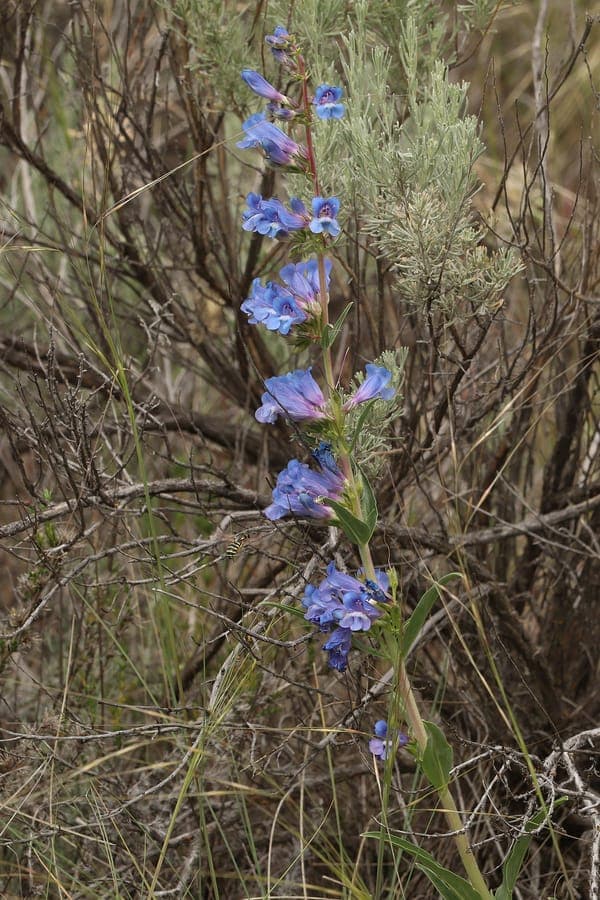
Walter Siegmund (talk) / CC BY-SA 4.0, via Wikimedia Commons
Royal penstemon: complete guide
Penstemon speciosus
Want to see Royal penstemon: complete guide in your garden?
1 minute, no credit card
Overview
Penstemon speciosus, known in English as Royal penstemon or Showy penstemon, is one of the most visually striking species in the large genus Penstemon. It was described in 1829 by the Scottish botanist and explorer David Douglas and belongs to the family Plantaginaceae. The species is native to the western United States, occurring in California, Oregon, Idaho, Nevada, Utah, and Washington, where it inhabits dry, rocky slopes, sandy terraces, and open sagebrush flats.
The botanical epithet speciosus - Latin for beautiful or showy - fully captures the character of this plant. Its large, deep cobalt-blue to light blue tubular flowers rival those of delphiniums or agapanthus in visual impact, yet require a fraction of the care. With a multiple-stem growth form, the plant presents a full, impressive silhouette in the garden. This combination of outstanding flower colour and low-maintenance reliability makes it a standout for contemporary garden designs.
At gardenworld.app, vivid blue flowers are among the most requested features in front garden and mixed border designs. Penstemon speciosus delivers that blue with remarkable ease and longevity, season after season.
Appearance and bloom cycle
Penstemon speciosus is an herbaceous perennial producing multiple sturdy stems that typically reach 30 to 80 cm in height depending on site conditions. Leaves are lance-shaped to elliptical, somewhat fleshy in texture, and green to blue-green in colour - a shade that harmonises beautifully with the intense blue flowers. Basal leaves are generally larger and broader than those higher on the stems.
The flowers are unmistakable: large, tubular, slightly inflated at the centre, with a widely spreading five-lobed mouth. Colour ranges from light blue through intense cobalt-blue to faint lavender, sometimes with faint purple guidelines in the throat. They appear in clusters along the upper portion of each stem and are sufficiently large and vivid to be noticed from a distance. The coarse leaf texture enhances the plant's robust, ornamental character.
Blooming occurs in late spring and early summer, broadly from May through July. In cooler years or higher positions the display may begin in June. After flowering, somewhat larger oval seed capsules form compared with most other penstemon species. The plant is a true perennial, re-emerging each spring from its root crown.
Ideal location
Penstemon speciosus demands full sun. A minimum of six hours of direct sunlight daily is necessary for strong flowering; more is better. In shade or dappled light, the plant flowers poorly and becomes drawn and susceptible to fungal problems.
In nature, this species occupies dry, open landscapes with rocky or sandy substrate, sometimes on gentle slopes or plateaus. In the garden it is ideal for a dry slope, raised bed, gravel garden, or rock garden. It suits modern, minimalist front garden designs with gravel groundcover and occasional bold perennials or subshrubs as focal plants.
Avoid damp, shaded, or still and humid corners. Good air circulation is important to prevent powdery mildew and other fungal disease.
Soil requirements
The key to long life for Penstemon speciosus is outstanding drainage. Preferred soil pH is 6.4 to 8.0, spanning from slightly acidic to mildly alkaline. The plant is native to poor, mineral-rich soils and is unaccustomed to heavily amended garden beds. Excessive nutrition produces lush but weak stems with fewer flowers.
Sandy, gravelly, or stony soil types are preferred. In heavy clay, substantial amendment is essential: mix coarse sand and grit thoroughly to a depth of at least 40 cm. In pots or containers, use a cactus or succulent compost mix supplemented with 30 percent extra perlite. A gravel or small stone mulch around the plant keeps the soil dry and warm.
Avoiding overly rich soil is as important as ensuring drainage: a fertiliser richer than N-P-K 5-5-5 is not recommended for this species.
Free design
Want to see Royal penstemon: complete guide in your garden? Make a free design now.
Watering
Penstemon speciosus is an emphatically drought-tolerant plant that, once well established, requires little to no supplementary watering. In the establishment year, water every two days for the first two to three weeks after planting to support root development. After that, switch to once per week in dry weather and once every two weeks in typical weather.
From the second year onwards, supplementary watering in an average Western European summer is barely necessary. Only during extreme drought lasting more than four weeks is a single deep watering worthwhile. When doing so, apply a generous amount directly to the root zone, then allow the soil to dry out completely before watering again.
Overwatering is the fastest way to lose P. speciosus. Wet feet during winter - when the plant is dormant - are especially damaging. Excellent winter drainage is therefore as important as summer drought tolerance.
Pruning
Royal penstemon requires minimal pruning. After blooming - late July or August - cut spent flower stems back to just above the basal leaf rosette. This encourages the formation of new lateral shoots and directs energy to root crown development for the following winter.
In early spring, around March, remove dead or frost-damaged stems. Important: never cut too deeply into living green tissue, as this weakens the plant. Heavy autumn pruning is not recommended, as the stems protect the crown through winter.
If seed propagation is desired, leave a few flower stems in place until the capsules are dry and brown. Seed can be sown directly outdoors in early spring or started indoors in late winter.
Maintenance calendar
January-February: Dormancy; leave stems in place to protect the crown. March: Check for frost damage; remove dead stems; leave green tissue undisturbed. April: New growth visible; remove weeds; no feeding needed. May: Flowering begins; enjoy the spectacular blue blooms; water only in extreme drought. June: Peak bloom; remove spent flower clusters to extend the display. July: Flowering ends; cut back flower stems; allow seed capsules to ripen if collecting seed. August-September: Plant replenishes energy; no pruning; minimal watering. October: Apply coarse gravel mulch around the crown for winter protection. November-December: Dormancy; no maintenance needed.
Winter hardiness
Penstemon speciosus is reasonably winter hardy but requires careful moisture management through winter. The species is native to areas with dry winters and is well adapted to a cold, dry rest period. In USDA hardiness zones 5 through 9 it survives outdoors in well-drained soil without difficulty.
In Western European gardens with wet winters, the main challenge is preventing moisture accumulation around the root crown. Ensure the ground around the plant slopes away and never retains standing water. A gravel or pebble mulch directly around the stem keeps the crown dry even during prolonged wet spells.
In cases of extreme cold (below -15 degrees Celsius), an additional protective layer of straw or pine needles is worthwhile. Container plants should be moved under cover or protected when temperatures drop below -10 degrees Celsius. Young, recently planted specimens are more vulnerable than established, mature plants.
Companion plants
Penstemon speciosus pairs magnificently with other drought-tolerant plants that share its preference for well-drained, sunny positions. Natural companions include the related P. roezlii and P. rydbergii, as well as lavender (Lavandula angustifolia), Russian sage (Salvia yangii, formerly Perovskia), ornamental sage (Salvia nemorosa), fleabane (Erigeron), and drought-tolerant flax (Linum).
For a cohesive blue colour palette, combine P. speciosus with Agastache, Veronica spicata, catmint (Nepeta), and globe thistle (Echinops ritro). Golden accents from Achillea 'Coronation Gold' or Helenium provide vivid colour contrast and extend the garden's interest across the full summer season.
Browse tailored planting combinations for your specific garden at gardenworld.app, including the ideal positioning and scale of Royal penstemon relative to other perennials and structural plants in your design.
Closing
Penstemon speciosus fully earns its name. With its large, vivid cobalt-blue flowers, coarse attractive foliage, and outstanding drought tolerance, it is a premier choice for sunny, dry gardens that must remain richly flowering and visually striking throughout the summer. Whether in a gravel garden, a dry border, or a rock garden, Royal penstemon consistently steals the show.
Seek out plants at specialist native plant nurseries or at larger garden centres in spring. Plant in April or May for best establishment before the flowering season. Given the right position and well-drained soil, P. speciosus will grace your garden with its unrivalled blue for many years to come.
Want to see Royal penstemon: complete guide in your garden? Make a free design now.
Upload a photo, pick a style, and get a photorealistic design with plant list in under a minute.
10,000+ gardens designed already
No credit card required


Similar plants
Roezl's penstemon: complete guide
Penstemon roezlii
Roezl's penstemon is a compact perennial with striking tubular flowers in purple-blue. Native to Oregon, California and Nevada; ideal for dry, sunny gardens.
Rydberg's beardtongue: complete guide
Penstemon rydbergii
Rydberg's beardtongue is a robust perennial with rich purple tubular flowers, native to mountain meadows across the western United States. Hardy and wildlife-friendly.