
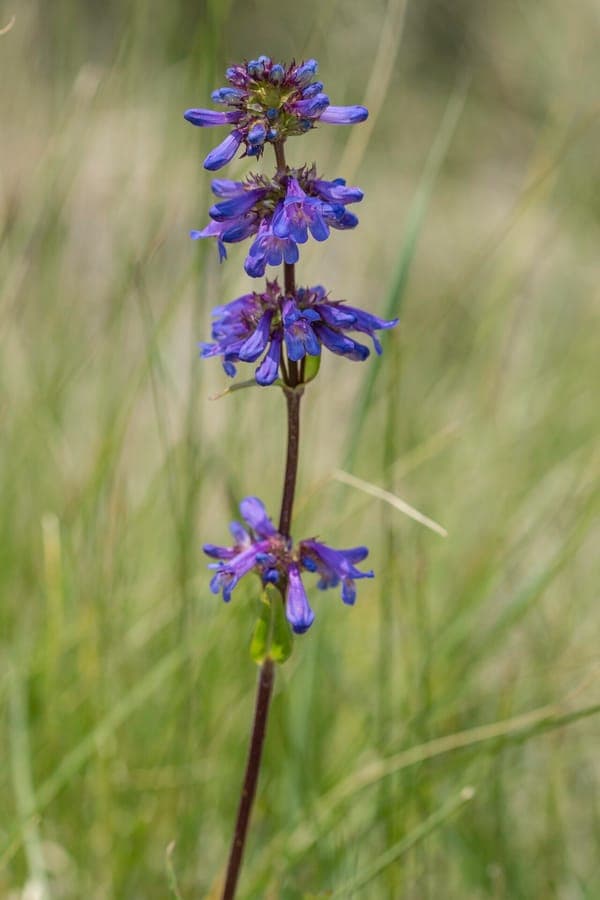
Craig Martin https://www.inaturalist.org/people/craigmartin / CC0, via Wikimedia Commons
Rydberg's beardtongue: complete guide
Penstemon rydbergii
Want to see Rydberg's beardtongue: complete guide in your garden?
1 minute, no credit card
Overview
Penstemon rydbergii, commonly known as Rydberg's beardtongue, meadow beardtongue, or Rydberg's penstemon, is a perennial forb and subshrub in the family Plantaginaceae. It was described by botanist A. Nelson in 1898 and named in honour of Per Axel Rydberg, the Swedish-American botanist who made major contributions to documenting the flora of western North America around the turn of the twentieth century. The species has a broad native range across the western United States, spanning from Arizona and New Mexico in the south to Montana, Wyoming, Idaho, and Washington in the north, with occurrences also in Colorado, Oregon, Nevada, and Utah.
This wide distribution reflects the species' adaptability: it grows in grasslands, mountain meadows, open forests, and along streambanks at elevations ranging from several hundred to over three thousand metres. In garden settings, Rydberg's beardtongue is valued for its robust beauty, richly coloured flowers, and meaningful contribution to biodiversity. At gardenworld.app, meadow-style and naturalistic garden designs frequently incorporate P. rydbergii as a reliable flowering component that supports bees, butterflies, and hummingbirds.
Appearance and bloom cycle
Penstemon rydbergii develops a bunch-forming clump with several upright stems typically reaching 30 to 70 cm in height, depending on growing conditions. Foliage is medium-textured, lance-shaped to elliptical, and green, arranged in opposite pairs along the stems as is characteristic of the Penstemon genus.
The flowers are tubular and slightly inflated, in a rich purple-blue to deep violet colour. They are arranged in several whorled clusters (verticillasters) along the upper portion of each stem, giving the plant a dense, abundantly flowering appearance. The staminode - the sterile fifth stamen that characterises the genus and gives beardtongues their common name - is clearly visible in the flower throat and is typically bearded with yellowish hairs.
Blooming occurs in summer, broadly from June through August. At higher elevations the display may not begin until July. Seed capsules are small and oval. After flowering, the stems remain decoratively in place for some time. The bunch-forming habit means clumps gradually become denser and more impressive with each passing year.
Ideal location
Rydberg's beardtongue thrives in full sun to lightly dappled shade. A minimum of five hours of direct sunlight daily is recommended for good flowering. Unlike many Penstemon species that favour dryer, more arid conditions, P. rydbergii naturally grows along streams, in moist mountain meadows, and in open mountain forest - making it somewhat more adaptable to moderate moisture.
This slightly broader moisture tolerance makes the species attractive for positions that other penstemons might find too damp - a lightly moist slope, an open spot at the edge of a woodland, or a naturalistic meadow planting. It fits beautifully in ecologically minded gardens that combine aesthetic appeal with habitat value for insects and birds.
Avoid extreme heat combined with prolonged drought. While P. rydbergii survives moderate dry periods, it performs best with some soil moisture retention, distinguishing it from more strictly xeric penstemon relatives.
Soil requirements
Penstemon rydbergii is somewhat less strictly drought-tolerant than many of its relatives and performs best in moderately moist to moderately dry soil with good drainage. The preferred pH range is 6.0 to 8.0 - the plant is thus quite tolerant of varying soil acidity levels. It grows on both sandy and loamy soils, but does not do well in heavy clay or waterlogged ground.
In gardens with heavier clay soils, improve drainage by working in compost and coarse gritty material before planting. A coarse gravel mulch around the plant helps regulate soil temperature and prevents excessive moisture retention around the crown. In pots and containers, use a free-draining but not bone-dry potting mix.
A light annual top-dressing of balanced slow-release fertiliser in early spring benefits the plant. However, excessive nitrogen leads to abundant lush foliage at the expense of flowering.
Free design
Want to see Rydberg's beardtongue: complete guide in your garden? Make a free design now.
Watering
Compared with other Penstemon species, P. rydbergii has a slightly higher moisture requirement, consistent with its natural preference for moist mountain meadows and streambanks. During the first year after planting, water regularly two to three times per week until the plant is well established.
From the second year onwards, supplementary watering in wet years is unnecessary, but in dry summers, watering once a week may be beneficial. Always water at the root zone and avoid wetting foliage in bright sunshine. Excessive waterlogging is harmful and can cause root rot.
In the temperate, wetter climates of Northern Europe, established plants in free-draining soil typically receive sufficient natural rainfall throughout the growing season without supplementary irrigation.
Pruning
Penstemon rydbergii requires minimal pruning. After flowering (August-September), cut spent flower stems back to the basal foliage. This encourages the development of fresh basal leaves and gives the plant a tidy look heading into autumn.
In early spring - around March - remove dead or frost-damaged stems. Avoid heavy pruning in autumn: the stems provide some overwintering protection for the plant itself and shelter for hibernating insects.
For seed propagation, leave some flower stems intact until the seed capsules ripen and dry out. Collect seeds and store in a cool, dry location for spring sowing at room temperature indoors. Young seedlings can be planted out after the last frost date.
Maintenance calendar
January-February: No maintenance; leave stems intact for overwintering insects. March: Remove dead or frost-damaged stems; do not cut into green living tissue. April: New growth emerging; add a light top-dressing of compost around the base if desired. May: Watch for slug damage on young shoots; water if April was unusually dry. June: Flowering begins; enjoy the rich purple blooms; no supplementary feeding needed. July: Peak bloom; remove spent flower spikes to extend the display. August: Flowering ends; cut back spent stems; leave seed stems if collecting seed. September: Resting phase; no pruning; check drainage is adequate. October: Apply a light protective layer of coarse gravel as winter mulch if needed. November-December: Dormancy, no maintenance required.
Winter hardiness
Penstemon rydbergii is highly winter hardy. Growing natively in mountain regions with severe winters - Montana, Wyoming, Idaho - the species tolerates temperatures down to -25 degrees Celsius or lower. It is suitable for USDA hardiness zones 4 through 9 in the open ground. In Western Europe, overwintering presents no difficulty under normal conditions.
As with other penstemons, the primary risk is not cold itself but the combination of frost with stagnant moisture. Always ensure good drainage. In wet gardens or in non-draining containers, root rot can develop even in light frost. A light protective mulch of straw or dry leaves is a sensible precaution for newly planted specimens in their first winter.
Established, well-rooted plants in Western Europe are virtually indestructible and return vigorously each year, even after hard winters.
Companion plants
Rydberg's beardtongue combines beautifully with a range of meadow and mountain plants. Fellow Penstemon species such as P. roezlii and P. speciosus are natural companions, each contributing a slightly different flower colour and preferred habitat. For a meadow effect, wild cranesbill (Geranium maculatum or G. pratense), yarrow (Achillea millefolium), harebells (Campanula rotundifolia), and goldenrod (Solidago canadensis) work excellently.
For insect-friendly combinations, blue vervain (Verbena hastata), purple loosestrife (Lythrum salicaria), common mallow (Malva sylvestris), and various Salvia species are suitable neighbours. In prairie-style borders, P. rydbergii pairs well with non-aggressive ornamental grasses that allow the flowers to show through.
Explore plant combinations for your specific garden at gardenworld.app, where you can visualise how Rydberg's beardtongue integrates into a biodiversity-focused or naturalistic planting scheme.
Closing
Rydberg's beardtongue is a powerhouse that asks little but delivers season after season. With its richly coloured purple flowers, broad winter hardiness, and wider habitat range compared to many other penstemons, it is one of the most versatile species of the genus for European gardens. It suits meadow and prairie borders, streamside plantings, woodland edges, and wildlife-friendly front gardens.
Look for plants at specialist native plant nurseries in spring. In the UK and mainland Europe, Penstemon species are available at larger garden centres and through mail-order nurseries. Plant in April or May so the plant has time to root in well before the summer flowering display begins.
Want to see Rydberg's beardtongue: complete guide in your garden? Make a free design now.
Upload a photo, pick a style, and get a photorealistic design with plant list in under a minute.
10,000+ gardens designed already
No credit card required


Similar plants
Roezl's penstemon: complete guide
Penstemon roezlii
Roezl's penstemon is a compact perennial with striking tubular flowers in purple-blue. Native to Oregon, California and Nevada; ideal for dry, sunny gardens.
Royal penstemon: complete guide
Penstemon speciosus
Royal penstemon is one of the most spectacular beardtongues, with large cobalt-blue tubular flowers. Native to the western US; thrives in dry, sunny gardens and borders.