
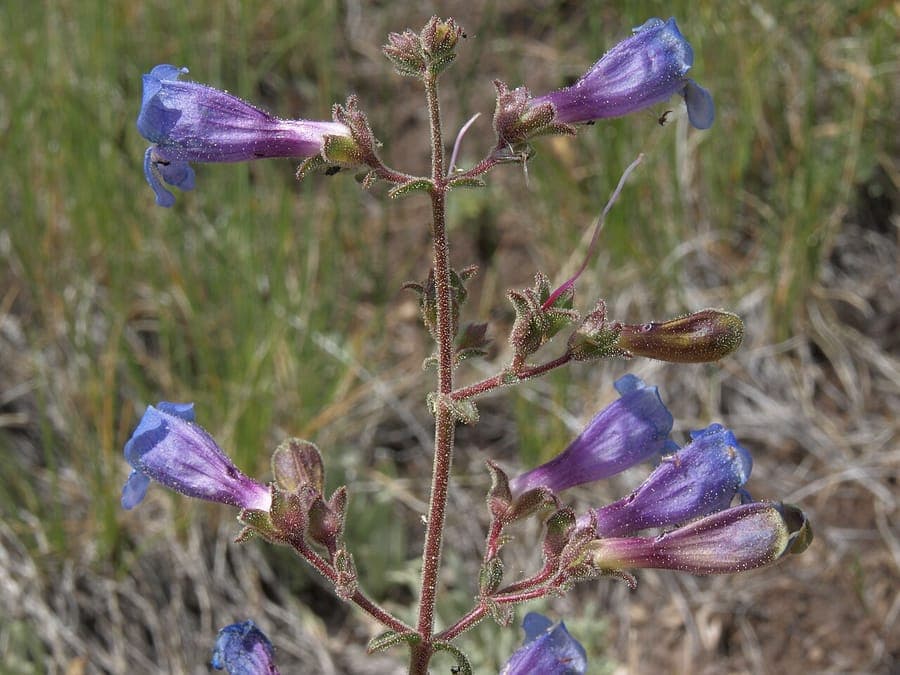
Jim Morefield from Nevada, USA / CC BY-SA 2.0, via Wikimedia Commons
Roezl's penstemon: complete guide
Penstemon roezlii
Want to see Roezl's penstemon: complete guide in your garden?
1 minute, no credit card
Overview
Penstemon roezlii, commonly known as Roezl's penstemon or Roezl's beardtongue, is a perennial herb and subshrub belonging to the family Plantaginaceae. It was formally described by the botanist Regel in 1872 and named in honour of Benedikt Roezl, the prolific Czech plant collector who gathered many specimens across North and Central America during the nineteenth century. The species grows natively in Oregon, northwestern California, and northwestern Nevada, where it inhabits open rocky slopes, dry hillsides, and open pine woodlands.
As a member of the large and diverse genus Penstemon - which encompasses more than 270 species across North America - P. roezlii exemplifies the characteristic traits of western beardtongues: tubular flowers designed for pollinators, moderate growth on lean soils, and strong adaptability to dry conditions. Its growth form is described as a single crown, growing as both a forb and a subshrub depending on conditions. This combination of visual appeal and ecological function makes it a valuable plant for naturalistic and water-wise garden designs.
At gardenworld.app, Penstemon species are regularly featured in drought-tolerant garden designs where their vivid flowers and low maintenance needs make them ideal choices for both front gardens and mixed borders.
Appearance and bloom cycle
Roezl's penstemon forms a compact clump with coarse-textured foliage. The leaves are lance-shaped to spatula-shaped, somewhat stiff and green, arranged in opposite pairs along the stems - a characteristic feature of the genus Penstemon. The foliage gives the plant an attractive, structured appearance even outside the flowering period.
Flowers appear on upright flowering stems and are characteristically tubular, slightly inflated in the middle, with five spreading lobes at the opening. In P. roezlii, the flowers are purple-blue to violet, sometimes with purple guidelines or streaks inside the throat. The staminode - the distinctive sterile fifth stamen that gives beardtongues their common name - is clearly visible in the flower throat.
Blooming occurs in late spring and early summer, roughly from May through July depending on location and season conditions. After flowering, small oval seed capsules develop. Plants grow at a moderate rate and gradually form dense, spreading clumps that fill their allotted space attractively.
Ideal location
Penstemon roezlii thrives in full sun to lightly dappled shade. A minimum of five to six hours of direct sunlight daily is recommended for strong flowering and a compact growth habit. In excessive shade, plants become leggy and bloom less freely.
In its native range, this species grows on open hillsides and clearings in pine forest, surrounded by rocks and gravel. In the garden, these conditions can be replicated by placing the plant on a raised bed, dry slope, or rock garden. It also suits gravel gardens and naturalistically designed front gardens, pairing attractively with other western North American natives and Mediterranean-style plantings.
Avoid spots where water can pool or stand. Wet feet are very damaging to penstemon, especially through winter. A free-draining corner facing south or southwest is ideal.
Soil requirements
The key to success with Penstemon roezlii is well-drained, moderately lean soil. Ideal pH ranges from 6.0 to 7.6, spanning slightly acidic to mildly alkaline. The plant tolerates poor soils well and does not require rich, well-fertilised ground - in fact, overly fertile soil tends to produce lush but weak, less floriferous plants.
Sandy or gravelly soils are perfect. Heavy clay soils need significant amendment with coarse sand and grit. When planting, incorporate a generous layer of free-draining material beneath the root ball. In containers, use a dry, free-draining mix - ideally combined with perlite or coarse sand in a ratio of 1:1.
A gravel mulch around the base of the plant helps stabilise soil temperature, retain a modest amount of moisture in summer without waterlogging, and provides some protection in harsh winters.
Free design
Want to see Roezl's penstemon: complete guide in your garden? Make a free design now.
Watering
Once properly established, Penstemon roezlii is an excellent drought-tolerant plant. During the establishment year - the first season after planting - regular watering is important until the plant has rooted in well. Water two to three times per week, but allow the soil to dry out thoroughly between sessions.
From the second year onwards, supplementary watering in typical summers is scarcely necessary. Only during prolonged dry spells lasting more than three weeks is additional irrigation worthwhile. When watering, avoid midday sun and direct the water to the root zone rather than onto the foliage. Overwatering is the most common mistake and leads directly to root rot.
In the cooler, wetter climate of Northern Europe, established plants in free-draining soil can typically survive a normal summer without supplementary water.
Pruning
Penstemon roezlii requires little maintenance pruning, but a light annual trim keeps the plant compact and vigorous. After flowering, cut the spent flower stems back to just above the basal foliage. This encourages new shoot development and maintains a tidy appearance.
In early spring - around March - remove any dead or frost-damaged stems. Never cut too hard into living green wood; this can damage or weaken the plant. Heavy autumn pruning is not recommended, as the stems provide some protection against frost build-up through winter.
If you wish to collect seed for propagation, leave some flower stems intact until the seed capsules ripen and dry. Remove them afterward and store seeds in a cool, dry place for spring sowing.
Maintenance calendar
January-February: No maintenance required; keep protective mulch intact. March: Check for frost damage, remove dead stems; avoid cutting into living wood. April: New growth visible; give the plant space, remove surrounding weeds. May: Start of bloom; enjoy the first blue flowers; water only during sustained drought. June: Full bloom; remove spent flowers to extend the display. July: End of flowering; cut back flower stems after bloom. August-September: Plant conserves energy for winter; no pruning, minimal watering. October: Apply a layer of coarse gravel as winter mulch. November-December: Dormancy, no maintenance needed.
Winter hardiness
Penstemon roezlii is reasonably winter hardy. Native to areas with cold winters, the species tolerates moderate frost well. In USDA hardiness zones 6 and above, plants typically survive outdoors without difficulty. In zone 5 and below, some protection is advisable - a thick mulch of dry leaves or coarse gravel over the root zone works well.
The primary risk in wet temperate climates is not cold alone but the combination of frost and persistent moisture. Always ensure excellent drainage; a cold but dry, frozen soil is far less damaging to P. roezlii than cold, waterlogged clay. Container-grown plants are best moved to a sheltered spot when temperatures drop below -10 degrees Celsius, or protected with horticultural fleece.
Companion plants
Roezl's penstemon pairs beautifully with other drought-tolerant perennials and subshrubs. Other Penstemon species such as P. speciosus and P. rydbergii are natural companions, each offering its own flower colour and texture. Lavender (Lavandula angustifolia), thyme (Thymus), ornamental sage (Salvia nemorosa), catmint (Nepeta) and tall verbena (Verbena bonariensis) are equally suitable neighbours.
For a naturalistic planting with western North American natives, combine P. roezlii with Artemisia, Eriogonum, Phlox, or Zauschneria. In gravel and rock gardens, saxifrage (Saxifraga) and stonecrops (Sedum) fill the gaps between clumps beautifully and complement the fine-textured flowers of the penstemon.
Visit gardenworld.app to visualise how Roezl's penstemon might look in your specific garden, with combinations tailored to your planting style and available space.
Closing
Roezl's penstemon is an elegant and underappreciated perennial that excels in dry, sunny gardens. Its beautiful blue-to-purple flowers, modest maintenance requirements, and drought tolerance make it a sustainable and ecologically responsible choice. It suits gravel gardens, rock gardens, dry slopes, and prairie-style borders, while attracting butterflies, bees, and hummingbird moths.
With a little attention to soil drainage and sun exposure, P. roezlii will reward you for years. Look for plants at specialist native plant nurseries and garden centres in spring, when penstemon species are most widely available. Plant early to enjoy the May-to-July flowering display at its most spectacular.
Want to see Roezl's penstemon: complete guide in your garden? Make a free design now.
Upload a photo, pick a style, and get a photorealistic design with plant list in under a minute.
10,000+ gardens designed already
No credit card required


Similar plants
Rydberg's beardtongue: complete guide
Penstemon rydbergii
Rydberg's beardtongue is a robust perennial with rich purple tubular flowers, native to mountain meadows across the western United States. Hardy and wildlife-friendly.
Royal penstemon: complete guide
Penstemon speciosus
Royal penstemon is one of the most spectacular beardtongues, with large cobalt-blue tubular flowers. Native to the western US; thrives in dry, sunny gardens and borders.