Kurt Stüber [1] / CC BY-SA 3.0, via Wikimedia Commons
Pineleaf penstemon (Penstemon pinifolius): complete guide
Penstemon pinifolius
Want to see Pineleaf penstemon (Penstemon pinifolius): complete guide in your garden?
Full design in HD: €7.99
Look after your Pineleaf penstemon with the GardenWorld app
Identify plants with your camera and get a care calendar with reminders for this plant.


Overview
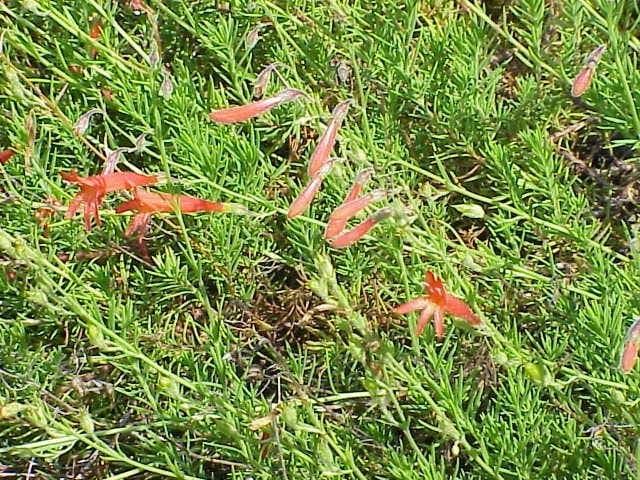
Pineleaf penstemon (Penstemon pinifolius) is a small evergreen beardtongue whose foliage looks remarkably like a tuft of pine needles. It forms a dense, bright green cushion, and from early summer onwards slender scarlet to orange tubular flowers rise just above it. It is one of the most garden-worthy of the dwarf penstemons and holds the Royal Horticultural Society's Award of Garden Merit, which tells you it copes well with a British and north-west European climate when it is sited properly.
In the wild it grows in south-western New Mexico, south-eastern Arizona and northern Mexico, on rocky slopes and in gritty mountain soils. Summers there are warm, winters are cold but largely dry, and water drains away almost as soon as it falls. Those are the conditions to recreate in the garden. Give it sun, grit and a dry winter, and Penstemon pinifolius rewards you with a neat, long-lived mound that looks tidy in every season.
Plants reach 20 to 40 cm in height and spread to 30 to 50 cm. Several selections are available: 'Mersea Yellow' has clear yellow flowers, 'Wisley Flame' is a vivid orange-red, and 'Compactum' stays even lower and tighter, making it ideal for troughs and small rock gardens.
Appearance and bloom cycle
Penstemon pinifolius is a sub-shrub with a slightly woody base. Numerous thin stems grow from that base, each densely clothed in needle-like leaves 1 to 3 cm long. They are arranged in little clusters along the stem, so up close the plant resembles a young conifer or a heather more than a typical penstemon. The foliage stays green all winter, though hard frost can tint it bronze.
Flowering starts in June and carries on into August, and in a warm year you may get a second flush in September. Each bloom is a narrow tube 2.5 to 3.5 cm long, scarlet to orange-red, opening into a small two-lipped mouth. Inside the throat sits a yellow, hairy staminode, the sterile stamen that earned the genus the name beardtongue. The flowers are carried loosely on short stems, a few at a time, rather than in dense spikes.
In its native range hummingbirds are the main pollinators. In European gardens bumblebees visit regularly, and bee-flies and butterflies call in too. The display is never as loud as that of the big border penstemons, but it lasts for weeks, and the fine texture of the plant earns its place long after the last flower has dropped.
Ideal location
Plant pineleaf penstemon in full sun. The warmer and brighter the spot, the more freely it flowers and the more compact it stays. In partial shade growth becomes loose, flowering is sparse and the foliage stays damp for longer, which invites fungal problems.
Good positions include a south-facing rock garden, the top of a dry-stone wall, a gravel garden, the edge of a raised bed or a stone trough. It also does well in a generous pot filled with a gritty, mineral mix, as long as the pot does not sit in winter rain. Wind is no problem at all; an airy site keeps the needles dry. Avoid planting beneath overhanging shrubs, where fallen leaves settle on the cushion and trap moisture. For a carpet effect, space plants 30 to 40 cm apart.
Soil requirements
Soil decides whether this plant lives for years or vanishes after its first winter. It needs ground that drains quickly and thoroughly: sandy, gritty or stony, and lean rather than rich. On heavy clay, or in soil that stays wet in winter, the roots rot, even though the plant is perfectly frost hardy in itself.
On heavier soils work plenty of coarse grit or gravel into the top 30 cm, or plant on a mound or in a raised bed so excess water can escape. pH is not critical; neutral to slightly alkaline soil is ideal, and slightly acidic sandy soil is fine too. Do not add compost or manure, because rich soil produces soft, leggy growth and shortens the plant's life. A mulch of gravel or stone chippings around the base keeps the crown dry and stops rain splashing soil onto the foliage.
Free preview
Want to see Pineleaf penstemon (Penstemon pinifolius): complete guide in your garden? Make a free preview of your design.
Watering
During the first growing season after planting, water once a week in dry spells until the roots have reached deep into the soil. Always let the ground dry out between waterings. Once established, the plant rarely needs extra water in a north-west European summer; only during a long, hot drought of several weeks should you give it a thorough soak.
Never water plants in open ground during winter. In containers, check every few days in summer, but again allow the top layer to dry first. Overwatering is by far the most common reason this penstemon fails in gardens, much more often than drought or cold. Always water at the base rather than over the foliage.
Pruning
Pruning is light work. After the first flush of flowers, cut the spent stems back to just above the leafy cushion. This keeps the plant neat and, in a warm summer, can encourage a smaller second flush.
In spring, around mid-April when the hardest frosts have passed, remove any dead twigs or winter-browned growth and give a gentle trim to shape. Never cut deep into old, bare wood, as the plant is slow to reshoot from it. If an older plant becomes bare in the middle after five to seven years, it is better to replace it with a young one. Propagation is easy: in summer take 5 cm cuttings from non-flowering tips and root them in a gritty mix. Seed is another option, but it needs a period of cold before it will germinate.
Maintenance calendar
March: Check how the cushion has come through the winter. Clear away any tree leaves lying on the plant.
April: Light trim and removal of dead twigs. A good month for planting, with grit worked into and spread over the planting hole.
May: Active growth and bud formation. Water young plants in dry weather; feeding is unnecessary.
June to August: Main flowering season. Remove spent stems. Take cuttings from non-flowering shoots.
September: Possible second flush. You can still plant on free-draining soil so the roots establish before winter.
October and November: Refresh the gravel mulch around the crown. Move pots under cover or against a dry wall.
December to February: Dormancy. Leave the plant alone, apart from gently brushing off heavy snow or wet leaves.
To keep these jobs on track, add the plant to the planting calendar on gardenworld.app and you will get a reminder for pruning and planting at the right moment.
Winter hardiness
In its home range Penstemon pinifolius is used to harsh but dry winters. On free-draining soil it survives down to roughly -20 °C in our region, and lower still in a dry continental climate. Here the real danger is not cold but winter wet: water lingering around the crown combined with frost does far more damage than a few bitter nights.
So always plant in a dry, sunny spot with grit around the base. In containers the plant is more vulnerable, because the whole rootball can freeze solid; stand pots against a house wall under an overhang and wrap them in hessian or bubble wrap. A loose layer of conifer branches over the cushion helps during prolonged frost below -15 °C without snow cover.
Toxicity: pineleaf penstemon is not known to be toxic to people or pets. As with any ornamental plant, it is still sensible not to eat it and to discourage children and animals from chewing it.
Companion plants
Penstemon pinifolius suits plants that enjoy the same dry, lean conditions. Houseleeks (Sempervivum tectorum) are a classic partner, their tight rosettes contrasting beautifully with the fine needles. Hardy ice plant (Delosperma cooperi) adds vivid pink at the same time of year, and the blue-grey donkey-tail spurge (Euphorbia myrsinites) provides a cool foil to the bright green all year round.
Sulphur flower (Eriogonum umbellatum), another mountain plant from western North America, shares its need for sun and drainage and carries yellow flowers above a mat of grey leaves. Thyme, low sedums, small grasses such as blue fescue and dwarf irises also make good neighbours. Avoid lush border plants that need plenty of water: they will shade the cushion and keep the soil too damp.
Final thoughts
Pineleaf penstemon is a plant for gardeners who appreciate fine detail: a green, needled cushion that looks good all year, topped for weeks in summer with elegant orange-red trumpets that bumblebees love. Sun, grit and dry feet in winter are all it asks for.
If you are looking for the right spot for it in a rock garden or gravel bed, you can have a garden design made on gardenworld.app that takes your soil and the aspect of your garden into account.
Frequently asked questions about Pineleaf penstemon
Is Pineleaf penstemon winter hardy?
In its home range Penstemon pinifolius is used to harsh but dry winters. On free-draining soil it survives down to roughly -20 °C in our region, and lower still in a dry continental climate.
When and how do you prune Pineleaf penstemon?
Pruning is light work. After the first flush of flowers, cut the spent stems back to just above the leafy cushion.
How much water does Pineleaf penstemon need?
During the first growing season after planting, water once a week in dry spells until the roots have reached deep into the soil. Always let the ground dry out between waterings.
Where does Pineleaf penstemon grow best?
Plant pineleaf penstemon in full sun. The warmer and brighter the spot, the more freely it flowers and the more compact it stays.
What soil does Pineleaf penstemon need?
Soil decides whether this plant lives for years or vanishes after its first winter. It needs ground that drains quickly and thoroughly: sandy, gritty or stony, and lean rather than rich.

See it in your garden
See Pineleaf penstemon in your garden
One photo of your garden and a few questions. You see the result in about a minute.
Try it with a photoIdentify this plant in your own garden. Identify a plant
Similar plants
Houseleek: complete guide
Sempervivum tectorum
Houseleek is the classic succulent for roofs and rock gardens - hardy, drought-tolerant, and maintenance-free. Learn cultivation, propagation, and care.
Delosperma cooperi: complete guide
Delosperma cooperi
Discover Delosperma cooperi, a hardy iceplant with rosy-magenta blooms. Full growing guide for this drought-tolerant succulent in your garden.
Blue spurge: complete guide
Euphorbia myrsinites
Blue spurge (Euphorbia myrsinites) is an elegant low-growing groundcover with glaucous blue-green foliage and bright yellow-green blooms.
