
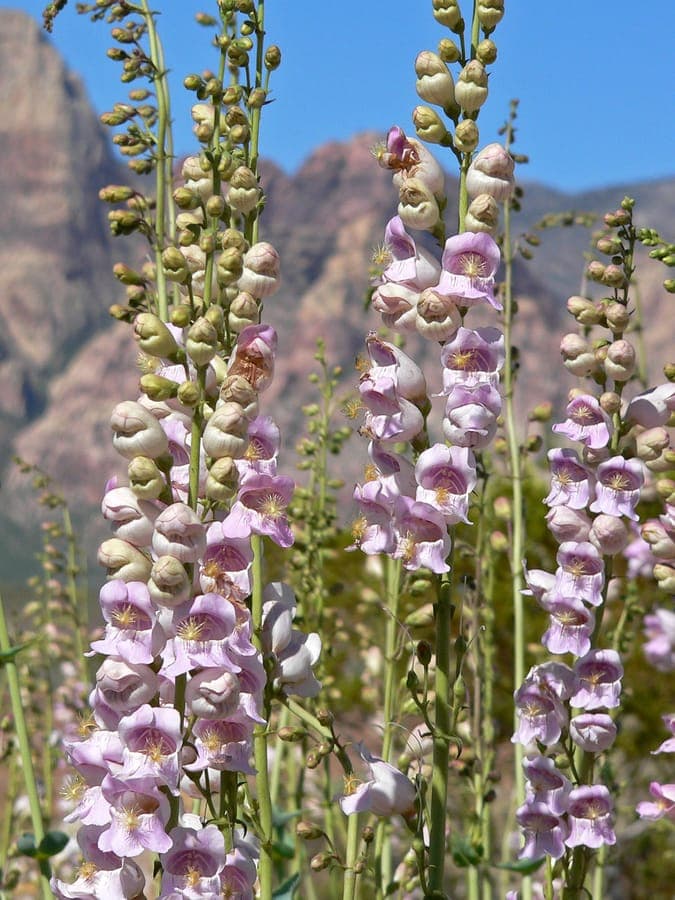
Stan Shebs / CC BY-SA 3.0, via Wikimedia Commons
Palmer's penstemon: complete guide
Penstemon palmeri
Want to see Palmer's penstemon: complete guide in your garden?
1 minute, no credit card
Overview
Penstemon palmeri, commonly known as Palmer's penstemon or Palmer's beardtongue, is one of the most distinctive members of the genus Penstemon, belonging to the family Plantaginaceae. Described by botanist A. Gray in 1868 and named for the American botanist and explorer Edward Palmer, this species is native to Arizona, California, Nevada, New Mexico and Utah, with introduced populations in Colorado, Idaho, Washington and Wyoming. In its natural habitat it grows on dry rocky slopes, limestone outcrops, roadsides and gravelly flats across the hot, arid landscapes of the American Southwest.
Palmer's penstemon stands out in the genus for two exceptional qualities: it is the largest-growing species and the only one to produce strongly fragrant flowers. The sweet, vanilla-like scent carries across a garden and draws hummingbirds, butterflies and bees from considerable distances. In garden settings it serves as a tall accent plant in dry borders, roadside plantings and prairie-style schemes. On gardenworld.app you can find garden designs where tall, fragrant perennials like this one create striking vertical focal points in dry summer borders.
Appearance and bloom cycle
Penstemon palmeri is an imposing plant in every respect. Flowering stems reach 60 to 150 cm in height, producing a dramatic column of blooms above glaucous blue-green foliage. The leaves are notably large for a penstemon: basal leaves are broad lance- to oval-shaped, while stem leaves are narrower and clasp the stem at their base - a feature useful for field identification. The grey-green, slightly waxy leaf surface reduces water loss, a classic adaptation to arid conditions.
Flowers open from May through August. Each bloom is large - up to 3.5 cm long - tubular and prominently two-lipped, in pale lavender to nearly white with purple nectar guides on the lower lip. The scent is strongest in the afternoon warmth. The staminode bears a long brush of yellow hairs typical of the genus. Each stem carries dozens of flowers in successive false whorls, so the display on any single stem lasts several weeks. After flowering, sturdy seed capsules develop and persist through autumn and winter.
Ideal location
Full sun is non-negotiable for Palmer's penstemon. In its native Mojave and Sonoran Desert habitat it endures intense heat and direct solar radiation. In the garden, choose a south- or west-facing position with at least 7 hours of direct sun per day. In cooler regions a sheltered spot against a south-facing wall provides useful warmth, but the plant always needs open light and good air movement.
Penstemon palmeri excels as a statement plant at the back of a dry border, along a sunny driveway or as the centrepiece of a xeriscape planting scheme. At its full height it bridges the gap between low border perennials and shrubs, providing strong vertical structure. Space plants 60 to 80 cm apart to allow airflow and prevent fungal problems. In regions with cool, humid summers, the warmest, most sheltered spot in the garden is the right choice.
Soil
Free-draining, neutral to alkaline soil suits Palmer's penstemon best, though it is remarkably adaptable across a pH range of 6.0 to 7.9. In its native range it often grows on calcareous, highly alkaline rocky soil - a pH of 7.5 to 7.9 is close to optimal. Chalky or lime-rich soils in European gardens are therefore an advantage rather than a problem.
The single firm requirement is good drainage. Heavy clay must be thoroughly amended with coarse grit or sharp sand before planting. A raised bed or elevated planting position in a border always gives the best results. Do not add nitrogen-rich fertiliser: on lean, dry soil the plant produces sturdy stems and abundant flowers; on rich soil it grows too lush and flops over.
Free design
Want to see Palmer's penstemon: complete guide in your garden? Make a free design now.
Watering
Once established, Palmer's penstemon is among the most drought-tolerant penstemons available. Mature plants survive extended dry periods thanks to a deep taproot that accesses moisture from lower soil layers. In the first growing season after planting, water every 7 to 10 days; from the second year onwards, supplementary watering is only useful during droughts lasting more than three weeks.
Moderate summer heat and dryness are normal conditions for this plant, not stress. Overwatering causes problems more rapidly than for most other penstemons: the large leaves transpire heavily and roots sitting in wet soil deteriorate quickly. Avoid overhead irrigation on the rosette. If supplementary water is needed, drip irrigation or a soaker hose directed at the base is the safest approach.
Pruning
After the first flowering flush - typically in June or July depending on climate - cut spent stems back to about one third of their height to encourage re-growth and a second bloom later in summer. Use clean, sharp secateurs or long-handled loppers for taller stems, cutting just above a leaf node or lateral shoot.
In autumn, once frost has killed the stems back, cut dead material down to 15 to 20 cm above ground. Leave the seed capsules standing into late autumn to supply food for finches and sparrows, and to allow self-seeding into nearby bare soil. The upright dried stems provide attractive winter silhouette in the border. In early March, remove the remaining stumps before new growth pushes through.
Maintenance calendar
January to February: dormant, no action needed. March: remove last year's dead stems; lightly loosen soil around the crown. April: new shoots appear; refresh grit mulch if needed. May to August: peak flowering; water only in prolonged drought. July: first trim after flowering to stimulate a second flush. August to September: second bloom possible; allow seed to ripen. October: harvest seed for sowing or propagation. November: cut stems to 15 cm, tidy the bed. December: no action.
Winter hardiness
Penstemon palmeri is hardy in USDA zones 4 to 9, making it one of the hardier large penstemons. In temperate European climates it survives reliably when planted in well-drained soil. On heavy or wet soils, losses can occur during hard winters.
In zones 4 and 5, a dry leaf or straw mulch over the crown in late November provides useful extra protection. In the milder coastal zones of north-western Europe (typically zone 7 to 8), Palmer's penstemon overwinters without extra cover on free-draining ground. After a mild winter, new growth is visible as early as March.
Companion plants
Thanks to its considerable height and pale lavender-white flowers, Penstemon palmeri acts as a calm, elegant companion to more vividly coloured perennials. Pair it with warm orange-yellow Rudbeckia fulgida, deep red Echinacea purpurea cultivars, the blue of Salvia azurea or the purple spires of Verbena bonariensis. Low-growing neighbours such as Nepeta x faassenii, Achillea millefolium or lavender form a carpet from which the tall stems rise like candles.
In a naturalistic border it combines beautifully with Eryngium planum, Echinops ritro and Liatris spicata - all sharing the same preference for lean, sunny, well-drained conditions. Look for Palmer's penstemon at specialist perennial nurseries and well-stocked garden centres. On gardenworld.app you can get a tailored planting plan that positions tall accent plants like this one within a dry summer border for maximum visual impact across the whole season.
Closing
Penstemon palmeri is a rare and rewarding combination of scale, scent and drought tolerance. Few perennials reach 150 cm while thriving on minimal water and demanding almost no maintenance after the first year. The pale lavender flowers, the vanilla fragrance and the long bloom season make it an outstanding choice for dry borders, gravel gardens and any planting scheme designed to look spectacular in a warm, sunny summer with little irrigation. Give it the sunniest, driest spot in your garden and it will earn its place every season.
Want to see Palmer's penstemon: complete guide in your garden? Make a free design now.
Upload a photo, pick a style, and get a photorealistic design with plant list in under a minute.
10,000+ gardens designed already
No credit card required


Similar plants
Mountain blue penstemon: complete guide
Penstemon laetus
Full care guide for Penstemon laetus, the mountain blue penstemon from California and Oregon. Planting, watering, pruning and garden design tips.
Mountain pride penstemon: complete guide
Penstemon newberryi
Full guide to Penstemon newberryi, the mountain pride beardtongue. Rock garden care, planting, watering, pruning and companion plant ideas.