
Stickpen / CC0, via Wikimedia Commons
Mountain blue penstemon: complete guide
Penstemon laetus
Want to see Mountain blue penstemon: complete guide in your garden?
1 minute, no credit card
Overview
Penstemon laetus, commonly known as mountain blue penstemon or gay penstemon, is a striking perennial belonging to the family Plantaginaceae. First described by botanist A. Gray in 1859 from specimens collected in northern and central California, this species has a natural range spanning California and Oregon, where it grows on dry slopes, open woodlands and rocky mountain terrain from low elevations up to the subalpine zone.
The species epithet "laetus" is Latin for "joyful" or "cheerful", a fitting reference to the bright blue to blue-purple flower colour that lights up rocky hillsides from spring through early summer. In garden settings, Penstemon laetus is prized for its low maintenance requirements, its ability to thrive on little water once established and its strong appeal to pollinators including bumblebees, butterflies and hummingbirds. On gardenworld.app you can explore garden design ideas built around drought-tolerant perennials like this one.
Appearance and bloom cycle
Penstemon laetus forms erect, slightly branching stems reaching 30 to 70 cm in height. Growth originates from a single basal crown, from which multiple flowering stems emerge each spring. The basal leaves are lance- to spoon-shaped, somewhat coarse in texture and deep green. Stem leaves are narrower and arranged in opposite pairs up the length of the flowering stalk.
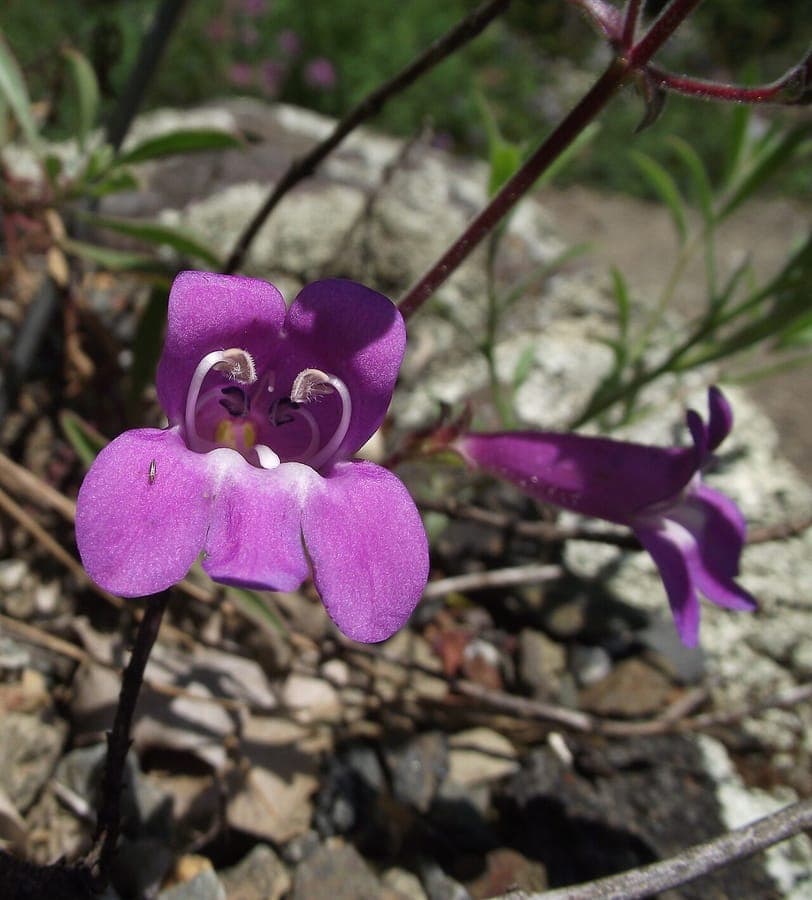
Flowers open from April through July, with timing shifting later at higher elevations and in cooler climates. Each bloom is tubular and slightly two-lipped, ranging from clear mid-blue to blue-purple. Inside the corolla tube, the sterile fifth stamen - the staminode - carries a characteristic tuft of beard-like hairs that gives the whole genus its English name "beardtongue". Each flowering raceme carries dozens of blooms arranged in false whorls. After flowering, dry seed capsules form along the stems and persist well into winter, providing food for small birds.
Ideal location
This penstemon performs best in full sun to very lightly dappled shade. In the wild it colonises open, sun-baked slopes and rocky outcrops where sunlight is unobstructed for most of the day. In the garden, a south- or west-facing position with at least 6 hours of direct sun is ideal.
Penstemon laetus is particularly well suited to rock gardens, gravel gardens, dry slopes and xeric borders. It works well alongside larger ornamental stones and thrives in the pockets between rocks where drainage is sharp. Avoid sites with waterlogging, heavy shade or root competition from large trees. Plants can be spaced 40 to 50 cm apart to allow good air circulation and prevent fungal problems.
Soil
Good drainage is the non-negotiable requirement for Penstemon laetus. The species tolerates a soil pH between 6.0 and 7.6 and adapts to sandy, loamy or rocky substrates. Heavy clay must be amended with coarse grit, perlite or sharp sand before planting to ensure rapid water movement through the root zone.
Avoid adding rich compost or fertiliser at planting time: overly fertile soil produces lush, soft growth that is more susceptible to crown rot and tends to flop over. Lean, well-drained soil encourages compact, strong stems and more abundant flowering. A thin layer of coarse gravel mulch around the base of the plant helps moderate soil temperature in summer without retaining excessive moisture.
Free design
Want to see Mountain blue penstemon: complete guide in your garden? Make a free design now.
Watering
Once established, Penstemon laetus is notably drought tolerant. Mature plants can endure weeks without rainfall thanks to a deep, far-reaching root system. During the first growing season after planting, regular watering is essential to help roots settle: water deeply every 7 to 10 days and allow the soil to dry out fully between sessions.
From the second year onwards, supplementary watering is only beneficial during prolonged dry spells lasting more than three weeks. Excessive moisture, especially during summer, raises the risk of crown and root rot. Avoid overhead irrigation in the evening. If supplementary water is needed, drip irrigation or soaker hoses directed at the root zone are the safest options.
Pruning
Once flowering finishes - typically in July - you can cut spent stems back by half to encourage a tidy, compact habit and sometimes trigger a modest second flush of blooms. Use clean, sharp secateurs and cut just above a leaf pair.
In autumn, once hard frosts have killed the stems back, you can trim the dead material to about 10 cm above the ground. Alternatively, leave the stems standing until late winter: the dried seed capsules supply food for finches and other small birds, and the upright silhouette adds winter structure to the border. In late February or early March, remove the old growth before new shoots push through.
Maintenance calendar
January to February: dormant, no action needed. Late February to March: cut away last year's dead stems and lightly loosen soil around the crown. April: watch for new shoots; apply a thin layer of grit mulch if desired. May to July: peak flowering; water only in extreme drought. July to August: cut back spent flower spikes. September: collect seed for propagation or allow self-seeding. October to November: prepare for winter - add a light layer of dry leaves over the crown in exposed positions. December: no intervention needed.
Winter hardiness
Penstemon laetus is hardy in USDA zones 5 to 9. In zones 5 and 6, very hard winters below -20 degrees Celsius can damage the crown, particularly on sites with poor winter drainage. A light covering of dry leaves or pine boughs placed over the crown in November provides useful extra insulation. The greatest threat is not cold alone but the combination of cold and wet soil: waterlogged clay in winter kills more plants than hard frost on well-drained ground.
In mild coastal zones 8 and 9, the foliage can remain semi-evergreen through winter and the plant bounces back quickly after mild winters.
Companion plants
The blue tones of Penstemon laetus pair beautifully with warm-coloured perennials. Consider combining it with orange Helenium cultivars, russet Heuchera selections, yellow Coreopsis and the pale gold flowers of Achillea filipendulina. In a prairie-style border it sits naturally alongside Salvia nemorosa, Nepeta x faassenii and fine-textured clumping grasses such as Festuca glauca or Stipa tenuissima.
For a rock garden, the combination with Armeria maritima, Dianthus deltoides and Sedum species is particularly effective. In a wilder naturalistic planting, Penstemon laetus works well next to Erigeron speciosus and Gaillardia. UK and European garden centres increasingly stock specialist penstemon varieties; look for named cultivars at specialist perennial nurseries. On gardenworld.app, you can get a personalised planting plan that pairs drought-tolerant perennials for maximum season-long interest.
Closing
Penstemon laetus is an underrated gem for sunny, dry gardens. Its vivid blue flowers, reliable drought tolerance and strong appeal to pollinators make it a worthy choice for any gardener aiming to reduce water use while boosting biodiversity. Seek it out at specialist perennial nurseries or well-stocked garden centres and give it a bright, well-drained position to see it at its best.
Want to see Mountain blue penstemon: complete guide in your garden? Make a free design now.
Upload a photo, pick a style, and get a photorealistic design with plant list in under a minute.
10,000+ gardens designed already
No credit card required


Similar plants
Mountain pride penstemon: complete guide
Penstemon newberryi
Full guide to Penstemon newberryi, the mountain pride beardtongue. Rock garden care, planting, watering, pruning and companion plant ideas.
Palmer's penstemon: complete guide
Penstemon palmeri
Full guide to Penstemon palmeri, the fragrant tall beardtongue of the American Southwest. Planting, care, pruning and companion plant ideas.