
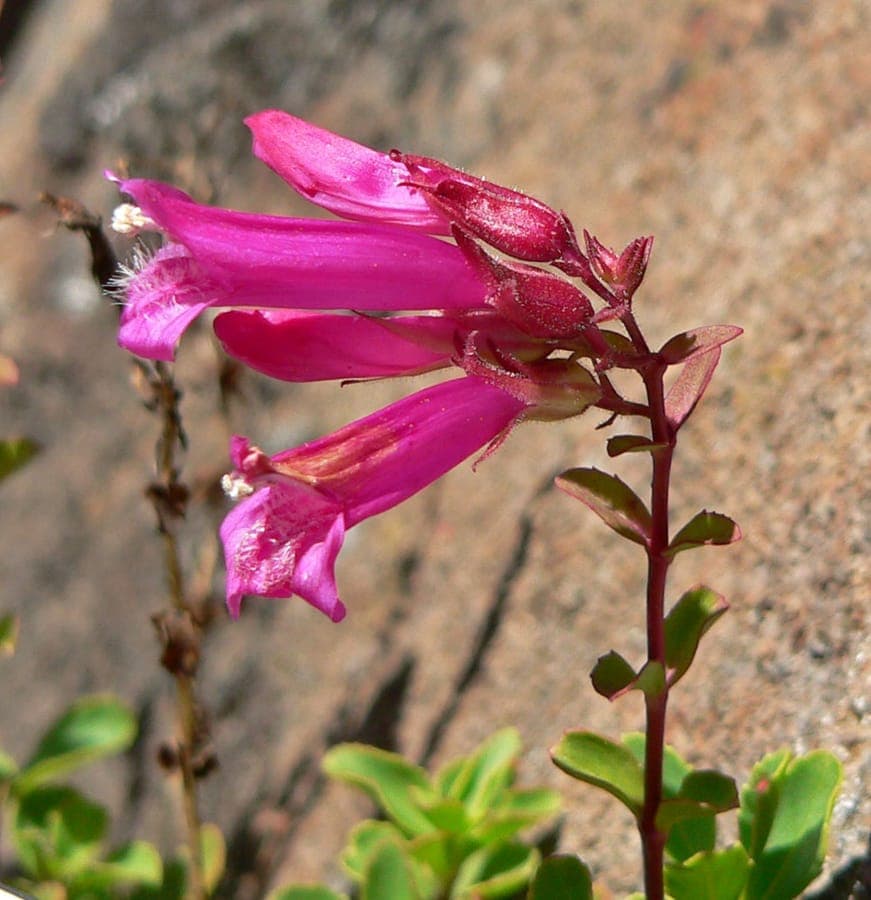
Stan Shebs / CC BY-SA 3.0, via Wikimedia Commons
Mountain pride penstemon: complete guide
Penstemon newberryi
Want to see Mountain pride penstemon: complete guide in your garden?
1 minute, no credit card
Overview
Penstemon newberryi, commonly called mountain pride or Newberry's beardtongue, is a low-growing, mat-forming subshrub in the family Plantaginaceae. The species was first described by botanist A. Gray in 1858 and named in honour of the American naturalist John Strong Newberry. Native to the Sierra Nevada and surrounding mountain ranges of southern California, Oregon and north-western Nevada, it grows naturally on granite outcrops, rocky cliff faces and thin soils in crevices between 1000 and 3500 metres elevation.
In gardens, Penstemon newberryi has earned a devoted following among rock garden enthusiasts. Its brilliant carmine-pink tubular flowers erupt from dense, semi-evergreen cushions in late spring and summer, drawing bumblebees, butterflies and hummingbirds. The plant's stoloniferous habit means it spreads slowly but steadily over rocky surfaces, forming tidy mats without becoming invasive. On gardenworld.app you can browse rock garden planting schemes where mountain pride plays a starring role.
Appearance and bloom cycle
Penstemon newberryi grows low and wide: flowering stems reach only 15 to 40 cm in height, but the plant spreads laterally via stolons to form dense cushions up to 60 cm across over several years. The leaves are small, thick, slightly succulent in texture, deep green and oval with finely toothed margins - a classic adaptation to intense solar radiation and periodic drought at high altitude.
Flowers open from May through August, with the exact timing depending on elevation. Each bloom is tubular and clearly two-lipped, in a vivid carmine-pink to cherry-red that stands out sharply against rocky grey backgrounds. The upper lip has two lobes and the lower three; the interior is pale with faint guide lines. The diagnostic beardtongue staminode carries a small tuft of hairs at its tip. Each flowering stem carries several racemes bearing 10 to 20 blooms each. After flowering, oval seed capsules split open when ripe, releasing small seeds.
Ideal location
Penstemon newberryi is a true specialist for the rock garden and the dry wall. It demands full sun - at least 6 hours of direct sunlight a day - on a south- or west-facing slope or outcrop. In nature it grows directly on granite slabs, in narrow cracks and on the sharply draining soils found between boulders. The further from any low, moist situation, the better.
In the garden, position plants on or between large stones, on a dry stone retaining wall or at the top edge of a raised bed. Penstemon newberryi also performs well in large terracotta containers with generous drainage holes. Avoid spots near trees, tall hedges or plants that drop heavy leaf litter: wet, decomposing leaves sitting on the cushions quickly cause fungal problems.
Soil
Sharp drainage and lean nutrition are the twin requirements for success. Penstemon newberryi tolerates pH 6.0 to 7.5 and thrives in sandy or gravelly substrates. Heavy clay or rich loam is unsuitable without thorough amendment: work the top 30 cm with at least one third of coarse horticultural grit or washed sharp sand.
For a rock garden planting pocket, fill with a mix of two parts coarse sand, one part topsoil and one part fine gravel. Avoid peat-rich potting compost or rich garden compost. Top-dress the surface around plants with 3 to 5 cm of fine gravel to keep the foliage dry, moderate soil temperature and discourage the stolons from rooting in excessively moist spots.
Free design
Want to see Mountain pride penstemon: complete guide in your garden? Make a free design now.
Watering
Once established, Penstemon newberryi needs almost no supplementary water. In its mountain habitat the plant relies on rainfall and snowmelt with no irrigation at all. In the garden, water weekly during the first year to aid establishment. From the second year onwards, supplementary watering is only warranted during droughts lasting more than three weeks.
Overwatering is the main risk: wet roots in summer almost invariably lead to crown and root rot. Overhead irrigation or evening watering is not recommended. If you must water, do so early in the morning, directing water at the base of the plant rather than over the cushions. In regions with high summer rainfall or on heavier soils, raise the planting position - a rocky plateau or raised bed ensures surplus water drains away rapidly.
Pruning
Once flowering finishes - generally in July or August depending on elevation - trim spent stems back to the level of the green cushion. Cut cleanly just above the lowest healthy leaf pair with sharp secateurs. This keeps the plant compact and dense and sometimes triggers a modest second flush of blooms in September.
In autumn, leave the cushions intact to insulate the crown. In early March remove any winter-damaged or dead shoots to make room for fresh growth. Hard pruning into old wood is unnecessary and can set the plant back significantly.
Maintenance calendar
January to February: dormant, no action. Early March: remove damaged material; lightly loosen soil around cushions. April: watch for new stolons; refresh gravel mulch if needed. May to August: peak flowering; water only in extreme drought. July to August: trim spent stems back to the cushion. September: collect seed for propagation or allow self-seeding in crevices. October to November: add light protection in very exposed positions. December: no action needed.
Winter hardiness
Penstemon newberryi is hardy in USDA zones 5 to 9. In its mountain home it survives deep snowpack and hard frost without any protection. The semi-evergreen cushions tolerate temperatures down to about -20 degrees Celsius on well-drained ground. In European gardens the challenge is rarely cold alone but the combination of cold and wet over winter.
On poorly drained soil or in zones 5 and 6, place a light cover of pine boughs or open-weave fleece over the cushions in November to limit direct rainfall on the crown. Remove the cover in early March before new growth begins.
Companion plants
The carmine-pink flowers of Penstemon newberryi create superb contrast against silver or grey-leaved plants. Consider pairing with Artemisia schmidtiana 'Nana', low Stachys byzantina cultivars, the white froth of Gypsophila repens or the silver leaf rosettes of Artemisia stelleriana. Next to blue-flowering plants such as Veronica prostrata, Scutellaria alpina or compact Salvia selections, the colour combination gives a classic mountain meadow effect.
For structure in the rock garden, low-growing Sedum, Sempervivum and creeping Thymus cultivars are excellent neighbours. Taller accents like Verbascum olympicum or Iris germanica 'Wabash' bring height without competing for root space. Specialist perennial nurseries and well-stocked garden centres carry Penstemon newberryi in season. On gardenworld.app, personalised planting plans can help you balance colour, height and bloom season in your rock garden design.
Closing
Penstemon newberryi is one of the most rewarding low-growing plants available for rock gardens and dry borders. Its brilliant carmine-pink flowers, semi-evergreen cushion habit and strong appeal to pollinators make it a must-have for any gardener aiming for colour, texture and wildlife value on sharply drained ground. Give it full sun, lean soil and excellent drainage, and it will reward you year after year with one of the most vibrant flower displays any rock garden can offer.
Want to see Mountain pride penstemon: complete guide in your garden? Make a free design now.
Upload a photo, pick a style, and get a photorealistic design with plant list in under a minute.
10,000+ gardens designed already
No credit card required


Similar plants
Mountain blue penstemon: complete guide
Penstemon laetus
Full care guide for Penstemon laetus, the mountain blue penstemon from California and Oregon. Planting, watering, pruning and garden design tips.
Palmer's penstemon: complete guide
Penstemon palmeri
Full guide to Penstemon palmeri, the fragrant tall beardtongue of the American Southwest. Planting, care, pruning and companion plant ideas.