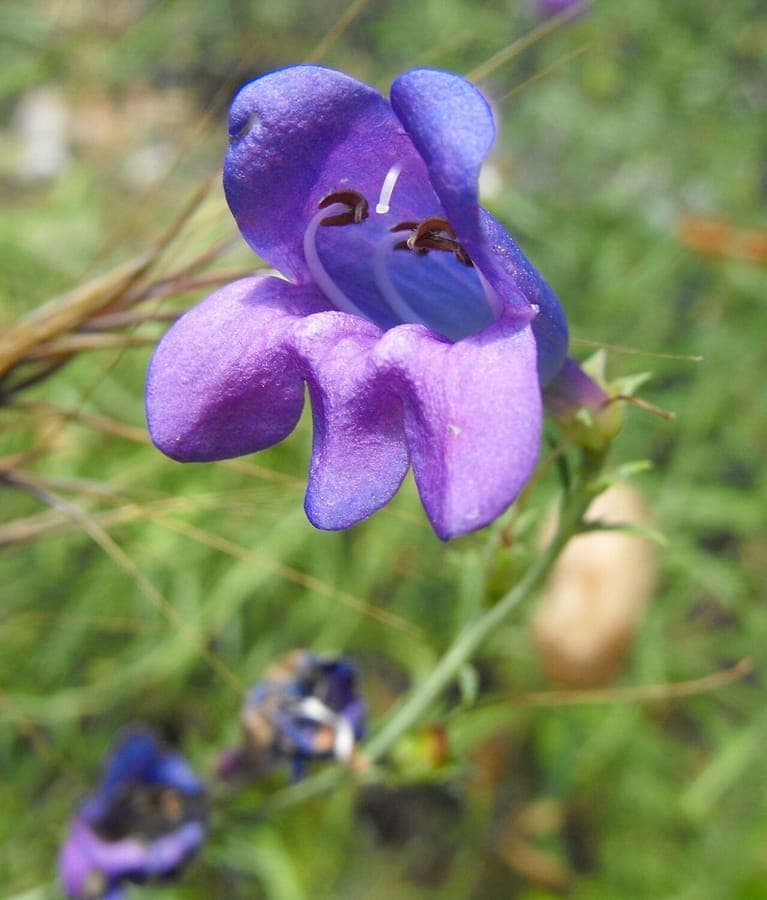
Stickpen / Public domain, via Wikimedia Commons
Foothill penstemon: complete guide to Penstemon heterophyllus
Penstemon heterophyllus
Want to see Foothill penstemon: complete guide to Penstemon heterophyllus in your garden?
Full design in HD: €7.99
Look after your Foothill penstemon with the GardenWorld app
Identify plants with your camera and get a care calendar with reminders for this plant.


Overview
True blue flowers are rare in the summer border, which is exactly why foothill penstemon (Penstemon heterophyllus) stands out. This small evergreen sub-shrub flowers from June to August with trumpet-shaped blooms in sky blue to violet-blue, often with a pink or purple flush on the tube. In garden centres it is usually sold as the cultivar 'Heavenly Blue'.
Penstemon heterophyllus belongs to the family Plantaginaceae and is endemic to California. It grows in the Coast Ranges and the foothills of the Sierra Nevada, in chaparral, open oak woodland and dry grassland. There it receives mild, wet winters and long, dry summers. That rhythm shapes how you should treat it in the garden: plenty of sun, soil that dries quickly and no wet feet in winter.
The species name heterophyllus means having different leaves and refers to the foliage, which varies in shape and size along the stem. In the garden this penstemon suits a sunny border, gravel garden, rock garden or a large container on the patio. If you are planning such a space, gardenworld.app can create a garden design for you in which compact, drought-loving plants like this form a coherent sunny border with lavender and grasses.
Appearance and bloom cycle
Penstemon heterophyllus forms a loose, shrubby mound 30–60 cm tall and 40–60 cm across, with a woody base. The stems are thin and upright to slightly spreading. The leaves are narrow, linear to lance-shaped, 3–10 cm long, green to grey-green, and remain on the plant through mild winters.
From June the flowers appear in loose sprays at the tips of the stems. Each is 2.5–3.5 cm long, tubular to funnel-shaped and two-lipped, with an open throat that reveals the stamens, as in the photograph. The colour ranges from clear sky blue and azure to violet-blue; the buds and tube are often tinged pink or purple, which gives the plant a lively play of colour during flowering.
The main flush runs from June to August, and after a light trim a few more flowers often appear in September. Bumblebees and other bees visit the flowers constantly. Well-known cultivars include 'Heavenly Blue' (blue with a purple tint), 'Electric Blue' (bright blue), 'Blue Springs' (compact, azure) and 'Züriblau' (deep blue).
Ideal location
Full sun is essential. Six or more hours of direct sunlight a day keeps growth compact and flowering generous. In partial shade the plant stretches and flowers less. A south-facing border, a gravel garden, a bank or a raised bed against a warm wall is ideal.
Because Penstemon heterophyllus dislikes cold, wet winters, choose a spot where rainwater drains away quickly. A sheltered position near a wall gives a little extra winter protection. Space plants 40–50 cm apart so that air can move between them.
It also does well in a container. Choose a pot at least 30 cm across with good drainage, and move it against the house wall in winter, out of cold, wet wind.
Soil requirements
The soil must be free-draining. Penstemon heterophyllus grows best in poor to moderately fertile, sandy or gravelly ground. Heavy, wet clay is the main cause of winter losses. Improve such soil with plenty of grit or coarse sand in the top 30 cm, or plant on a raised bed.
The ideal pH is around 6 to 7.5, slightly acidic to neutral. Feed sparingly: rich soil produces long, floppy stems and makes the plant more vulnerable to frost. A thin layer of compost at planting time is enough. A gravel mulch keeps the base of the stems dry.
In containers, use a mix of peat-free compost with a third grit, coarse sand or pumice.
Watering
Once established, this penstemon copes well with drought. In the first year, water thoroughly once a week during dry spells. From the second year onwards, water only during long, hot droughts.
A common mistake is overwatering. Wet soil around the roots, especially from autumn onwards, leads to root rot. Always water at the base, let the soil dry out between waterings and avoid automatic irrigation that keeps the border damp every day. Container plants need more water in summer: check every two or three days and water when the top few centimetres are dry.
Free preview
Want to see Foothill penstemon: complete guide to Penstemon heterophyllus in your garden? Make a free preview of your design.
Pruning
Penstemon heterophyllus needs careful pruning, rather like lavender. After the main flush in August, remove the faded sprays and trim the stems lightly. This keeps the plant compact and sometimes encourages a second, smaller flush.
Do not cut back in autumn. The existing foliage protects the plant through winter. Wait until April, when new growth begins, then cut frosted or bare shoots back to just above a healthy pair of leaves. Never cut deep into bare, old wood, as the plant struggles to regrow from it.
This penstemon usually lives for three to five years, so take cuttings every summer. Semi-ripe tip cuttings 6–8 cm long, taken in July or August, root readily in a mix of sand and cutting compost. Overwinter them frost-free and plant out in spring.
Maintenance calendar
March: Check that water is not pooling around the plants. Remove dead leaves.
April: Cut frosted and bare shoots back to healthy growth. A good month for planting.
May: Spread a gravel mulch around the base. Water young plants in dry weather.
June–July: Main flowering. Water only during prolonged drought.
August: Remove faded sprays and trim lightly. Take semi-ripe cuttings.
September–October: Leave the plant alone. Raise containers on feet and move them against a sheltered wall.
November–February: In hard frost, cover the plant with a loose layer of conifer branches. Keep the soil as dry as possible.
The planting calendar on gardenworld.app reminds you when it is time to prune, take cuttings or protect your containers.
Winter hardiness
Penstemon heterophyllus is moderately hardy. The Royal Horticultural Society rates cultivars such as 'Heavenly Blue' and 'Züriblau' H4, which corresponds to frost down to about -10 °C. In most of the UK and the Low Countries the plant survives typical winters, provided the soil drains well. In severe frost below -10 to -12 °C, or during long, wet cold spells, it may die.
Narrow-leaved penstemons such as this one are generally hardier than broad-leaved types. Even so, cold and wet together remain the greatest threat. A dry position, a gravel mulch and a layer of conifer branches in hard frost improve its chances. Always keep a few cuttings somewhere frost-free as insurance.
Penstemon heterophyllus is not known to be toxic to people or pets. As with any ornamental plant, it is still best to discourage animals from nibbling it. It has no known invasive behaviour in Europe.
Companion plants
The blue flowers of Penstemon heterophyllus pair beautifully with silver foliage and other drought-loving plants. Lavender (Lavandula angustifolia) is an obvious partner: the same needs, the same pruning and a lovely interplay of blue and purple. Cotton lavender (Santolina chamaecyparissus) adds silver-grey foliage and yellow button flowers for contrast.
At the front of the border, Mexican fleabane (Erigeron karvinskianus) softens the edge with its white and pink daisies. Blue fescue (Festuca glauca) echoes the blue in its foliage. For structure and a winter silhouette, add a Mediterranean spurge (Euphorbia characias) with blue-green leaves and lime-green flower heads in spring.
Avoid plants that need plenty of water and feeding. Their damp, rich soil shortens the life of this penstemon.
Final thoughts
Penstemon heterophyllus is one of the finest blue summer flowers for a sunny, dry garden. It stays compact, flowers for months and draws in bumblebees and other bees. Poor, free-draining soil, little water, careful pruning in April and a few spare cuttings are all it needs.
Plant a group of three 'Heavenly Blue' among lavender and cotton lavender in a gravel border, and from June to August you will have a blue accent that every visitor asks about.
Frequently asked questions about Foothill penstemon
Is Foothill penstemon winter hardy?
Penstemon heterophyllus is moderately hardy. The Royal Horticultural Society rates cultivars such as 'Heavenly Blue' and 'Züriblau' H4, which corresponds to frost down to about -10 °C.
When and how do you prune Foothill penstemon?
Penstemon heterophyllus needs careful pruning, rather like lavender. After the main flush in August, remove the faded sprays and trim the stems lightly.
How much water does Foothill penstemon need?
Once established, this penstemon copes well with drought. In the first year, water thoroughly once a week during dry spells.
Where does Foothill penstemon grow best?
Full sun is essential. Six or more hours of direct sunlight a day keeps growth compact and flowering generous.
What soil does Foothill penstemon need?
The soil must be free-draining. Penstemon heterophyllus grows best in poor to moderately fertile, sandy or gravelly ground.

See it in your garden
See Foothill penstemon in your garden
One photo of your garden and a few questions. You see the result in about a minute.
Try it with a photoIdentify this plant in your own garden. Identify a plant
Similar plants
English Lavender: complete guide
Lavandula angustifolia
Everything about English Lavender (Lavandula angustifolia): planting, pruning, care and overwintering. Practical tips for lush purple blooms.
Lavender cotton: complete guide
Santolina chamaecyparissus
Lavender cotton (Santolina chamaecyparissus) is a beautiful gray-green shrub from the Asteraceae family. This Mediterranean plant offers fragrance and refined appearance for dry gardens.
Erigeron karvinskianus: complete guide
Erigeron karvinskianus
Discover Erigeron karvinskianus, Karwinsky's fleabane or Mexican daisy, a delightful rock garden plant. Learn cultivation, care requirements, and design for challenging garden spaces.
