
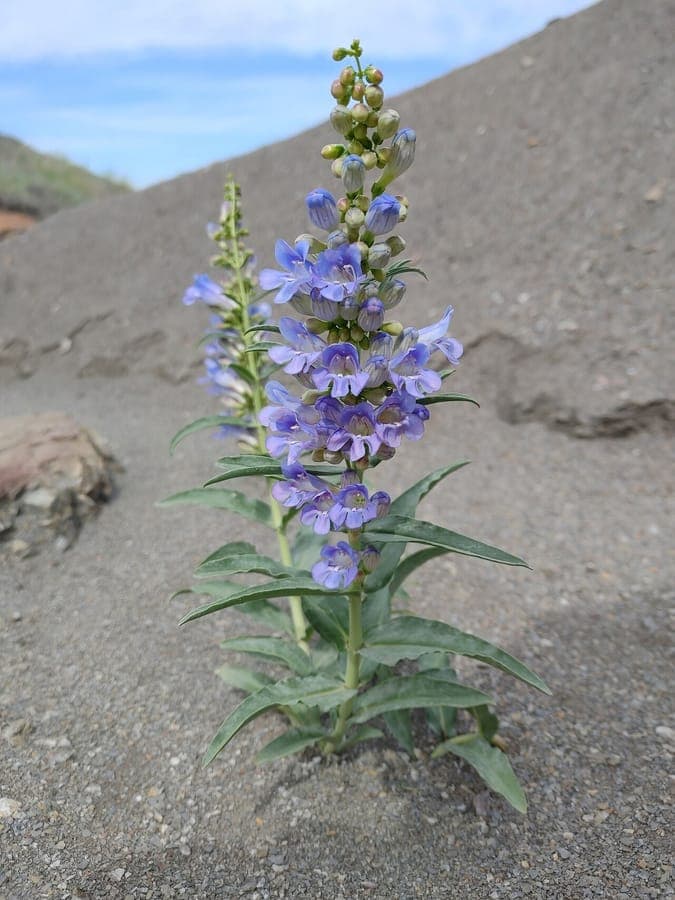
Brian Dickerson https://www.inaturalist.org/people/aggie_wildlifer / CC0, via Wikimedia Commons
Sawsepal penstemon: complete guide
Penstemon glaber
Want to see Sawsepal penstemon: complete guide in your garden?
1 minute, no credit card
Overview
Penstemon glaber, commonly known as sawsepal penstemon or western smooth beardtongue, is a striking perennial in the family Plantaginaceae, described as early as 1813 by the Prussian-American botanist Frederick Pursh in his influential 'Flora Americae Septentrionalis'. The species epithet glaber is Latin for smooth or hairless, referring to the notably smooth, glabrous leaves and stems that distinguish this species from many hairy beardtongue relatives such as Penstemon eriantherus.
The natural range spans the west-central and central United States: Colorado, Montana, Nebraska, New Mexico, North Dakota, South Dakota, and Wyoming, extending into north-eastern Mexico. Within that range the species colonises open prairie flats, dry rocky slopes, grassy valleys, and open woodland margins on sandy to loamy, well-drained soils. This is a broader ecological niche than that of Penstemon eatonii or Penstemon gairdneri, making Penstemon glaber a somewhat more accessible choice for European garden conditions.
In Sweden the plant is sometimes known by the vernacular 'indigohatt' (indigo hat), which points directly to the striking deep blue to indigo-purple flower colour the species achieves, particularly on cooler sites. That rich flower colour is the primary reason the species is valued as a garden plant in Europe: the large, wide-mouthed tubular flowers in deep blue-purple are spectacular on a sunny border or dry prairie-style planting. Explore how sawsepal penstemon can work in your own garden design at gardenworld.app.
The plant has a multi-stem growth form - several stems arising from the same base - growing as a subshrub-herbaceous perennial of moderate growth rate. It is reliably treated as a long-lived perennial in suitable garden conditions.
Appearance & bloom cycle
Penstemon glaber forms a multi-stemmed clump of erect to slightly arching stems 40-80 cm tall in flower. The leaves are the most distinctive feature of the species: they are conspicuously smooth and glossy, without the soft hairs present in many other penstemon species. Basal leaves are broadly lance-shaped to elliptic, 5-15 cm long and 1.5-4 cm wide, bright green to blue-green in colour. Stem leaves are narrower, sessile, and partially clasping.
The flowers are the great attraction. They are broadly tubular to funnel-shaped and considerably wider at the mouth than those of Penstemon eatonii, giving them the appearance of small trumpets rather than narrow tubes. Colour ranges from vivid blue-purple to deep indigo-blue, tending more towards violet in cooler years or on shadier sites. The characteristic staminode is present and slightly bearded. Flowers are 2.5-4 cm long.
Flowers are arranged in fairly dense, multi-sided racemes along the upper half of the stems. In Dutch and Belgian gardens, the main flowering period runs from June to August, peaking typically in July. The rich colour and large flower size make Penstemon glaber one of the most ornamentally rewarding beardtongue species for European gardens.
After flowering, brown, egg-shaped seed capsules develop, drying open in autumn to disperse their seeds. The plant has a modest tendency to self-sow on dry, open ground - generally a welcome addition rather than a nuisance.
Ideal location
Penstemon glaber is somewhat less demanding in its site requirements than its relatives Penstemon eatonii and Penstemon gairdneri, but still needs an open, sunny position for optimal flowering. Six or more hours of direct sun daily is ideal. On sites receiving four to five hours of sun, more modest flowering is possible but the plant remains healthy.
The species is well suited to prairie-style borders, dry rock gardens, gravel gardens, and open borders alongside sunny walls. In its native habitat it grows on flat prairies and gentle slopes - conditions best replicated in the garden by choosing an open, slightly elevated site where air circulation is good and rainwater drains away quickly.
Compared to Penstemon eatonii, the sawsepal penstemon is somewhat more tolerant of brief periodic moisture: the soils in its natural range (Colorado, Nebraska, Wyoming) are on average slightly less extreme than the desert-margin zones of Penstemon eatonii. This makes Penstemon glaber suitable for a wider range of European garden applications, including well-drained standard garden soil beds.
Avoid low-lying, moist, or shaded positions. The plant also dislikes highly exposed, windy sites without some wind shelter: the taller stems are more prone to wind-lodging than the compact Penstemon gairdneri.
Soil
The soil for Penstemon glaber must drain well, but need not be as extremely lean as for Penstemon eatonii or Penstemon gairdneri. Optimal pH is between 6 and 8 - a wide range making the plant adaptable to diverse soil types. On normal, lightly to moderately fertile garden soil with adequate drainage, the plant performs excellently.
On standard clay or mixed soils, blending in 20-30 % coarse sand or gravel through the top 25-30 cm before planting is advisable. This improves drainage without dramatically impoverishing the soil. On existing sandy or lightly loamy garden soils, simply loosening and checking drainage may be all that is needed.
Feed sparingly: a 3-5 cm layer of well-rotted compost around the plants in early spring is sufficient. Too much nitrogen leads to overly lush, heavy stems that may require support and flower less freely. Avoid fresh manure, high-analysis granular fertilisers, and lawn feeds near this plant.
Calcareous soils - common in parts of Belgium and the Dutch south - are perfectly suitable for Penstemon glaber without amendment. At pH below 6, on acid sands or heathland substrates, a light application of ground limestone (100 grams per square metre) is advisable.
Watering
Penstemon glaber is a good drought-tolerant plant but slightly less extreme than Penstemon eatonii or Penstemon gairdneri. It tolerates regular summer rainfall better than its south-western relatives and is thus better adapted to the European climate with its moderate summers.
In the first year after planting, regular watering is needed: water every seven to ten days, deeply enough for moisture to reach 20-25 cm, but allow the soil to dry almost completely between waterings. From the second year, normal summer rainfall in most Dutch and Belgian conditions is fully sufficient, except during exceptional drought (more than three weeks without rainfall).
During dry spells exceeding three weeks, apply two to four litres per plant per session, deeply and thoroughly, and let the soil dry fully before the next application. Over-watering in summer or a waterlogged site in winter leads to root rot - the primary cause of plant failure in beardtongue species. Morning watering is preferred to allow leaves to dry before nightfall.
Mulching with a layer of fine gravel (3-5 cm around the plant, not directly against the stem base) is helpful for regulating soil temperature, reducing evaporation, and preventing mud from splashing onto the glossy leaves in rain. Avoid organic mulch immediately around the stem base.
Free design
Want to see Sawsepal penstemon: complete guide in your garden? Make a free design now.
Pruning
Penstemon glaber requires modest pruning. Remove spent flower stems after the main flowering in July-August by cutting back to just above the uppermost leaves on the stem. This keeps the plant tidy and encourages a light second flowering in September in favourable years.
Leave the basal leaf rosette and lower stem portions intact through autumn and winter. The remaining stems provide some frost protection to the crown and are attractive to overwintering insects through the colder months. Remove dead and brown material in early spring - March or April - as new shoots emerge.
After three to five years, specimens may flower less freely. At that point, in early spring, cut the plant back hard to just above the living base - check that the tissue is still green and moist before cutting. Many specimens respond with a vigorous new flush of growth that flowers in the same year. Division of the clump is also possible in early spring: drive a sharp spade through the central clump and replant the healthy outer sections at 40-50 cm spacing.
Maintenance calendar
January - February: Minimal care. Check for water accumulation around the root base. During prolonged wet and frosty conditions, a temporary thin covering of dry needles or loose coarse gravel helps keep the root crown dry. Do not remove stems or basal leaves.
March - April: Remove dead stems and winter debris in March as new green shoots appear. Apply a thin layer of well-rotted compost (3-5 cm, not directly against the stem base). This is the best time to plant new specimens from garden centres, and the ideal moment to divide overcrowded clumps.
May: Rapid growth. Check for aphids on young shoots. Weed around the plants and ensure the soil dries adequately between waterings. Apply a thin gravel mulch layer if not already in place.
June - August: Flowering period. Remove spent flower stems regularly. Enjoy the deep blue to indigo-purple blooms and the bees, bumblebees, and butterflies they attract. Water only during drought periods exceeding three weeks.
September: Possible light second flowering. Seed capsules ripen. Leave capsules if you want the plant to self-sow in the garden.
October - November: Remove dead above-ground material after the first night frost. Leave the stem base intact. Stop watering. Apply a gravel mulch layer if desired for frost protection.
December: No action needed. Check drainage after heavy rainfall.
Winter hardiness
Penstemon glaber is exceptionally winter hardy for European conditions. The species originates from areas including Montana, Wyoming, Colorado, and the Dakotas, where continental winters with temperatures down to -30 degrees Celsius are not uncommon. In the garden, the species corresponds to USDA hardiness zones 3-8, meaning it can withstand temperatures down to at least -35 degrees Celsius on a dry, well-drained site.
In practice in the Low Countries - with their moist, variable winters - the decisive factor is again soil moisture rather than minimum temperature. On well-drained soil, Penstemon glaber survives European winters without any extra protection. On wet, heavy soil, winter death is a real risk. The broad geographic origin of the species - from Montana to New Mexico - means that some populations are better adapted to moist winter conditions than the purely desert-edge beardtongue species.
In normal Dutch and Belgian winters, where temperatures rarely fall below -15 degrees Celsius, Penstemon glaber is one of the most reliable beardtongue species for the garden. Mulching with a layer of gravel (3-5 cm) before the first frost is a simple precautionary measure that further improves winter survival on heavier soils. Visit gardenworld.app to discover which combinations of winter-hardy drought-tolerant plants work best in your garden situation.
Companion plants
Penstemon glaber pairs beautifully with other prairie-style and drought-tolerant perennials on an open, sunny site. The blue-purple to indigo flower colour offers rich combination possibilities with yellow, white, and orange flowers:
- Rudbeckia fulgida (Orange coneflower) - yellow flowers with dark centres from July to October; the yellow and blue-purple combination is a classic prairie colour pairing. Plant 40-50 cm apart.
- Ratibida pinnata (Prairie coneflower) - gracefully nodding yellow flowers on stems to 150 cm; blooms simultaneously with Penstemon glaber and gives the planting an open, naturalistic character. Space 50 cm.
- Liatris spicata (Blazing star) - purple feather-like spikes from August to September; the combination of indigo-blue penstemon with purple liatris on a prairie bed is compelling. Space 30-40 cm.
- Gaillardia aristata (Blanket flower) - fiery red-orange with yellow margins, blooms June to October; a vivid contrast to the cool tones of Penstemon glaber. Space 40 cm.
- Salvia nemorosa (Wood sage) - blue-purple spikes June to September; complementary but harmonious blue-purple that frames the penstemon blooms without dominating. Space 30 cm.
- Stipa capillata (Feather grass) - finely textured swaying grass that creates a lightly transparent curtain around the penstemon stems in a breeze. Space 40 cm.
Allow 40-50 cm between Penstemon glaber plants - wider than for compact Penstemon gairdneri - since the multi-stem habit needs more space for optimal air circulation and flowering. Groups of five to seven create the finest prairie effect. Look for Penstemon glaber at specialist prairie plant nurseries and perennial garden centres; it is growing in availability as prairie-style planting becomes more popular.
Closing
Penstemon glaber is one of the most ornamental and reliably winter-hardy beardtongue species for the European garden. The indigo-purple to deep blue-purple flowers, smooth glossy foliage, and excellent drought tolerance make it a standout choice for prairie borders, rock gardens, and dry sunny borders. The plant returns reliably year after year, offering a rich summer bloom that draws bees, bumblebees, and butterflies in abundance. For a robust yet elegant perennial suited to dry, sunny sites, sawsepal penstemon is an outstanding candidate well worth seeking out.
Want to see Sawsepal penstemon: complete guide in your garden? Make a free design now.
Upload a photo, pick a style, and get a photorealistic design with plant list in under a minute.
10,000+ gardens designed already
No credit card required


Similar plants
Firecracker penstemon: complete guide
Penstemon eatonii
Full guide to Penstemon eatonii: fiery red blooms, drought tolerance, ideal site, winter hardiness, and companion plants for this striking perennial.
Gairdner's beardtongue: complete guide
Penstemon gairdneri
Full guide to Penstemon gairdneri: compact habit, lavender blooms, drought tolerance, rock garden culture, and care tips for this elegant beardtongue.