
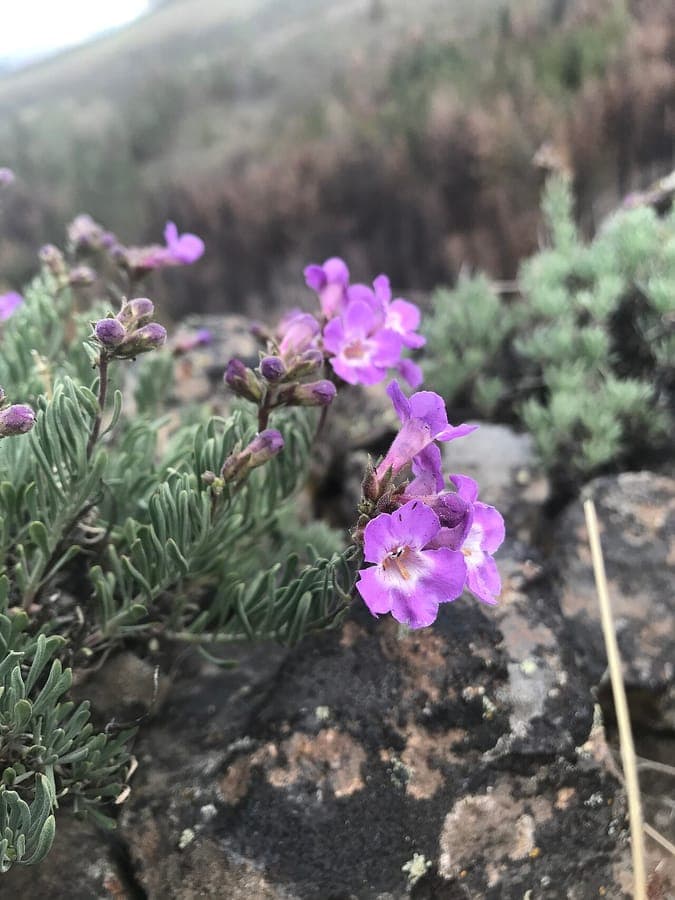
Lindsey Salmonson https://www.inaturalist.org/people/lindsey09 / CC BY 4.0, via Wikimedia Commons
Gairdner's beardtongue: complete guide
Penstemon gairdneri
Want to see Gairdner's beardtongue: complete guide in your garden?
1 minute, no credit card
Overview
Penstemon gairdneri, commonly known as Gairdner's beardtongue or Gairdner's penstemon, is a compact, semi-woody perennial in the family Plantaginaceae, described by the Scottish botanist William Jackson Hooker in 1838 in his foundational work 'Flora Boreali-Americana'. The species is named for Meredith Gairdner, a Scottish physician and naturalist who worked as a surgeon for the Hudson's Bay Company in the Oregon Territory during the 1830s, making botanical observations in a region then barely known to European science.
The natural range of Penstemon gairdneri is relatively restricted: central Washington south to eastern Oregon and into Idaho. Within that range, the plant occupies dry basalt outcrops, open sunny slopes, and grassy flats on well-drained, lean to moderately fertile soils. Botanically it is described as a subshrub or herbaceous perennial with a compact, single-crown growth habit. Growth rate is moderate, and the plant maintains its tidy, mounded form consistently over the years.
For European gardens, Penstemon gairdneri is a distinctive choice for anyone seeking a less common, refined beardtongue species suited to rock gardens, gravel gardens, and dry borders. Its relative scarcity in the trade makes it all the more desirable as a special planting element. Explore how less common perennials like Gairdner's beardtongue can be incorporated into a professionally designed garden at gardenworld.app.
A botanical detail worth noting: Hooker published the species in 1838 from field material collected by Gairdner, but the precise taxonomic circumscription was later refined by David Keck, who described a subspecies typicus now treated as a synonym. The currently accepted name remains Penstemon gairdneri Hooker.
Appearance & bloom cycle
Penstemon gairdneri forms a compact, somewhat semi-woody perennial that in maturity creates a low, dense mound 20-40 cm tall and 25-40 cm wide. The stems are slightly woody at the base, forming a tight, tufted structure. Leaves are narrow to almost linear, 2-5 cm long and barely 3-6 mm wide, grey-green in colour with a medium-fine texture. Stem leaves are similar in size and are sessile.
The flowers are the most attractive aspect of the plant. They are tubular to narrowly funnel-shaped, light lilac to blue-purple, occasionally nearly white in some populations, with the characteristic 'beard tongue' staminode typical of penstemon species. The flower colour is softer and cooler than the fiery red of Penstemon eatonii but no less elegant. Flowers are 1.5-2.5 cm long and are produced in loose, one-sided racemes at the ends of the stems.
In garden cultivation at temperate latitudes, the main flowering period falls in May and June, with sometimes a lighter second flush in August or September in favourable conditions. The flower stems are compact, so the plant retains its tidy appearance even in full bloom. After flowering, small oval seed capsules develop, drying open to release the seeds.
The plant spreads slowly via the crown and produces no aggressive root runners, making it especially suited to smaller rock gardens and walled borders where unwanted spread is a concern.
Ideal location
Penstemon gairdneri requires an open, full-sun position. Like most beardtongue species, it does not tolerate shade or partial shade: fewer than five hours of direct sun per day leads to lax growth, sparse flowering, and increased susceptibility to fungal disease. Choose a site that receives full sun all day, ideally at a slightly elevated position ensuring good air movement.
The plant is ideally suited to rock gardens, xeriscapes, raised gravel beds, and dry valley borders. In its native range it grows on basalt rock - a mineral-lean substrate that absorbs heat quickly and dries fast. You can replicate these conditions in the garden by building the planting site up with a base of coarse gravel, rubble, or basalt chips.
In urban gardens with a heat island effect - alongside a sunny wall or on a sun-warmed terrace - Penstemon gairdneri performs particularly well. Avoid positions exposed to hot, desiccating winds without any shelter, however: the compact stems are somewhat vulnerable to desiccation damage in extreme heat stress. A slightly sheltered yet still fully sunny position is optimal.
The compact habit makes Gairdner's beardtongue well suited to the edges of gravel drives and paths, where it provides a neat border accent without spreading excessively into surrounding areas. It also combines well with low-growing, drought-tolerant companions in the rock garden.
Soil
The soil for Penstemon gairdneri must drain well to excellently. pH tolerance is broad, from 6.3 to 8, slightly acid to slightly alkaline - a wide range that makes the plant adaptable to diverse substrates. Heavy wet clay soils are entirely unsuitable and will cause inevitable root rot.
In its native habitat the species grows on impoverished, thin rocky soils with minimal organic fraction. In European gardens it is therefore advisable to blend at least 30-40 % coarse gravel or stone chips into the top 25-30 cm of the soil at planting time. On existing light sandy soils, planting may be relatively straightforward without major soil improvement, as long as drainage is secured.
Feeding is not desired: too-rich soil encourages excessive leafy growth, shortens the plant's lifespan, and leads to a loss of compactness. At most, apply a thin layer of coarse compost (2 cm) once at planting and let the plant grow at its own pace thereafter. Additional feeding in subsequent years is generally unnecessary.
In Dutch and Belgian gardens with clay-sand mixed soils: blend in 30 % coarse sand or gravel, verify drainage, and avoid fertile compost-rich preparations. On calcareous soils - common in the Belgian loess belt - the plant thrives without any amendments.
Watering
Penstemon gairdneri is by nature a pronounced drought-tolerant plant, adapted to the sparse rainfall and hot, dry summers of central Washington and eastern Oregon. In the European garden this means the plant, once well established, is nearly self-sufficient in terms of water.
In the first year after planting, regular watering is important to encourage root development: water once a week, deeply enough for moisture to reach 20-25 cm, but allow the soil to dry completely between waterings. Too-frequent watering in the establishment phase promotes shallow rooting and makes the plant more drought-sensitive in the long run.
From the second year, natural rainfall in most Dutch and Belgian conditions is completely sufficient. Only during exceptionally prolonged dry spells - more than four to six weeks without significant rainfall - is supplemental watering needed. In those cases, give a thorough deep watering (four to six litres per plant) and then let the soil dry fully before the next application. Over-watering is the primary cause of mortality with this species.
Never allow water to collect at the stem base. Mulching with fine gravel (3-4 cm around the plant, but not touching the stems) is beneficial for regulating soil temperature and preventing moisture from pooling directly at the root crown.
Free design
Want to see Gairdner's beardtongue: complete guide in your garden? Make a free design now.
Pruning
Penstemon gairdneri needs little pruning thanks to its compact, semi-woody habit. The main pruning measure is removing spent flower stems after the main flowering in June or July: cut stems back to the level of the uppermost leaf. This gives the plant a tidier appearance and may - in favourable conditions - stimulate a light second flush of blooms.
In late autumn - October to November - remove dead and damaged material, but leave the basal, woody portion of the stems completely intact. The semi-woody base provides frost protection and is the origin of new shoots in the following season. Never cut into the woody stem unless the material is demonstrably dead.
Older, less floriferous specimens can be lightly cut back to living green stem tissue in early spring - February or March. Check beforehand that the tissue is alive by gently pressing the bark or making a small cut: living tissue is green and moist, dead tissue is dry and brown. Cutting into dead wood can kill the plant.
To encourage compactness in young plants, pinch out some of the flower buds in the first year after planting. This promotes a denser, more branched habit before the plant flowers fully for the first time.
Maintenance calendar
January - February: Little to do. Check for water accumulation around the plant. If prolonged thaw follows a freeze, water may pool around the root crown: restore drainage immediately by loosening the surrounding soil. In extreme cold, loosely cover the plant with pine boughs or coarse gravel.
March - April: Remove dead and brown material as soon as new green shoots appear, typically in March. This is the best time to plant new specimens: specialist rock garden nurseries sometimes stock Penstemon gairdneri in spring. Check the site drainage before the new growing season begins.
May - June: Flowering period. The plant needs little attention during bloom. Avoid removing flower stems while the plant is actively flowering. Enjoy the soft lavender blooms and the bees and bumblebees they attract.
July: Remove spent flower stems after the main flowering period. Check that the soil is adequately dry. No feeding.
August - September: Possible light second flowering on sheltered warm sites. Seed capsules ripen. Check for powdery mildew during persistently humid weather - rarely a problem with good air circulation.
October - November: Remove dead above-ground material. Leave the semi-woody stem base intact. Stop watering.
December: No maintenance required. Check drainage after heavy rainfall.
Winter hardiness
Penstemon gairdneri is reliably winter hardy by European standards, but requires the same attention to drainage conditions as all drought-tolerant beardtongue species. The plant withstands temperatures down to at least -20 degrees Celsius on dry, well-drained soils - corresponding to USDA hardiness zones 5-8. In its native habitat in central Washington, it experiences cold, dry winters with variable snow cover.
In the Low Countries - with their moist maritime winters - the critical winter factor is not the minimum temperature but soil moisture. On well-drained soil, the plant overwinters without difficulty. On clay-heavy or wet soils, winter death is a real risk even at relatively mild temperatures. Gardeners wishing to grow the plant in high-rainfall areas with heavy soils would do well to grow it in a container or a raised gravel bed.
The semi-woody stem base provides some extra protection compared to fully herbaceous species: the woody tissue insulates the root crown to some degree. It is nonetheless advisable to mulch the planting site with a thin layer (3-4 cm) of fine gravel in November, before the first hard frost. This stabilises soil temperature and reduces the risk of the root crown freezing during alternating freeze-thaw periods.
On sheltered sites in urban gardens - alongside a south-facing wall or on a covered terrace - Penstemon gairdneri is reliably hardy throughout the Low Countries and western Germany. Visit gardenworld.app to explore which drought-tolerant perennials best suit your garden situation and climate zone.
Companion plants
Penstemon gairdneri fits best alongside other compact, drought-tolerant plants sharing the same full-sun position and well-drained soil. Proven combinations for the rock garden or gravel garden:
- Lewisia cotyledon (Lewisia) - compact mountain plant with pink to white flowers in May-June; the same preference for dry, excellently drained soil and full sun. Plant 20-25 cm apart.
- Armeria maritima (Sea thrift) - low-growing ground cover with pink ball-flowers; blooms May to August and creates a pleasant low front layer before the taller penstemon stems. Space 20 cm.
- Phlox subulata (Moss phlox) - dense carpet-forming ground cover with pink, white, or pale purple flowers in April-May; equally drought-tolerant and sun-loving. Space 25-30 cm.
- Sedum reflexum (Reflexed stonecrop) - succulent with yellow star-shaped flowers and blue-green foliage; excellent for dry rock and gravel gardens. Space 20 cm.
- Festuca glauca (Blue fescue) - compact blue-grey grass that contrasts beautifully with the lavender-purple penstemon flowers. Space 20-25 cm.
- Thymus praecox (Early thyme) - low creeping, strongly aromatic ground cover with purple flowers in June-July; fills the gaps around penstemon clumps and suppresses weeds. Space 20 cm.
Allow 25-35 cm between Penstemon gairdneri plants for optimal air circulation and to give the semi-woody base sufficient room to establish well. The plant is also suited to dry stone walls, gravel surfaces alongside terraces, and raised beds with a drainage base of crushed stone or gravel. Look for it at specialist rock garden nurseries and perennial plant centres.
Closing
Penstemon gairdneri is a rare and refined beardtongue species that deserves a place in any rock garden design where drought tolerance and compact habit are desired. The soft lilac-purple flowers, semi-woody compact growth form, and excellent drought tolerance make it a reliable choice for rock gardens, gravel gardens, and dry borders in sunny positions. For gardeners looking for an alternative to the more common beardtongue species, Gairdner's penstemon offers distinctive beauty and quiet charm throughout the entire garden season.
Want to see Gairdner's beardtongue: complete guide in your garden? Make a free design now.
Upload a photo, pick a style, and get a photorealistic design with plant list in under a minute.
10,000+ gardens designed already
No credit card required


Similar plants
Firecracker penstemon: complete guide
Penstemon eatonii
Full guide to Penstemon eatonii: fiery red blooms, drought tolerance, ideal site, winter hardiness, and companion plants for this striking perennial.
Sawsepal penstemon: complete guide
Penstemon glaber
Full guide to Penstemon glaber: deep blue-purple blooms, prairie culture, drought tolerance, winter hardiness, and companion plants for this elegant beardtongue.