
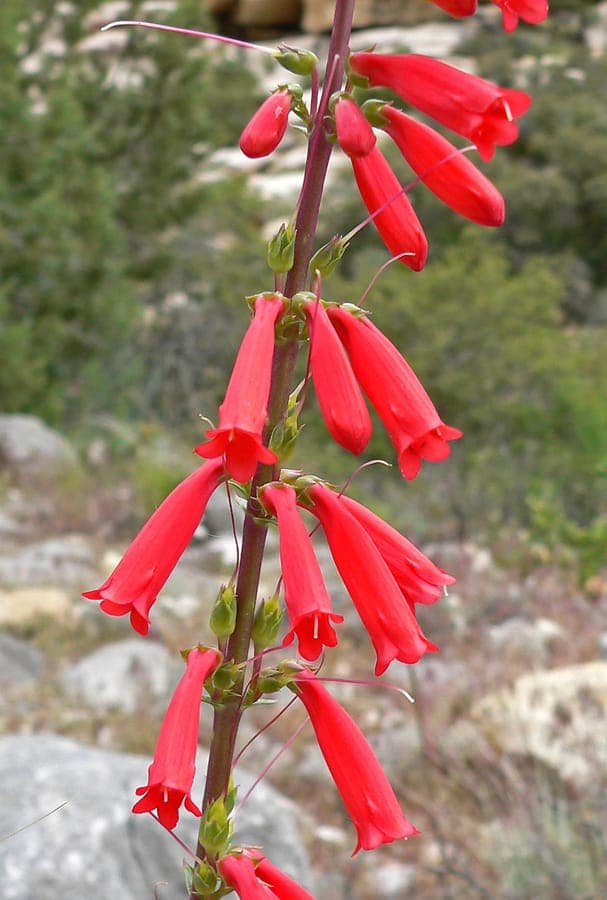
Stan Shebs / CC BY-SA 3.0, via Wikimedia Commons
Firecracker penstemon: complete guide
Penstemon eatonii
Want to see Firecracker penstemon: complete guide in your garden?
1 minute, no credit card
Overview
Penstemon eatonii, commonly called firecracker penstemon or Eaton's penstemon, is a striking perennial in the family Plantaginaceae, described by Asa Gray in 1872 from specimens collected in the American West. The species honours Daniel Cady Eaton, a nineteenth-century American pteridologist who participated in early scientific surveys of the south-western United States. The common name 'firecracker' perfectly captures the plant's most dramatic feature: dense spikes of scarlet-red, narrowly tubular flowers that erupt along the upper stems in late spring and early summer, giving the impression of a rack of fireworks about to go off.
In the wild, Penstemon eatonii grows across the western and west-central United States - Arizona, California, Colorado, Idaho, Nevada, New Mexico, Utah, and Wyoming. Within that range it colonises dry rocky slopes, desert margins, open pinyon-juniper woodlands, and higher-elevation dry valleys, typically on well-drained calcareous or sandy soils at elevations of 900 to 2,700 metres. Soil pH in its native habitat sits between 7 and 8, neutral to slightly alkaline.
For European gardens, Penstemon eatonii is an outstanding choice for dry sunny borders, rock gardens, gravel gardens, and prairie-style plantings. In its native range the flowers are pollinated by hummingbirds, which are attracted by the narrow red tubes - a flower shape known as hummingbird syndrome. In Europe the long-tongued bumblebees and solitary bees take over this role. Explore how this brilliant red-flowered perennial can fit into your own front garden design at gardenworld.app.
The plant has an upright growth form with a single stem base and belongs to the group of fast-growing herbaceous perennials. In garden cultivation it is treated as a reliable perennial that, given the right site, persists for multiple years without intensive care.
Appearance & bloom cycle
Penstemon eatonii forms rosettes of lance-shaped to ovate basal leaves, fresh green in colour, with smooth margins and a slightly glossy surface. Basal leaves measure 5-12 cm long and 1-3 cm wide. Stem leaves are smaller, narrower, and semi-clasping. The erect stems reach 50-100 cm in flower.
The flowers are the defining feature of this species. They are scarlet to fiery red, narrowly tubular and cylindrical, 3-4 cm long, arranged in dense, half-whorl clusters (verticillasters) along the upper half of the stem. The calyx lobes are also red-tinged. The corolla tube is narrow and nearly straight, lacking the prominent 'beard tongue' (staminode) that projects noticeably in many other penstemon species. This narrow tube shape is a precise adaptation to hummingbird pollination in its native range.
In the Netherlands and Belgium, the main flowering period runs from May to July, with early blooms sometimes appearing in April on sheltered warm sites. At the height of summer the display is at its most impressive. After flowering, small brown capsule fruits develop, containing seeds dispersed by wind. The ripening seed capsules have their own quiet ornamental quality in late summer.
The plant does not self-seed aggressively in European conditions, but can occasionally germinate spontaneously in dry gravel gardens and rock gardens on warm, sunny sites. This is generally a welcome bonus rather than a problem.
Ideal location
Penstemon eatonii requires full sun: at least six hours of direct sunlight per day is essential for good flowering and healthy growth. Shade or partial shade results in drawn, weak stems, few flowers, and increased susceptibility to fungal diseases. Choose a position that benefits from warm, reflective heat - alongside a sunny wall, on an elevated border, or in a rock garden on a mound.
The plant is perfectly suited to dry, sunny borders in the style of prairie plantings or xeriscape designs. In the front garden it works well as a focal point in gravel or stone mulching, in combination with other drought-tolerant plants. Some shelter from persistent westerly winds is desirable, as the tall stems can bend in strong gusts. At sites with a warm south-facing wall - a classic microclimate in urban gardens - the plant blooms with exceptional exuberance.
In its native habitat the species grows at elevations where nights stay cool even in summer. In the European oceanic climate, summer nights are warm enough to keep the plant active but not so hot as to cause heat stress. A slightly elevated position in the garden - on a terrace, slope, or rock mound - replicates the draining and heat-accumulating properties of its natural habitat particularly well.
Soil
The soil for Penstemon eatonii must drain exceptionally well. In its native habitat the plant grows on calcareous, sandy, or stony soils with a pH of 7 to 8. Clay-rich, wet, or highly fertile garden soil is unsuitable and quickly leads to root rot and plant death. The soil by no means needs to be fertile: a too-rich medium encourages excessive leafy growth at the expense of flowers and shortens the plant's lifespan.
When planting in standard garden soil, it is essential to blend in at least 30-40 % coarse gravel or washed river sand through the top 30 cm. On heavy clay soils it is better to build a raised bed or a gravel-filled planting pocket. On light sandy soils, removing excess organic matter and improving drainage may be all that is needed.
Liming to bring a below-neutral pH up to the preferred range of 7 to 8 is worthwhile: work ground limestone or dolomite at 100-150 grams per square metre into the top 20 cm before planting. Feeding is minimal: a light dressing of coarse compost (2-3 cm) once every two years is ample.
Watering
Once well established, Penstemon eatonii is a pronounced drought-tolerant plant. From the second year after planting it can survive long periods without rainfall. The first summer after planting, however, the plant needs regular watering to develop a good root system: water once a week, deeply enough for moisture to reach 20-25 cm.
From the second year, natural rainfall in most Dutch and Belgian conditions is sufficient, except during periods of more than three to four weeks without rain. In those cases, give a thorough watering - three to five litres per plant - and allow the soil to dry completely before the next application. Over-watering is the single most common mistake made with this plant: wet roots in winter and from excessive summer watering almost invariably cause root rot.
Never let water pool at the leaf rosette. Morning watering is preferred over evening. Mulching with gravel (3-5 cm around the plant, but not directly against the stem base) keeps the soil cooler in summer and reduces evaporation without trapping moisture. Avoid organic mulch immediately around the plant.
Free design
Want to see Firecracker penstemon: complete guide in your garden? Make a free design now.
Pruning
Penstemon eatonii needs little pruning, but a few targeted interventions significantly extend the plant's productive life. Cut spent flowering stems back to just above the basal rosette once the flowers have fully finished, typically in July or August. This avoids energy being diverted into seed production and keeps the plant compact and tidy.
Leave the basal rosette intact through autumn and winter: the basal leaves provide frost protection to the crown. Remove dead and brown leaves in early spring - March or April - when new shoots are already visible. Cutting below the crown damages the plant and inhibits regrowth.
Older specimens that flower less freely after three to five years can be cut back hard to the basal rosette in early spring. Many plants then produce fresh new stems that flower again in the same year. Sometimes, however, it is better to buy a new plant than to force an aged specimen: in garden cultivation, Penstemon eatonii has a natural lifespan of three to seven years, depending on site conditions.
Maintenance calendar
January - February: Check drainage around the plant. In persistent wet and frosty weather, an extra layer of fine gravel or loose pine needle mulch is helpful. Do not remove basal leaves.
March - April: Remove dead stems and any winter protection once night frosts end. Apply a thin layer of coarse compost (2-3 cm, not directly against the stem base). This is the best time to purchase and plant new specimens from garden centres. Lightly fork any compacted surface gravel to improve air exchange.
May: Rapid new growth begins. Check for aphids on young shoots. Ensure soil dries fully between any waterings. Begin weeding around the plant.
June - July: Flowering period. Remove spent stems regularly for a tidy appearance. Enjoy the fiery red flowers and the bees they attract. Water only during extreme drought (more than three weeks without rain).
August - September: Late flowering on sheltered warm sites. Seed capsules ripen. Leave some capsules for ornamental effect or for seed collection. Avoid feeding during this period.
October - November: Leave the basal rosette in place for frost protection. Remove rotting stems but leave dry material standing. Stop watering.
December: No action needed. Check drainage after heavy rainfall.
Winter hardiness
Penstemon eatonii is reliably winter hardy in most of the Netherlands and Belgium. The species is generally assigned to USDA hardiness zones 4-8, meaning it can survive temperatures down to -35 to -12 degrees Celsius depending on the zone. In practice, the decisive factor for winter survival is not the minimum temperature but soil moisture: a dry, free-draining site will see the plant through even severe winters without difficulty.
In its native range in Utah, Colorado, and Nevada, the plant endures cold, dry winters with little or no snow cover. In the European maritime climate - where winters are moist and rainfall is high - ensuring well-drained soil is the key to successful winter survival. Clay soils that become saturated in winter are fatal for this plant.
On free-draining soil in a sunny position, Penstemon eatonii survives temperatures down to -15 degrees Celsius without any additional protection. Only in exceptionally cold and wet winters in zone 5 or below - rare in the Low Countries - is a temporary covering of loose brushwood or fine gravel useful to keep the root crown dry. Never use plastic sheeting or dense mulch, as these trap moisture and create exactly the conditions you are trying to avoid.
Companion plants
Penstemon eatonii combines beautifully with other drought-tolerant plants sharing the same sunny, free-draining position. Some proven combinations:
- Salvia nemorosa (Wood sage) - blue-purple flower spikes that bloom simultaneously with or shortly after Penstemon eatonii; the blue tones form a vivid contrast to the fiery red. Plant 30 cm apart.
- Achillea filipendulina (Fernleaf yarrow) - flat yellow flower heads on sturdy stems to 90 cm; blooms June to September and fills the period after the penstemon's main flush seamlessly. Space 40 cm.
- Stipa tenuissima (Mexican feather grass) - finely textured, swaying grass that perfectly frames the scarlet penstemon flowers with a rippling, light green mass. Space 30 cm.
- Echinacea purpurea (Purple coneflower) - purple flowers from July to September; thrives in the same well-drained soil and full sun. Space 40-50 cm.
- Thymus serpyllum (Creeping thyme) - compact ground cover that fills gaps between taller plants and itself produces lavender-purple flowers in June and July.
- Allium christophii (Star of Persia) - purple-blue ornamental onion appearing in early summer; the round flower balls contrast elegantly with the narrow tubular blooms of the penstemon.
Allow 40-50 cm between Penstemon eatonii plants so that air circulation remains good and each specimen has sufficient space to reach its full height. On larger border areas, plant groups of three to five for a dramatic colour impact. Look for Penstemon eatonii at specialist rock-garden nurseries and perennial garden centres; availability at larger chains can be seasonal. Once you find it, it is well worth snapping up. Visit gardenworld.app for design inspiration showing how drought-tolerant perennials like the firecracker penstemon can transform a sunny front garden.
Closing
Penstemon eatonii is one of the most eye-catching drought-tolerant perennials available for the European garden. The scarlet flowers, robust drought tolerance, and low maintenance needs make this species an ideal choice for rock gardens, gravel gardens, and prairie-style borders on sunny, free-draining sites. Once established, the plant blooms year after year with undiminished vigour and intensity, without the need for extensive feeding or irrigation. For gardeners seeking a reliable, visually striking perennial that makes an impression from the street, firecracker penstemon is a superb candidate.
Want to see Firecracker penstemon: complete guide in your garden? Make a free design now.
Upload a photo, pick a style, and get a photorealistic design with plant list in under a minute.
10,000+ gardens designed already
No credit card required


Similar plants
Gairdner's beardtongue: complete guide
Penstemon gairdneri
Full guide to Penstemon gairdneri: compact habit, lavender blooms, drought tolerance, rock garden culture, and care tips for this elegant beardtongue.
Sawsepal penstemon: complete guide
Penstemon glaber
Full guide to Penstemon glaber: deep blue-purple blooms, prairie culture, drought tolerance, winter hardiness, and companion plants for this elegant beardtongue.