
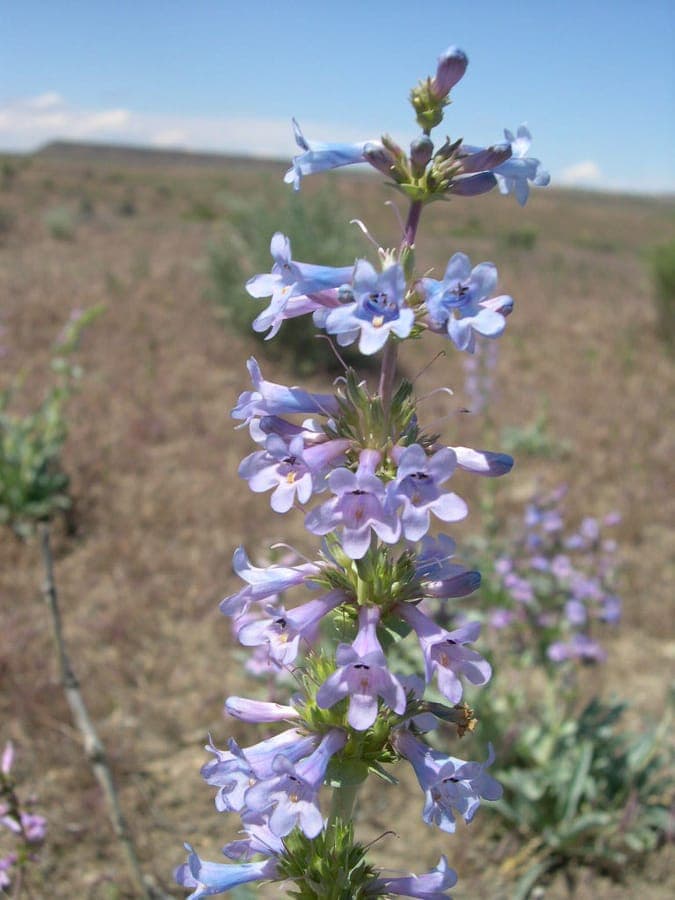
Thayne Tuason / CC BY-SA 4.0, via Wikimedia Commons
Sharpleaf penstemon (Penstemon acuminatus): complete guide
Penstemon acuminatus
Want to see Sharpleaf penstemon (Penstemon acuminatus): complete guide in your garden?
1 minute, no credit card
Overview
Penstemon acuminatus, commonly known as sharpleaf penstemon or sand-dune beardtongue, is a handsome perennial belonging to the plantain family (Plantaginaceae). Described in 1829 by Douglas ex Lindl., this plant is native to the dry, sandy landscapes of the Pacific Northwest of North America - specifically Idaho, Nevada, Oregon and Washington State. The name 'acuminatus' refers to the sharply pointed, tapered leaves that are a key identifying feature of the species.
In its native range, Penstemon acuminatus grows on open sand dunes, dry rocky slopes and scrubland in a semi-arid climate. It is a robust, adaptable species that transfers well to garden cultivation, provided the soil is well-drained. The brilliant blue to blue-violet tubular flowers make it a popular choice for wildlife-friendly, drought-tolerant borders and rock gardens. gardenworld.app is a useful resource for planning and visualising how plants like this can be combined in a harmonious garden design.
The genus Penstemon is the largest genus of flowering plants endemic to North America, with over 270 species. Penstemon acuminatus is one of the more garden-worthy species thanks to its reliable flowering, its tolerance of poor soils and its appeal to pollinators.
Appearance and bloom cycle
Penstemon acuminatus is an upright-growing perennial, typically reaching 30 to 70 cm in height. Stout, erect stems rise from a basal rosette of leaves. The foliage is distinctive: the leaves are green, somewhat leathery, and - true to the name - sharply pointed at the tip. Leaves on the stems are lance-shaped and clasp the stem at their base, a feature typical of many Penstemon species. The overall texture is relatively coarse, which gives the plant a sturdy, architectural quality.
The flowers are the primary ornamental feature. They are tubular, typical of the Penstemon genus, and coloured in shades of blue to blue-violet - occasionally approaching a cool lavender tone. The flowers are arranged in loose, branched panicles that extend well above the foliage. Each flower is two-lipped, with three lower lobes and two upper lobes, often with fine guide-lines inside the throat. The sterile stamen (staminode) that gives all penstemons the common name 'beardtongue' is present, sometimes bearing a short tuft of hairs.
Flowering takes place in spring to early summer, typically from April through June. The flowers are highly attractive to bumblebees, solitary bees and other long-tongued pollinators. In its native North American range, hummingbirds are also frequent visitors.
Ideal location
Full sun is the number-one requirement for Penstemon acuminatus. As a plant of open, exposed sandy habitats, it needs unrestricted sunlight to flower freely and maintain a compact, upright habit. A minimum of six hours of direct sun per day is recommended; in practice, the more sun the better.
Partial or full shade leads to etiolated, floppy growth, reduced flowering and increased susceptibility to stem and root rots. An open, south or south-west facing aspect is ideal in Northern European gardens. Rock gardens, gravel borders, raised beds and sunny south-facing slopes all replicate the conditions of its native environment.
Good air circulation around the plant is also beneficial: Penstemon acuminatus is accustomed to open, breezy sites and does not perform well in enclosed, humid corners. Avoid planting in frost pockets or low-lying areas where cold air and water collect over winter.
Soil
Soil selection is critical with Penstemon acuminatus. The plant originates from dry, sandy desert-edge habitats and requires excellent drainage above all else. Waterlogged or heavy clay soils lead rapidly to crown rot and root rot, particularly in combination with winter cold and moisture.
The ideal soil is lean, sandy to gravelly and free-draining. The pH tolerance is broad - from 6.0 to 8.0 - meaning the plant performs well in neutral to moderately alkaline conditions, making it suitable for chalky or limestone-rich gardens as well as neutral soils. When planting in heavier soils, work in generous amounts of coarse grit or perlite - at least one-third by volume - to improve drainage significantly.
Avoid adding compost or fertiliser at planting time. Penstemon species bloom most freely in lean soils and are more prone to rotting when over-fed with nitrogen. A mulch of coarse grit around the base of the plant, applied over the soil surface, keeps the crown dry and deters slugs.
Watering
Once established, Penstemon acuminatus is highly drought-tolerant and one of the easiest penstemons to maintain in dry conditions. Originating in the semi-arid Pacific Northwest and Great Basin, it is adapted to long dry summers with minimal rainfall. Overwatering is the most frequently cited cause of failure in cultivation.
In the first growing season, water moderately to encourage root establishment, always allowing the soil surface to dry out between waterings. In subsequent years, supplemental watering is rarely needed under typical Northern European rainfall patterns - only during exceptional dry spells or prolonged heatwaves. Container-grown plants need slightly more attention: water when the substrate is completely dry, never allowing pots to stand in saucers of water.
In autumn and winter, watering is drastically reduced. Garden-grown plants in open ground need no supplemental water during the dormant period. Container plants should be kept nearly dry through winter - just enough to prevent the roots from desiccating entirely.
Free design
Want to see Sharpleaf penstemon (Penstemon acuminatus): complete guide in your garden? Make a free design now.
Pruning
Penstemon acuminatus benefits from a straightforward pruning routine. After the main flowering period in late spring or early summer, cut back the spent flower stems to just above the basal foliage. This deadheading can stimulate a second, lighter flush of flowers later in the season in some years, and also keeps the plant looking tidy.
In autumn, resist the temptation to cut the plant back hard. The standing stems provide some protection to the root crown and the basal rosette through winter. Cut back to the basal rosette in late February or early March, once the worst of winter has passed and new growth is beginning to stir from the crown. This timing gives the plant the benefit of stem protection through the coldest months without leaving it straggly for too long into the new growing season.
Do not cut back into old woody stems unnecessarily, as Penstemon acuminatus does not regenerate vigorously from old wood in the way that some other penstemons do. Always use clean, sharp secateurs and sterilise blades between plants.
Maintenance calendar
January and February: Dormancy. No action needed for garden plants. Container plants kept cool and nearly dry in a bright frost-free location. Check drainage is functioning.
March: New growth emerges from the basal rosette. Gently remove any dead stems from the previous year. Watch for slugs on emerging shoots.
April: Active growth. Flower buds beginning to form. Water moderately in dry spells. Do not fertilise.
May to June: Peak flowering. Full sun, minimal watering. Excellent for bees and bumblebees. Leave flower spikes standing during peak bloom.
July: Remove spent flower spikes to encourage possible reblooming. Plants remain attractive through their foliage.
August to September: Growth slows. Little water needed. Seeds ripen - collect for propagation if desired.
October to November: First frosts may damage foliage tips. Leave stems standing for crown protection.
December: Stems can be left or lightly tidied. Container plants moved to frost-free position. Very little to no watering.
Winter hardiness
Penstemon acuminatus is moderately to well frost-hardy, rated at USDA zones 4 to 8. It tolerates sustained cold winters - a result of its origins in the Pacific Northwest and the high-desert basins of the American West, where winters are cold but typically dry. In garden conditions in Northern and Central Europe, it overwinters outdoors successfully in well-drained soils and sheltered positions.
The primary winter risk, as with so many plants in this group, is not temperature but moisture: wet, heavy soils during freeze-thaw cycles cause crown rot far more readily than cold alone. A well-drained planting position and a collar of coarse grit around the crown are the most effective preventive measures. On sandy or gravelly soils, the plant typically requires no additional winter protection at all.
In areas with cold, wet winters on heavy soils, a single layer of dry straw or a light bark mulch over the crown - without smothering the rosette - offers useful protection. Container plants should be brought into a cool, bright, frost-free glasshouse, conservatory or garage for winter. Visiting gardenworld.app can help you plan where to site penstemons in your garden to give them the best drainage and microclimate.
Companion plants
Penstemon acuminatus is an excellent candidate for drought-tolerant, sun-drenched border combinations. Its upright, architectural form and blue flowers combine beautifully with a range of complementary perennials and subshrubs that share its preference for open, free-draining conditions.
Other Penstemon species make natural companions: Penstemon digitalis, Penstemon barbatus and Penstemon heterophyllus all offer varying colours in the same structural style. Beyond the genus, excellent companions include Salvia nemorosa, Echinacea purpurea, Agastache, Achillea and Gaillardia for a long-season prairie-style border. For a rock garden setting, Sedum spectabile, Sempervivum, Armeria maritima and Thymus praecox complement the stiff, upright stems of P. acuminatus without competing.
Local garden centres across the UK typically stock a range of Penstemon cultivars in spring; ask for Penstemon acuminatus specifically by botanical name as it is more commonly found at specialist perennial nurseries than at mainstream retailers.
Closing thoughts
Penstemon acuminatus is a rewarding, low-maintenance perennial for any sunny, well-drained garden. Its combination of early blue flowers, upright form and exceptional drought tolerance makes it particularly valuable in the increasingly dry summers that gardens across Northern Europe are experiencing. It demands very little once established - just sun and sharp drainage - and repays that modest investment with reliable, pollinator-rich flowering season after season.
For gardeners looking to reduce watering commitments while maintaining a beautiful and wildlife-friendly border, sharpleaf penstemon is an ideal starting point.
Want to see Sharpleaf penstemon (Penstemon acuminatus): complete guide in your garden? Make a free design now.
Upload a photo, pick a style, and get a photorealistic design with plant list in under a minute.
10,000+ gardens designed already
No credit card required


Similar plants
Showy locoweed (Oxytropis splendens): complete guide
Oxytropis splendens
Complete growing guide for Oxytropis splendens: ideal location, soil, watering, pruning and winter hardiness for this striking prairie perennial.
Oenothera speciosa: complete guide
Oenothera speciosa
Discover the stunning Oenothera speciosa, showy evening primrose with delicate pink and white flowers. Growing tips, soil requirements, watering, and maintenance guide.
Wild marjoram: complete guide
Origanum vulgare
Origanum vulgare, or wild marjoram, is a hardy herb that thrives in sunny, dry gardens. Perfect for borders, pots, and kitchen use.