
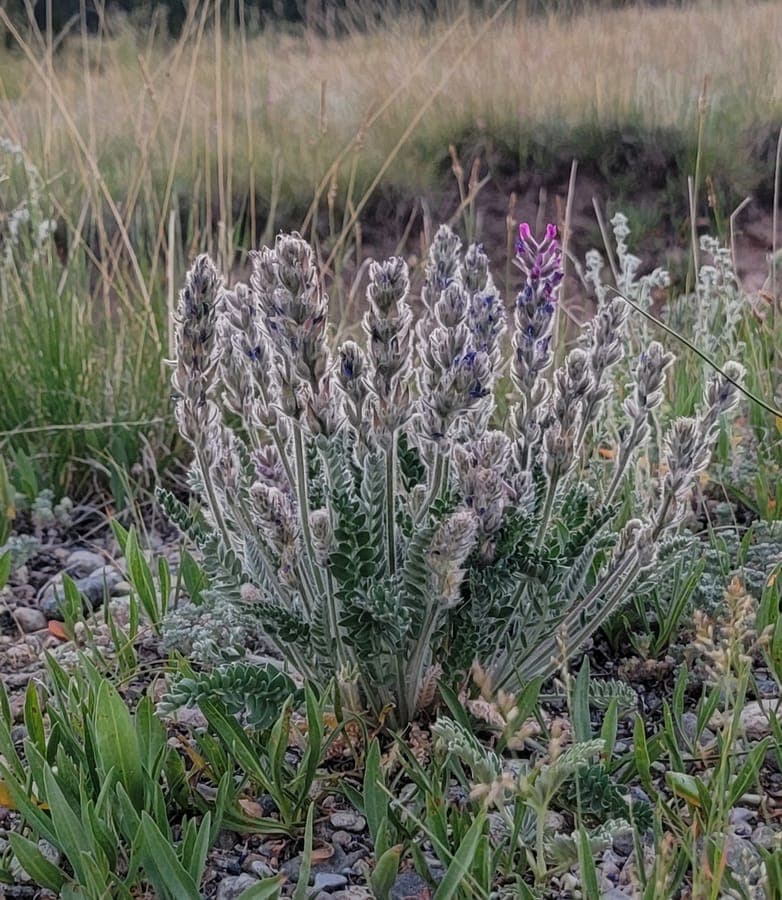
Carlp941 / CC BY-SA 4.0, via Wikimedia Commons
Showy locoweed (Oxytropis splendens): complete guide
Oxytropis splendens
Want to see Showy locoweed (Oxytropis splendens): complete guide in your garden?
1 minute, no credit card
Overview
Oxytropis splendens, commonly known as showy locoweed or showy crazyweed, is a striking perennial belonging to the legume family (Fabaceae). Described by Douglas in 1831, this plant is native to the open prairies and montane grasslands of the western Great Plains of North America, with its range extending across Colorado, Montana, Wyoming, North Dakota, Minnesota and New Mexico. The Latin epithet 'splendens' - meaning 'shining' or 'splendid' - perfectly captures the plant's most distinctive feature: its densely silky-hairy leaves that shimmer in sunlight like a silver sheen across the landscape.
Botanically, Oxytropis splendens belongs to the locoweeds, a group of plants in the Oxytropis and Astragalus genera that contain the alkaloid swainsonine and are toxic to livestock when consumed in quantity. For ornamental garden use, however, this poses no practical problem: the plant is rarely browsed by pets or livestock in small quantities, and it performs beautifully as a drought-tolerant specimen in rock gardens and prairie-style borders. You can find design ideas for prairie-style and dryland gardens at gardenworld.app.
Appearance and bloom cycle
Oxytropis splendens is a low-growing, rosette-forming perennial, typically reaching 20 to 40 cm in height when in flower. The foliage is among the most beautiful of any native prairie plant: the pinnate leaves are densely covered in long, silky, silvery-white hairs that catch the light and give the plant a luminous, frosted appearance. This silvery pubescence is not merely decorative - it serves to reflect intense sunlight and reduce moisture loss in the exposed, dry habitats where the plant naturally grows.
Flowers appear from late May through July, carried in dense, upright, ovoid spikes on sturdy stems that rise well above the foliage. The colour ranges from bright violet-purple to rose-purple, and occasionally approaches deep blue. Each individual flower has the typical pea-family structure: an upright standard petal, two wing petals and a lower keel. The flowers are attractive to bumblebees, which are the primary pollinators. After blooming, small, papery pods develop, containing several seeds.
Ideal location
Full sun is essential for Oxytropis splendens to thrive and flower well. In its native habitat it grows in wide open spaces - prairies, mountain meadows and rocky slopes - where sunlight is unrestricted all day. In garden conditions, a minimum of six to eight hours of direct sun produces the best results. Even light dappled shade results in reduced flowering and a less compact, silver-leafed habit.
Good air circulation around the plant is also beneficial, as the dense, hairy foliage can be prone to fungal issues in damp, still conditions. Open, elevated positions - such as a raised bed, a scree garden or a south-facing slope - suit this plant very well. Avoid planting in low-lying spots where cold air or water collects in winter.
In Northern Europe, a south or south-east facing aspect in a rock garden or gravel border is ideal. The plant also performs well in deep containers with excellent drainage, making it suitable for terraces and sunny balconies.
Soil
Soil type is critical for Oxytropis splendens, but the requirements are simple: it needs excellent drainage and relatively low fertility. In its natural range it grows on dry, sandy or gravelly prairie soils, rocky hillside scree and stony mountain meadows - all of which drain rapidly and offer modest nutrient levels. The ideal pH range is 6.1 to 7.4, from slightly acid to neutral.
In the garden, combine standard loam-based compost with at least 30 to 50 percent coarse horticultural grit or perlite for a suitably free-draining mix. As a legume, the plant fixes atmospheric nitrogen through root nodules, so rich, fertilised soils will produce only lush foliage at the expense of flowers. Avoid clay soils entirely unless they are heavily improved. A layer of coarse gravel or grit around the base of the plant, especially around the crown, helps keep the foliage collar dry and reduces the risk of crown rot.
Watering
Once established, Oxytropis splendens is extremely drought-tolerant. In its native Great Plains environment, the plant endures months of summer drought without difficulty. Overwatering is by far the most common cause of failure in cultivation - the roots simply cannot tolerate prolonged waterlogging.
In the first season after planting, water moderately to encourage root development, allowing the soil to dry out between waterings. After establishment, the plant is largely self-sufficient under normal temperate rainfall. Only during exceptional heat waves or prolonged dry spells should supplemental watering be needed.
For container-grown plants, water when the top of the substrate feels dry to the touch, then drain freely. Reduce watering substantially in autumn and maintain containers nearly dry over winter. Garden plants in open ground need little or no supplemental watering outside the active growing season.
Free design
Want to see Showy locoweed (Oxytropis splendens): complete guide in your garden? Make a free design now.
Pruning
Oxytropis splendens requires minimal pruning. After the flowers fade, spent flower spikes can be removed to keep the plant tidy and to prevent unwanted self-seeding if the soil conditions are suitable for germination. The silvery foliage remains attractive through the entire growing season and can be left on the plant until late autumn.
In autumn, once the plant has fully died back to the crown, old dead foliage can be gently cleared away to allow good airflow around the plant base during winter. Avoid cutting back into living growth during the growing season - the rosette is slow to recover from disturbance. Do not divide or disturb established plants unnecessarily.
If dividing a mature clump, do so in early spring before growth begins, or in early autumn. Ensure each division retains a good root system and replant immediately into well-prepared, free-draining soil.
Maintenance calendar
January and February: Full dormancy. No action needed for garden plants. Container plants should be stored cool and nearly dry in a bright, frost-free location.
March: New leaf growth begins to emerge. Gently remove any dead foliage from the previous year. Watch for slug damage on emerging shoots.
April: Active growth underway. Water moderately in dry spells. Do not feed with nitrogen-rich fertilisers.
May to June: Peak flowering. Full sun, minimal watering. Bumblebees will be regular visitors. Leave bloom spikes intact during flowering.
July: Remove spent flower spikes once blooming finishes, unless seeds are wanted. Plant continues to look attractive through the silvery foliage.
August to September: Growth slows. Very little water needed. Harvest seeds if desired for propagation.
October to December: Plant enters dormancy. Clear dead foliage after hard frost. Move container plants to a cool, bright frost-free position. Check drainage.
Winter hardiness
Oxytropis splendens is extremely cold-hardy - one of this plant's great strengths for temperate garden use. Native to the Great Plains and Rocky Mountain foothills where winters are long and bitter, it is rated at USDA zones 3 to 7, meaning it tolerates temperatures as low as -35 degrees Celsius. In Northern and Central Europe, it overwinters outdoors without any special protection under most circumstances.
The main winter risk is not cold but wet: prolonged waterlogging of heavy soils during freeze-thaw cycles can cause crown rot at the base of the plant. A well-drained planting position and a collar of coarse grit around the crown are the best preventive measures. In very heavy soils or wet winters, a simple pane of glass or a cloche positioned over the plant without touching the foliage will keep excess rain off the crown.
Unlike many borderline-hardy exotics, this plant requires no wrapping, mulching for warmth or indoor overwintering in typical Northern European conditions. It is a genuinely hardy prairie perennial that rewards very little intervention with reliable performance year after year.
Companion plants
Oxytropis splendens is most at home in a prairie-style or rock garden planting scheme alongside other drought-tolerant, sun-loving species that share its preference for lean, sharply drained soils. Planning such a planting scheme is made easy with the visualisation tools at gardenworld.app.
Excellent companions from the North American prairie flora include Penstemon, Echinacea purpurea, Liatris spicata, Gaillardia, Callirhoe involucrata and Dalea purpurea. These all share similar growing conditions and create a rich, naturalistic display from late spring through autumn. In the rock garden, Sedum, Sempervivum, Armeria maritima and Thymus praecox make good textural companions.
Other Oxytropis species (such as O. campestris or O. lambertii) and related Astragalus species pair naturally with O. splendens and echo its silver-hairy form while adding variation in flower colour. Local garden centres in the UK and Ireland are increasingly stocking a wider range of prairie perennials; ask for availability by botanical name.
Closing thoughts
Oxytropis splendens is a plant of real distinction for the sunny, well-drained garden. Its combination of luminously silver foliage, rich violet flower spikes and genuine hardiness makes it a standout choice for rock gardens, gravel borders and prairie plantings where low maintenance and high ornamental value are both important.
Propagation is straightforward from seed - stratify seeds in damp sand in the refrigerator for four to six weeks before sowing in a free-draining seed compost. Once established, the plant asks for very little in return for a beautiful display every summer.
Want to see Showy locoweed (Oxytropis splendens): complete guide in your garden? Make a free design now.
Upload a photo, pick a style, and get a photorealistic design with plant list in under a minute.
10,000+ gardens designed already
No credit card required


Similar plants
Field locoweed: complete guide
Oxytropis campestris
Discover Oxytropis campestris, a hardy alpine plant with golden flowers. Growing tips and companion plants perfect for mountain gardens.
Purple locoweed: complete guide
Oxytropis lambertii
Everything about Oxytropis lambertii: cultivation, location, soil needs and care of this vivid purple prairie perennial from the North American plains.
Sainfoin: complete guide
Onobrychis viciifolia
Discover sainfoin (Onobrychis viciifolia), a nutrient-rich fodder crop and stunning bloomer from Central and Southeast Europe. Ideal for meadows and natural gardens.