
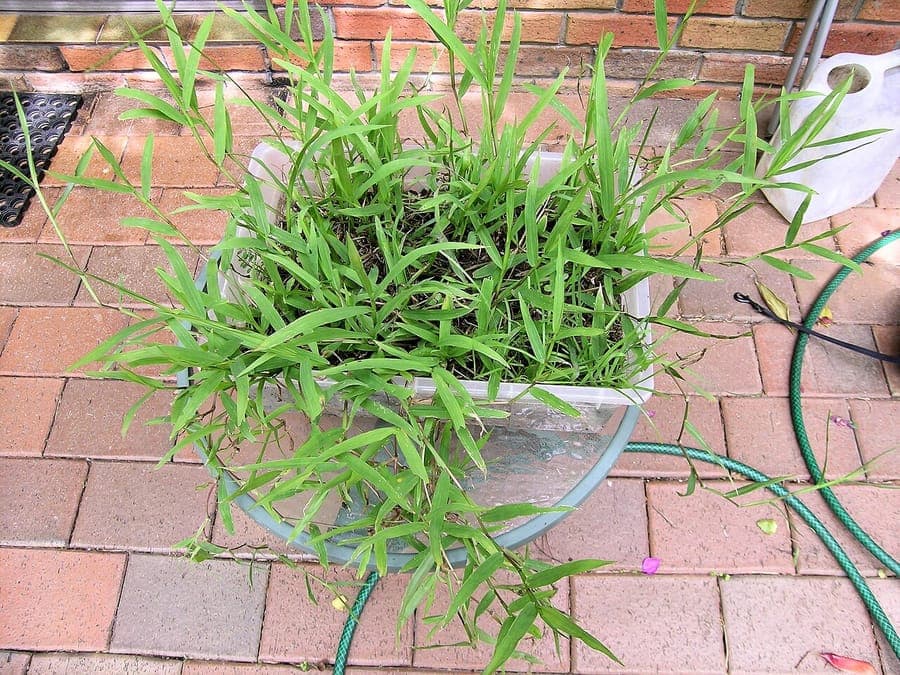
Harry Rose from South West Rocks, Australia / CC BY 2.0, via Wikimedia Commons
Hilo grass: complete guide
Paspalum conjugatum
Want to see Hilo grass: complete guide in your garden?
1 minute, no credit card
Overview
Paspalum conjugatum, known in English under several common names - hilo grass, sour paspalum, sour grass, water grass, and buffalo grass among them - is a stoloniferous perennial in the family Poaceae, native to tropical and subtropical regions of the Americas. The species was formally described in 1772 by the Swedish botanist P.J. Bergius. Its scientific epithet 'conjugatum' - meaning 'paired' or 'yoked together' - refers directly to its most distinctive morphological feature: the two slender, symmetrically arranged seed spikes that fork at the tip of each stem.
From its native range across tropical America, stretching from the southern United States through Central America and the Caribbean to Bolivia, Paraguay, and northern Argentina, Paspalum conjugatum has spread across virtually every tropical and subtropical region on earth. It has been introduced to large parts of sub-Saharan Africa, South and Southeast Asia, the Pacific islands, and Australia, where it is valued in some contexts as a ground cover capable of stabilising bare and eroded tropical soils, while in others it is regarded as a troublesome invasive weed in coconut, tea, and rubber plantations.
The French names 'herbe creole' and 'herbe sure' (sour herb) reference the mild acidity of its foliage. For gardeners in temperate Europe, this plant is primarily of botanical interest or suitable for heated glasshouses; the climate is too cool for outdoor cultivation year-round. Those interested in how tropical plants can be incorporated into a garden design vision can explore gardenworld.app for photorealistic design inspiration.
Appearance and bloom cycle
Paspalum conjugatum is a low-growing, mat-forming grass with a strongly stoloniferous habit. The stems are decumbent to ascending, rooting at the lower nodes as they creep along the ground, and can reach 20 to 80 cm in length. This rooting habit contributes substantially to the plant's ability to form dense, persistent mats that are difficult to eradicate once established.
The leaves are lanceolate, 5 to 20 cm long and 5 to 12 mm wide, slightly hairy on both surfaces and along the margins. The sheaths are slightly compressed and pale green. The leaf blade is flat and soft, without the cutting edges found in some other grass species.
The inflorescence consists of two paired, slender racemes, each 7 to 15 cm long, spreading horizontally and arranged symmetrically at the apex of each culm - the 'paired' feature that gives the species its name. The spikelets are arranged in a single row along each raceme and are fringed with fine silky hairs that give the spikes a feathery appearance when caught in sunlight. In tropical climates the plant can flower and set seed throughout the year; in areas with a distinct dry season, flowering concentrates in the wet, warm months.
Seeds are small and easily dispersed by wind, water, animals, and human activity, which explains the species' rapid naturalisation wherever suitable conditions exist.
Ideal location
Paspalum conjugatum is notably shade-tolerant compared with most grass species, a trait that makes it a particularly effective and problematic weed in partially shaded agricultural systems. In the wild it occupies disturbed ground in a wide range of light conditions: from open, full-sun roadsides and field margins to the partial shade beneath orchard trees and plantation canopies.
The plant thrives in warm, humid conditions and requires minimum temperatures above approximately 10 degrees Celsius to survive. In its native range and introduced territories it is found from sea level to around 1800 metres altitude in the tropics. It is not frost-tolerant and cannot be grown outdoors year-round in temperate climates.
For gardeners in northern Europe, this plant is suitable only as a glasshouse subject or as a tender summer plant in containers, to be brought indoors before the first autumn frosts. In subtropical gardens (USDA zones 9 and above), it can be grown outdoors with minimal protection in all but the coldest winters.
Soil
One of the keys to Paspalum conjugatum's global success as a weed is its remarkable tolerance of poor soil. It grows on sandy loams, clay-based soils, lateritic tropical soils, and even on the thin, highly leached soils of tropical rainforest margins that support little other vegetation. This wide edaphic tolerance allows it to establish in conditions that would deter most competing species.
The plant performs best on moist to wet soils with a slightly acid to neutral pH. It tolerates waterlogging better than most grass species and is often found along stream margins and in seasonally flooded areas. On degraded, erosion-prone tropical soils it is sometimes deliberately planted as ground cover to stabilise bare earth, since its dense mat and strong root system bind the topsoil effectively.
No particular soil preparation is necessary for garden cultivation in heated glasshouses or as a container plant. Standard potting mix with good drainage is adequate; the main requirement is consistent moisture.
Free design
Want to see Hilo grass: complete guide in your garden? Make a free design now.
Watering
Paspalum conjugatum is a plant of moist tropical habitats and grows most vigorously with consistent and generous moisture. In its native range it thrives along watercourses, in seasonally flooded grasslands, and in areas that receive 1500 mm of rainfall or more per year.
During dry periods the plant slows markedly in growth and the leaves may yellow and partially dry out, but the stolons and buried nodes remain alive and the plant regrows rapidly when moisture returns. This resilience is part of what makes it such a persistent weed in managed landscapes.
For glasshouse cultivation in temperate climates, regular watering is essential, particularly in summer. Container-grown plants can dry out quickly; check moisture levels frequently and water thoroughly when the top centimetre of potting mix feels dry. Reduce watering in winter when the plant is less active, but do not allow it to dry out completely.
In tropical garden designs that feature water features or moist borders - the kind that can be visualised through gardenworld.app - Paspalum conjugatum might serve as a ground-level component in the planting palette.
Pruning
Without active management, Paspalum conjugatum spreads rapidly and aggressively via its creeping, rooting stolons. In gardens and managed landscapes in the tropics, regular mowing or cutting is the primary means of control and containment.
The plant tolerates frequent mowing well and regenerates quickly from the stolons. At a mowing height of 3 to 5 cm it forms a relatively low, dense turf. As a ground cover under taller plants, cutting or trimming every six to eight weeks is generally sufficient to keep growth within bounds.
In glasshouse cultivation, cut back stems that become too long using sharp scissors or secateurs. Removed stem sections can be used for vegetative propagation: any section bearing a node will root readily in moist substrate, making propagation simple but also reminding the grower to dispose of cuttings carefully to prevent unintended spread.
In natural or semi-natural garden settings, hand-pulling stolons at the margins of a planting is a labour-intensive but effective way of preventing unwanted spread into adjacent areas.
Maintenance calendar
Maintenance needs vary significantly with climate zone.
In tropical climates (USDA zones 10 and warmer): The plant is active year-round. Mow or cut monthly to manage spread. Remove stolons extending beyond the desired area. Monitor for spread into sensitive or natural habitats nearby.
In subtropical climates (USDA zones 9 to 10): The plant may slow or partially die back in the cooler, drier months but recovers strongly in spring. Cut back in early spring to refresh growth.
In temperate climates (glasshouse or container, zones 8 and below): Bring plants indoors before the first frost in autumn. Reduce watering and keep the glasshouse frost-free. In spring, resume regular watering and move the plant back outside gradually once night temperatures are reliably above 10 degrees Celsius.
At specialist tropical plant nurseries and some large garden centres, you can obtain advice on overwintering tropical grasses in containers.
Winter hardiness
Paspalum conjugatum is frost-sensitive and cannot be considered winter-hardy in temperate climates. Even light frost damages the foliage, and sustained freezing temperatures kill the above-ground parts of the plant. Only deeply buried nodes may survive a brief, mild frost if the soil does not freeze solid.
In USDA zone 10 and warmer, the plant grows outdoors year-round without protection. In zone 9, it can survive mild winters in sheltered, frost-free microclimates. In zone 8 and below, it must be treated as a tender annual or overwintered indoors as a container plant in a frost-free glasshouse.
For gardeners in the Netherlands, Belgium, and most of Germany, outdoor cultivation year-round is not possible. The plant is best enjoyed as an exotic glasshouse specimen or as a summer container plant that is moved indoors in September. It is rarely available at mainstream garden centres in these countries; specialist tropical plant nurseries are the most likely source.
Companion plants
In its native tropical range, Paspalum conjugatum grows alongside a diverse community of tropical and subtropical plants that share its preference for moist, disturbed, or partially shaded conditions. Common associates include species of Cyperus, Commelina, Oxalis, and various other low-growing, moisture-tolerant plants of tropical grassland margins.
For glasshouse or indoor tropical displays in temperate countries, excellent companions include ferns such as Nephrolepis exaltata and Asplenium nidus, Tradescantia varieties, tropical bromeliads, small Heliconia species, and Canna cultivars. These share the requirement for warmth and consistent moisture and together create a layered, tropical atmosphere.
In a large glasshouse setting, Paspalum conjugatum can serve as a low, green carpeting layer beneath taller tropical specimens, providing a naturalistic ground-level effect. Gardeners interested in how such tropical compositions might be visualised in a garden context can use gardenworld.app to explore design possibilities.
Closing thoughts
Paspalum conjugatum is a grass of global ecological significance - simultaneously valued for soil stabilisation and cursed as an invasive weed, depending on context. For the temperate-zone gardener it represents an exotic curio rather than a practical garden plant: best appreciated in a warm glasshouse or as a summer container subject, and worthy of study for the insight it gives into the dynamics of tropical plant communities.
Its remarkable adaptability - to shade, to poor soils, to mowing, to flooding - is a testimony to the resilience of tropical grass species. Understanding plants like Paspalum conjugatum deepens appreciation of the diversity and complexity of the plant world far beyond the borders of the familiar temperate garden.
Want to see Hilo grass: complete guide in your garden? Make a free design now.
Upload a photo, pick a style, and get a photorealistic design with plant list in under a minute.
10,000+ gardens designed already
No credit card required


Similar plants
Sporobolus pungens: complete guide
Sporobolus pungens
Sporobolus pungens is a stoloniferous Mediterranean coastal grass with outstanding salt and drought tolerance, perfect for seaside and dry gardens.
Mediterranean aegilops: complete guide
Aegilops biuncialis
Everything about Aegilops biuncialis, a Mediterranean annual grass with ornamental spikes and outstanding drought tolerance for dry gardens.
Silver bluestem: complete guide
Bothriochloa saccharoides
Full guide to Bothriochloa saccharoides (silver bluestem): site, soil, watering, winter hardiness, pruning, and garden companions.