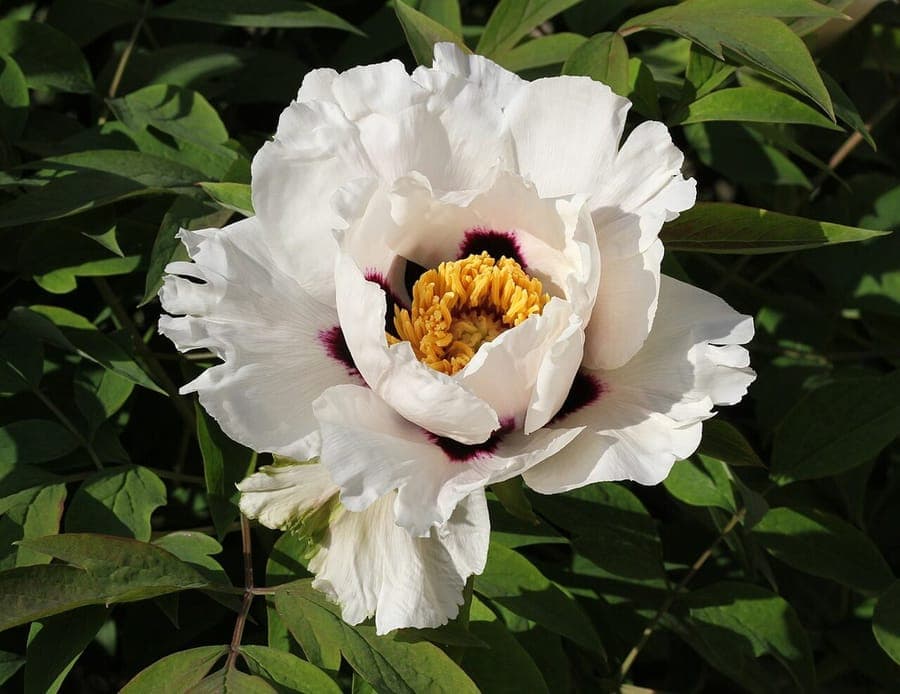
George Chernilevsky / Public domain, via Wikimedia Commons
Paeonia rockii: Rock's tree peony
Paeonia rockii
Want to see Paeonia rockii: Rock's tree peony in your garden?
Full design in HD: €7.99
Look after your Paeonia rockii with the GardenWorld app
Identify plants with your camera and get a care calendar with reminders for this plant.


Overview
For many peony enthusiasts, Paeonia rockii is the finest of all tree peonies. Its large white flowers, each petal marked at the base with a dark, almost black-purple blotch, are instantly recognisable and hard to forget. The species comes from the mountains of north-western and central China, above all southern Gansu, and is named after the plant hunter Joseph Rock. In the 1920s he sent seed from a monastery in Gansu to the West, and the plants raised from it became the ancestors of a whole group of garden forms.
In China these garden forms are known as the Gansu peonies. They come in white, pink, lilac and purple-red, but all share those distinctive dark blotches. In the wild, Rock's peony is rare and threatened; in the garden, by contrast, it is a robust, long-lived shrub and exceptionally hardy. On gardenworld.app you can have a garden design made that gives this tree peony pride of place, for instance beside a seating area where you can enjoy its fragrance at close quarters.
Paeonia rockii usually grows 1.5 to 2 m tall and as wide, eventually reaching 2.5 m in some gardens. It is slow to establish: expect four or five years before a young plant flowers freely. That patient start is amply repaid.
Appearance and bloom cycle
Flowering takes place in May, a little later than many other tree peonies. The flowers are 13 to 19 cm across, single to semi-double, with broad, slightly frilled petals in pure white or soft pink. At the base of each petal sits a large, sharply defined blotch of deep maroon to purple-black. The photograph shows this well: a semi-double white flower with dark red blotches around a dense crown of golden stamens, set against fresh green foliage. The disc around the carpels is pale in Paeonia rockii, which helps to tell it apart from Paeonia ostii, where the disc is purple.
The flowers are beautifully scented, sweet with a hint of citrus, especially on warm mornings. Bees and bumblebees visit them eagerly. A mature plant can carry dozens of blooms at once, a spectacular sight in May.
The leaves are two or three times divided into many narrow, lance-shaped leaflets, usually smooth-edged and slightly hairy beneath. As a result the plant looks finer and airier than the common tree peony. In autumn the foliage turns yellow to brown before it falls.
Ideal location
Paeonia rockii wants a sunny or lightly shaded position. In the wild it grows on slopes in open woodland and scrub, in a continental climate with cold, dry winters and warm summers. In British and Western European gardens it performs best with at least five hours of sun a day, ideally with a little shade during the hottest part of the afternoon so the flowers last longer.
Choose a sheltered spot out of the wind, as large flowers on long stems can snap in wind and rain. Avoid frost pockets where cold air lingers; the young shoots are vulnerable in April even though the plant itself is extremely hardy. Leave at least 1.5 m between it and other shrubs so that air can move freely through the branches.
Soil requirements
Above all, the soil must drain well. In the wild Paeonia rockii grows on deep, limy, dry loess soils. A neutral to slightly alkaline soil with a pH between 6.5 and 8 is ideal. It dislikes wet feet in winter: on heavy clay the fleshy roots are prone to rot.
Dig a generous planting hole about 60 cm deep and wide and mix the excavated soil with coarse grit and a little compost. Plant in autumn, from September to November. If the plant is grafted, set the graft union 10 to 15 cm below ground so that the scion forms its own roots. Seed-raised plants or those on their own roots go in at the same depth as in the pot.
Free preview
Want to see Paeonia rockii: Rock's tree peony in your garden? Make a free preview of your design.
Watering
Young plants need regular watering in their first year: a full can of about 10 litres a week in dry weather, aimed at the base. Once established, Paeonia rockii is remarkably drought tolerant, more so than most tree peonies. Extra water is then only needed in long dry spells in spring and early summer, when next year's buds are forming.
Too much water is more dangerous than too little. Make sure water never stands around the plant and do not pile mulch against the stems. Feed sparingly with a handful of organic fertiliser or some compost in March.
Pruning
Prune as little as possible. Paeonia rockii flowers on the previous year's wood, and any hard pruning in spring costs flowers. After flowering, remove faded blooms just above a good leaf, unless you want to collect seed. In spring, cut out dead or frost-damaged wood as soon as you can see which buds are alive.
An old, bare branch can be cut low after flowering to rejuvenate the shrub, but do this with no more than one branch a year. On grafted plants, remove rootstock suckers at the base as soon as they appear.
If you would like to raise your own plants, collect ripe seed in September and sow it straight away in a pot outdoors. Germination is slow: the root appears in autumn, the first leaf only in the second spring. Seedlings flower after five to seven years and may differ in colour from the parent.
Maintenance calendar
February to March: Apply a layer of compost or organic fertiliser. Keep fleece ready for frosty nights once the buds swell.
April: Leaves unfold. Cover young shoots overnight if frost threatens. Remove dead wood.
May: Flowering. Support heavy blooms if needed and deadhead faded flowers.
June to August: Water during long dry spells. Keep the base free of weeds.
September to November: Time for planting and sowing. Clear fallen leaves to limit grey mould.
December to January: Dormant. No care needed.
To see which jobs are waiting in your garden each month, the plant calendar on gardenworld.app gives you a handy overview.
Winter hardiness
Paeonia rockii is one of the hardiest tree peonies. When dormant it tolerates temperatures down to around -30 °C, a legacy of the harsh winters in its native range. Anywhere in Britain and the Low Countries it needs no winter protection. The only real risk is late frost in April, which can damage young shoots and buds. A layer of fleece over the plant on a frosty night is enough.
Wet winters are a bigger problem than cold ones. On free-draining soil it overwinters without difficulty.
Like all peonies, Paeonia rockii is mildly toxic. Roots, leaves, flowers and seeds contain compounds such as paeonol that can cause stomach upsets in people if eaten, and vomiting or diarrhoea in dogs, cats and horses. Serious poisoning is rare.
Companion plants
Let this tree peony take centre stage and choose calm partners. Lady's mantle (Alchemilla mollis) makes a soft, lime-green underplanting that shows off the dark blotches in the flowers. Geranium himalayense opens clear blue flowers from late May and fills the space around the base. Allium cristophii adds a playful touch at the same time with large, silvery-purple heads.
If you want more tree peonies, combine it with the deep red Paeonia delavayi or a pink-flowered Paeonia × suffruticosa. Avoid dense, tall perennials pressed against the shrub: Paeonia rockii needs light and air.
Final thoughts
Paeonia rockii is not a plant for impatient gardeners, but give it time and you gain a shrub for life. It is exceptionally hardy, tolerates drought, needs hardly any pruning and flowers every spring with fragrant white blooms full of dark blotches. Give it a sunny, sheltered spot with free-draining, limy soil, protect the young shoots from late frost and otherwise leave it in peace.
Frequently asked questions about Paeonia rockii
Is Paeonia rockii winter hardy?
Paeonia rockii is one of the hardiest tree peonies. When dormant it tolerates temperatures down to around -30 °C, a legacy of the harsh winters in its native range.
When and how do you prune Paeonia rockii?
Prune as little as possible. Paeonia rockii flowers on the previous year's wood, and any hard pruning in spring costs flowers.
How much water does Paeonia rockii need?
Young plants need regular watering in their first year: a full can of about 10 litres a week in dry weather, aimed at the base. Once established, Paeonia rockii is remarkably drought tolerant, more so than most tree peonies.
Where does Paeonia rockii grow best?
Paeonia rockii wants a sunny or lightly shaded position. In the wild it grows on slopes in open woodland and scrub, in a continental climate with cold, dry winters and warm summers.
What soil does Paeonia rockii need?
Above all, the soil must drain well. In the wild Paeonia rockii grows on deep, limy, dry loess soils.

See it in your garden
See Paeonia rockii in your garden
One photo of your garden and a few questions. You see the result in about a minute.
Try it with a photoIdentify this plant in your own garden. Identify a plant
Similar plants
Tree peony (Paeonia x suffruticosa): complete guide
Paeonia x suffruticosa
Discover tree peonies: cultivation, care essentials, and garden placement. Magnificent flowers and long-lived shrub plants.
Delavay peony: complete guide
Paeonia delavayi
Discover the elegant tree peony of Delavay (Paeonia delavayi) from Tibet. Guide for cultivation, care, and enjoying these unique flowers.
Garden lady's-mantle: complete guide
Alchemilla mollis
Alchemilla mollis, or garden lady's-mantle, is a graceful perennial perfect for borders, shade gardens, and low-maintenance landscapes. Grows 15–30 cm tall, blooms June–August.
