peachberry98 / CC BY 2.0, via Wikimedia Commons
Paeonia ostii: the Feng Dan tree peony
Paeonia ostii
Want to see Paeonia ostii: the Feng Dan tree peony in your garden?
Full design in HD: €7.99
Look after your Paeonia ostii with the GardenWorld app
Identify plants with your camera and get a care calendar with reminders for this plant.


Overview
Paeonia ostii is a tree peony from central China, known in gardens mainly through a single selection: 'Feng Dan Bai', a white, single-flowered form that Chinese growers have cultivated for centuries. The name Feng Dan refers to the area around Tongling in Anhui province, where the plant is grown on a large scale for its root bark, used in traditional medicine, and more recently for its oil-rich seeds. In China it is also the standard rootstock for grafted tree peonies, so many gardeners have grown its roots without ever seeing the species itself in flower.
That is a pity, because Paeonia ostii is a rewarding garden shrub in its own right. It flowers early, generously and reliably, grows with more vigour than many double-flowered cultivars and has a calm, uncluttered beauty. Broad white saucers with a heart of purple filaments look as much at home in a contemporary gravel garden as in a traditional mixed border. On gardenworld.app you can have a garden design made that gives this tree peony a permanent place, for example as a focal point beside a terrace or rising above low perennials.
This is a deciduous shrub that usually reaches 1 to 1.5 m in height and a similar width. Like all tree peonies it resents being moved, so choose its position carefully from the start.
Appearance and bloom cycle
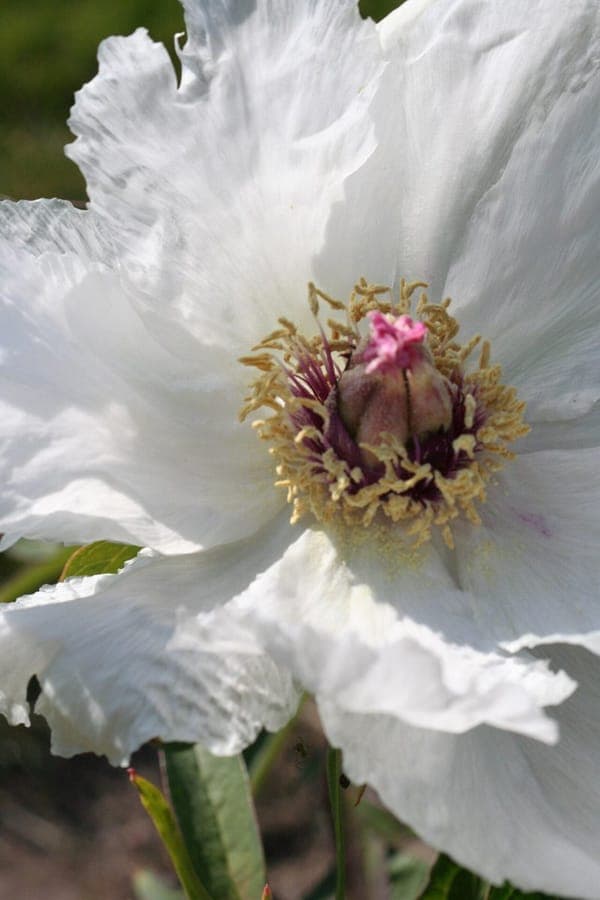
Flowering runs from late April to mid-May, often a week or two ahead of most other tree peonies. The flowers are single, 12 to 16 cm across, with ten to fifteen broad, gently ruffled petals. They are pure white, sometimes faintly flushed pink at the base as they open. The centre is the real feature: a ring of golden anthers on purple-red filaments, surrounding a pink to purple disc that sheathes the carpels. The photograph shows that centre in close-up, with the pink stigmas standing proud of the stamens. Bees and bumblebees visit them freely.
The leaves are twice divided into fifteen or more narrow, lance-shaped leaflets, usually with smooth margins. This sets Paeonia ostii apart from the common garden tree peony (Paeonia × suffruticosa), whose leaflets are broader and often lobed. New growth emerges reddish in March and soon turns fresh green.
After flowering, star-shaped clusters of hairy seed pods develop, holding large, glossy black seeds. These seeds are rich in oil, and peony seed oil is pressed as a cooking oil in China. In the garden it is better not to let every pod ripen, since the plant then puts energy into seed rather than next year's buds.
Ideal location
Paeonia ostii likes full sun or light shade. Four to six hours of direct sun a day is enough for good flowering. A position with morning sun and some protection from the fiercest afternoon heat is ideal: the white flowers last longer and are less likely to scorch.
More important than the amount of sun is shelter from late frost and wind. Because this species breaks bud early, a frosty night in April can damage young shoots and flower buds. Avoid frost pockets where cold air collects, and ideally avoid spots that catch the first sun of the morning, since rapid thawing makes frost damage worse. A sheltered position near a wall or hedge, open to the east or south, works well.
Give the plant room. Allow at least 1.2 m between a tree peony and neighbouring shrubs so that air can move freely around the branches. Good air flow is the best defence against grey mould (Botrytis), the main disease of peonies.
Soil requirements
Tree peonies prefer deep, fertile, well-drained soil. A loamy garden soil with a pH between 6.5 and 7.5 is ideal, and a little lime does no harm. On heavy clay that stays wet in winter the roots tend to rot. Improve such ground by digging a planting hole at least 60 cm wide and deep and mixing the excavated soil with coarse grit and well-rotted compost.
Plant in autumn, from September to November, so that roots can establish before winter. Many plants on sale are grafted. In that case set the graft union 10 to 15 cm below soil level; the scion will then form its own roots and the plant will become stronger and longer-lived. A plant on its own roots goes in at the same depth as it grew in the pot.
Free preview
Want to see Paeonia ostii: the Feng Dan tree peony in your garden? Make a free preview of your design.
Watering
In the first year after planting, Paeonia ostii needs regular watering, especially in spring and during dry summers. Give a generous can of about 10 litres once a week, aimed at the base rather than over the leaves.
Once established, the plant copes well with dry spells thanks to its deep, fleshy roots. Water only during prolonged drought, particularly in May and June when next year's buds are forming. A 5 cm mulch of compost or bark keeps the root zone cool and moist; keep it a hand's width away from the stems.
Feed sparingly. A handful of organic fertiliser or a layer of compost in March is plenty. Too much nitrogen produces soft growth that is more prone to frost damage and fungal disease.
Pruning
Tree peonies need very little pruning. They flower on the previous year's wood, so cutting back hard in spring simply removes the flowers. Limit yourself to the following.
After flowering, remove spent blooms just above the first well-developed leaf. This prevents seed formation and removes a common entry point for grey mould. In March or April, once you can see which buds are swelling, cut out dead or frost-damaged wood back to a live bud.
Over the years, old bare stems can be renewed by cutting one of them low down in summer after flowering; new shoots usually appear from the base. Do this with no more than one stem per year. On grafted plants watch for suckers from the rootstock: they appear from the ground away from the main stems and carry different foliage. Remove them at the base.
Maintenance calendar
February to March: Spread compost or organic fertiliser around the plant. Keep horticultural fleece handy for frosty nights once the buds swell.
March to April: Leaves unfurl. Cover the plant overnight with fleece if frost is forecast. Remove dead wood as soon as you can see where growth is.
Late April to May: Flowering. Support heavy branches during spells of rain. Deadhead faded blooms.
June to August: Water during prolonged drought. Keep the base free of weeds and remove any rootstock suckers.
September to November: The best time for planting. Clear fallen leaves, especially if they showed grey mould spots.
December to January: Dormant season. No special care required.
For a month-by-month overview of jobs in the garden, use the plant calendar on gardenworld.app.
Winter hardiness
Paeonia ostii is fully hardy and tolerates temperatures down to about -25 °C when dormant, so winter cold is not a concern anywhere in Britain or the Low Countries. The real risk is late frost. Because growth starts early, a frost in April can kill young shoots and flower buds. The plant itself almost always survives, but that year's flowers are lost.
Young plants in their first winter benefit from a mulch around the base. Plants in containers are more vulnerable; stand the pot against a sheltered wall in winter and make sure water drains away freely.
Bear in mind that peonies are mildly toxic. All parts of Paeonia ostii, including roots, leaves, flowers and seeds, contain compounds such as paeonol. Eating larger amounts can cause stomach upsets in people, and dogs, cats and horses may suffer vomiting and diarrhoea. Serious poisoning is rare, but keep curious pets away from fallen seeds.
Companion plants
A white tree peony needs partners that do not shout over it. Allium hollandicum flowers at the same time and lifts purple globes above low planting, picking up the purple centre of the peony. Geranium macrorrhizum makes an excellent ground cover beneath the shrub: it tolerates dry shade and root competition and keeps the soil covered.
Catmint (Nepeta × faassenii) gives a long second wave of blue-violet once the peony has finished. To extend the peony season into summer, plant a herbaceous peony (Paeonia lactiflora) nearby; it flowers in late May and June, after Paeonia ostii is over. The common tree peony (Paeonia × suffruticosa) also makes a good neighbour, adding colours this species does not offer.
Avoid tall, spreading plants that lean into the shrub.
Final thoughts
Paeonia ostii is the quiet ancestor behind many tree peonies, yet it deserves a place as a garden plant in its own right. It flowers early and freely, grows more strongly than many named cultivars and needs very little pruning. Give it a sheltered, sunny position, deep and well-drained soil and, above all, time: once planted, leave it alone and the display will improve year after year. Protect the young shoots from late frost and this white classic will reward you for decades.
Frequently asked questions about Paeonia ostii
Is Paeonia ostii winter hardy?
Paeonia ostii is fully hardy and tolerates temperatures down to about -25 °C when dormant, so winter cold is not a concern anywhere in Britain or the Low Countries. The real risk is late frost.
When and how do you prune Paeonia ostii?
Tree peonies need very little pruning. They flower on the previous year's wood, so cutting back hard in spring simply removes the flowers.
How much water does Paeonia ostii need?
In the first year after planting, Paeonia ostii needs regular watering, especially in spring and during dry summers. Give a generous can of about 10 litres once a week, aimed at the base rather than over the leaves.
Where does Paeonia ostii grow best?
Paeonia ostii likes full sun or light shade. Four to six hours of direct sun a day is enough for good flowering.
What soil does Paeonia ostii need?
Tree peonies prefer deep, fertile, well-drained soil. A loamy garden soil with a pH between 6.5 and 7.5 is ideal, and a little lime does no harm.

See it in your garden
See Paeonia ostii in your garden
One photo of your garden and a few questions. You see the result in about a minute.
Try it with a photoIdentify this plant in your own garden. Identify a plant
Similar plants
Tree peony (Paeonia x suffruticosa): complete guide
Paeonia x suffruticosa
Discover tree peonies: cultivation, care essentials, and garden placement. Magnificent flowers and long-lived shrub plants.
Garden peony: complete guide
Paeonia lactiflora
Everything about the garden peony (Paeonia lactiflora): planting depth, fragrant blooms, cultivars and long-term care. Expert tips for flowers that last a lifetime.
Persian onion: complete guide
Allium hollandicum
Persian onion (Allium hollandicum) blooms with striking purple spherical flower heads. Learn how to grow this spectacular bulb plant and enjoy its dramatic spring display.
