Flobbadob / CC BY-SA 4.0, via Wikimedia Commons
Paeonia ludlowii: the Tibetan tree peony
Paeonia ludlowii
Want to see Paeonia ludlowii: the Tibetan tree peony in your garden?
Full design in HD: €7.99
Look after your Paeonia ludlowii with the GardenWorld app
Identify plants with your camera and get a care calendar with reminders for this plant.


Overview
Paeonia ludlowii, the Tibetan tree peony, is one of the largest and most striking peonies you can grow. It comes from a small area of south-eastern Tibet, in the valley of the Yarlung Tsangpo, where it grows on slopes between 2,900 and 3,500 m. The species is named after Frank Ludlow, who collected seed there with George Sherriff in the 1930s. It is rare and endangered in the wild, yet it thrives in gardens thanks to its vigour and the ease with which it can be raised from seed.
What makes this shrub special is the combination of large, elegantly cut foliage and clear yellow, cup-shaped flowers. Even out of flower it is a handsome plant with an almost tropical look. On gardenworld.app you can have a garden design made that gives Paeonia ludlowii the space it needs, for instance as a specimen in a lawn or at the back of a broad border.
Expect a substantial plant: after ten to twenty years it will measure 1.5 to 2.5 m tall and at least as wide. Plan for that generously, since it does not take kindly to being moved.
Appearance and bloom cycle
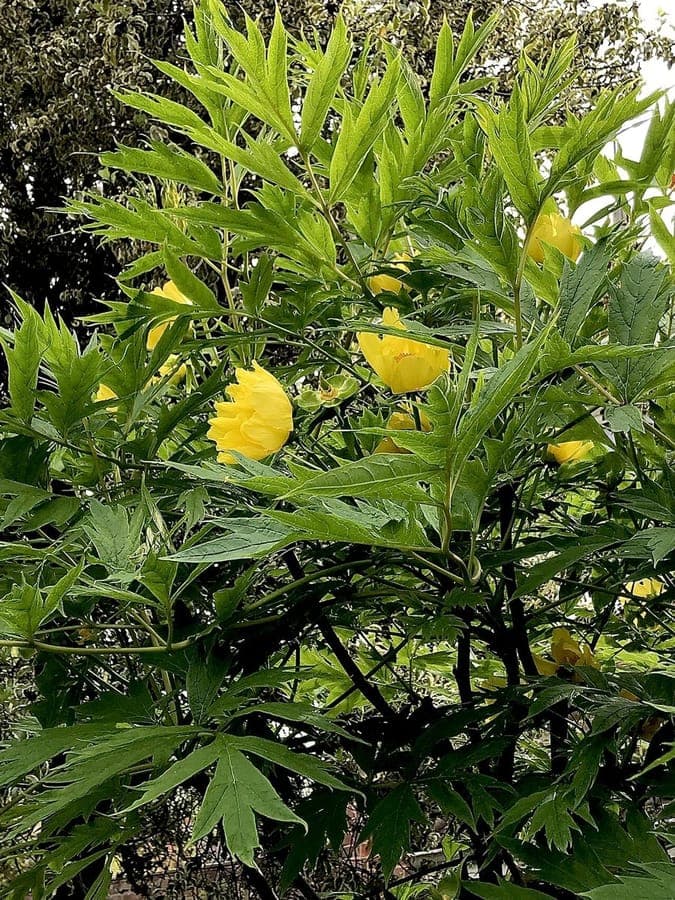
Flowering runs from mid-May to early June. The flowers are single, 10 to 12 cm across, cup-shaped and often slightly nodding. They are a clean buttery yellow without red markings, with a centre of yellow stamens. That sets the species apart from its relative Paeonia delavayi, whose yellow forms have smaller flowers that are sometimes marked with red. The photograph shows the typical picture: yellow blooms half hidden among large, light green, deeply cut leaves, carried on dark woody stems.
The way the flowers sit partly within the foliage is a feature of the species, not a fault. They are best admired by looking up from beneath the shrub. Bees and bumblebees find them without trouble.
The leaves are large, up to 30 cm long, and deeply divided into pointed lobes. They emerge fresh light green in April and stay ornamental throughout summer. By late summer they can look a little ragged, and in autumn they yellow and fall fairly early. After flowering, plump fruits develop containing the largest seeds of any peony, up to 1.5 cm long, brown at first and later almost black.
Ideal location
Paeonia ludlowii grows in sun or partial shade. It flowers most freely in full sun but also tolerates a few hours of shade a day, which makes it more adaptable than many other tree peonies. It does well in the dappled shade of tall trees as long as root competition is not too fierce.
Choose a sheltered position, as the big leaves can tear in strong wind. The young shoots appear in April and are then vulnerable to late frost, so avoid frost pockets where cold air settles. Allow at least 2 m between it and other shrubs.
Soil requirements
A deep, fertile, well-drained soil is ideal. The species is not fussy about pH: slightly acidic to slightly alkaline soils all suit it. Wet feet in winter are a problem, though, and on heavy, waterlogged clay the roots may rot. Work in coarse grit and compost there, or plant slightly proud of the surrounding ground.
Plant in autumn, from September to November, or in early spring. Paeonia ludlowii is usually raised from seed and therefore grows on its own roots; plant it at the same depth as it was in the pot. Dig a generous hole about 60 cm deep and wide, and mix the soil with compost.
Free preview
Want to see Paeonia ludlowii: the Tibetan tree peony in your garden? Make a free preview of your design.
Watering
In its first year the plant needs regular watering, especially in dry spells in spring and summer. Give around 10 litres at the base once a week. A mature plant copes reasonably well with drought, but the large leaves soon show when it is really too dry. During long dry periods in June and July, a thorough soaking every fortnight is welcome.
A 5 cm mulch of compost or leaf mould keeps the soil cool and moist. Feed modestly with some compost or organic fertiliser in March.
Pruning
Paeonia ludlowii needs little pruning, but it tolerates it better than other tree peonies because it readily sends up new shoots from the base. After flowering, remove spent blooms if you do not want seed. If you leave the fruits, you can harvest the large seeds in September.
In early spring, cut out dead and frost-damaged branches. If the shrub becomes too large or bare at the base, saw one or two of the oldest stems off close to the ground after flowering. Young shoots will then grow from the base. Do this gradually and never remove all the stems at once.
Raising plants from seed is easy. Sow fresh seed in September in a deep pot outdoors. The root appears in autumn or winter, the first leaf usually the following spring. Seedlings flower after four to six years.
Maintenance calendar
February to March: Remove dead wood. Spread a layer of compost around the plant.
April: Leaves unfurl. Protect young shoots with fleece on frosty nights.
May to June: Flowering. Afterwards, deadhead or leave the flowers to set seed.
July to August: Water during long dry spells. Renew an old stem straight after flowering if needed.
September to October: Harvest and sow ripe seed. A good time for planting.
November to January: Leaves fall; clear them away. Dormant season.
For a monthly overview of jobs in the garden, have a look at the plant calendar on gardenworld.app.
Winter hardiness
Paeonia ludlowii is fully hardy and tolerates temperatures down to about -20 °C when dormant. In Britain and the Low Countries it comes through normal winters without protection. As with most tree peonies, the risk lies in late frost: young shoots in April can be frozen. The plant usually recovers, but flowering may be reduced that year. Keep fleece to hand for frosty spring nights.
Young plants in their first winter benefit from a mulch around the base.
Peonies are mildly toxic. The roots, leaves, flowers and the conspicuous large seeds of Paeonia ludlowii contain compounds such as paeonol, which can cause stomach upsets in people and vomiting or diarrhoea in dogs, cats and horses if eaten. Keep children and pets away from the seeds in particular, as they look tempting.
Companion plants
The light green, cut foliage and yellow flowers call for partners in calm colours. Brunnera macrophylla opens sky-blue flowers at the base in spring and enjoys the same partial shade. Geranium phaeum fills the edges with small, dusky purple flowers. Allium giganteum adds tall purple accents in June beside the yellow and green.
A purple-leaved smoke bush (Cotinus coggygria) makes a strong contrast with the pale peony foliage. For a collection of tree peonies, pair it with the deep red Paeonia delavayi, which flowers at about the same time.
Final thoughts
Paeonia ludlowii is an impressive shrub that makes its mark with both flowers and foliage. It is vigorous, hardy, tolerates some shade and is easy to raise from seed. All it really needs is space. Give it a sheltered spot with deep, well-drained soil, protect the young shoots from late frost and you will have a yellow showpiece in your garden for many years.
Frequently asked questions about Paeonia ludlowii
Is Paeonia ludlowii winter hardy?
Paeonia ludlowii is fully hardy and tolerates temperatures down to about -20 °C when dormant. In Britain and the Low Countries it comes through normal winters without protection.
When and how do you prune Paeonia ludlowii?
Paeonia ludlowii needs little pruning, but it tolerates it better than other tree peonies because it readily sends up new shoots from the base. After flowering, remove spent blooms if you do not want seed.
How much water does Paeonia ludlowii need?
In its first year the plant needs regular watering, especially in dry spells in spring and summer. Give around 10 litres at the base once a week.
Where does Paeonia ludlowii grow best?
Paeonia ludlowii grows in sun or partial shade. It flowers most freely in full sun but also tolerates a few hours of shade a day, which makes it more adaptable than many other tree peonies.
What soil does Paeonia ludlowii need?
A deep, fertile, well-drained soil is ideal. The species is not fussy about pH: slightly acidic to slightly alkaline soils all suit it.

See it in your garden
See Paeonia ludlowii in your garden
One photo of your garden and a few questions. You see the result in about a minute.
Try it with a photoIdentify this plant in your own garden. Identify a plant
Similar plants
Delavay peony: complete guide
Paeonia delavayi
Discover the elegant tree peony of Delavay (Paeonia delavayi) from Tibet. Guide for cultivation, care, and enjoying these unique flowers.
Great forget-me-not: complete guide
Brunnera macrophylla
Brunnera macrophylla, also known as Great forget-me-not, is a shade-loving perennial with heart-shaped leaves and spring blue flowers. Learn care, soil and planting tips.
Dusky cranesbill: complete guide
Geranium phaeum
Dusky cranesbill offers unique dark purple flowers in shady corners. This hardy plant thrives in woodland conditions.
