
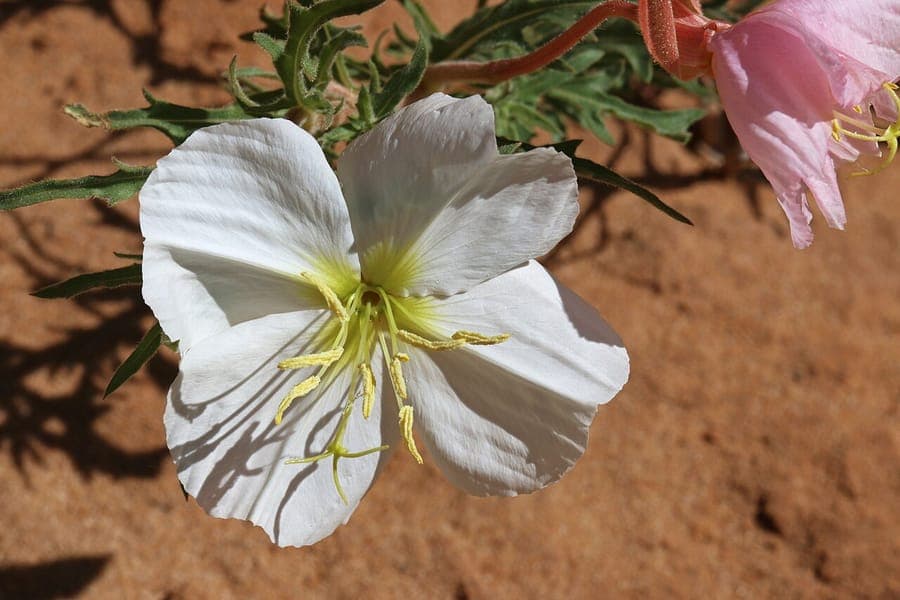
Andrey Zharkikh from Salt Lake City, USA / CC BY 2.0, via Wikimedia Commons
Pale evening primrose: complete guide
Oenothera pallida
Want to see Pale evening primrose: complete guide in your garden?
1 minute, no credit card
Overview
Oenothera pallida, commonly known as pale evening primrose, is a perennial herb in the family Onagraceae. Native to a broad swath of western North America - from British Columbia and Alberta southward through Wyoming, Colorado, Utah, Nevada, New Mexico and Texas into northern Mexico - it grows naturally on rocky slopes, sandy prairies, open grasslands and dry canyon floors. The species was first formally described by John Lindley in 1828, and its synonym Anogra pallida is still sometimes encountered in older literature.
The word 'pallida' means pale in Latin, and it aptly describes the flowers: four broad, heart-shaped petals in brilliant white to soft cream, measuring 3 to 6 cm across. Like all evening primroses, the blooms open at dusk and stay fully open through the night, closing the following morning. This nocturnal flowering habit evolved in tandem with sphinx moths (hawkmoths), which are the plant's primary pollinators - drawn in by the white colour and sweet fragrance that intensifies after sunset.
For gardeners in Europe, pale evening primrose is a rewarding choice for dry, sunny spots where little else thrives. Its rhizomatous growth form means it slowly spreads to fill gaps in a border without becoming invasive, and once established it is virtually self-sufficient. At gardenworld.app you can explore garden designs that incorporate drought-tolerant prairie perennials including evening primroses.
Cultivars worth seeking out include 'Innocence', a compact selection reaching around 30 cm with especially large pure-white flowers, and the wild-type form that seeds freely in gravel and rock gardens to create naturalistic drifts.
Appearance & bloom cycle
Pale evening primrose is a low to medium-statured perennial, typically growing 20 to 50 cm tall. On lean, dry soils it stays compact; with slightly richer conditions it can reach up to 60 cm. The stems are often whitish and softly hairy - a classic adaptation to reduce water loss in arid environments - giving the whole plant a somewhat silvery appearance in bright sunlight.
The leaves are lance-shaped to elliptic, finely toothed and pale to grey-green. Foliage texture is fine, reinforcing the delicate overall impression. In some populations the leaf margins are slightly wavy.
The flowers are unquestionably the showpiece. Each has four broad, heart-shaped petals in white or very pale cream, with conspicuous yellow stamens at the centre. Diameter ranges from 3 to 6 cm depending on conditions. They open each evening from May through August, peaking in June and July. On favoured sites the season may start in late April and extend into September. Each individual flower lasts only one night; new buds open the following evening. Because buds open sequentially along the stem, a single plant provides weeks of continuous display.
After flowering, inconspicuous brown seed capsules develop, containing small seeds that disperse by wind. If left, pale evening primrose seeds generously in gravel and sandy soil, producing colonies that expand year on year - a desirable trait in a wild or prairie-style garden.
Ideal location
Pale evening primrose requires full sun - at least six to eight hours of direct sunlight daily. In partial shade it will grow but flower much less freely, and stems become lax and prone to flopping. Choose the hottest, brightest spot you have: a south-facing slope, a gravel bed, a raised border beside a sunny wall.
The plant is perfectly suited to exposed positions that experience drying winds and summer drought. In a European context it thrives against south-facing house walls, on dry banks and roadsides, and in gravel gardens. It is not suited to heavy, wet or shaded positions.
As a companion in a border, its white evening flowers work beautifully alongside lavender-blue Salvia nemorosa 'Caradonna', the steely blue of Festuca glauca, the wispy plumes of Stipa tenuissima or bold Echinacea purpurea. For a more dramatic, xeriscape feel, combine it with the hardy cactus Opuntia polyacantha.
In containers, use the compact 'Innocence' cultivar in a pot of at least 30 cm diameter filled with a gritty, free-draining mix - a blend of three parts loam to two parts coarse sand and one part fine grit works well.
Soil requirements
The ideal soil is lean, sharply drained and slightly acidic to slightly alkaline, with a pH between 6.0 and 8.0. Pale evening primrose actually performs better on poor soils: excessive fertility produces lush foliage at the expense of flowers and makes the plant more susceptible to fungal disease.
Sandy, stony and gravelly soils are ideal. Heavy clay soils must be substantially improved by incorporating coarse sand or fine grit (at least 20-30% by volume) before planting. Avoid fresh manure and high-nitrogen fertilisers entirely.
For a new planting area, a good mix is three parts garden soil, two parts coarse horticultural sand and one part fine gravel. This replicates the lean, free-draining substrates of the western prairies. In rock gardens and gravel beds, no soil preparation is necessary beyond clearing competing weeds - plant directly into the grit and let the plant find its own level.
A mulch of fine gravel or stone chippings around the stem base keeps the crown dry, suppresses weeds and reflects warmth back to the plant during cool nights.
Free design
Want to see Pale evening primrose: complete guide in your garden? Make a free design now.
Watering
Once established, pale evening primrose is exceptionally drought-tolerant and requires virtually no supplemental watering in a British or northern European climate. During the establishment period in the first growing season, a weekly to fortnightly deep watering helps develop a robust root system. Water deeply each time - enough to wet the soil to 25-30 cm depth - so roots are encouraged to penetrate downward rather than staying near the surface.
In established plantings, only water during prolonged drought of three weeks or more combined with temperatures above 28-30 degrees Celsius. When you do water, water at the base of the plant; never wet the foliage, as this encourages powdery mildew.
Avoid all watering in winter. The roots must remain dry during dormancy, and winter waterlogging on imperfectly drained soils is the most common cause of failure with this plant. Good drainage is non-negotiable.
In wet summers or on soils with any tendency toward water retention, consider raising the planting position or improving drainage before planting, rather than trying to compensate with reduced watering afterward.
Pruning
Pale evening primrose requires minimal pruning, but a few targeted interventions improve the display significantly. After the first main flush of flowers in June, cut spent flowering stems back to the basal rosette. This encourages a second flush of new flowering stems, extending the season into late August or even September.
In autumn, after the first frost has killed off the foliage, cut all stems back to around 5 cm above ground. This tidy-up reduces the risk of fungal disease over winter and promotes clean, vigorous regrowth the following spring.
If you wish to control self-seeding, deadhead spent flowers before the seed capsules ripen and burst - typically six to eight weeks after flowering. In wilder areas of the garden, however, allowing some seed set produces attractive natural colonies.
Never remove more than one-third of the plant at one time during the growing season. Hard pruning during active growth stresses the plant and can reduce flowering the following year.
Maintenance calendar
March: Check overwintered stems for damage; remove dead growth down to the first green shoots. Apply a fresh layer of grit mulch around the stem base if needed.
April: Growth resumes; in warm, sheltered positions first buds may form. No watering needed unless spring is unusually dry.
May: First flowers open on favoured sites. Check for slug damage on young growth. Planting distance for new introductions: 30-45 cm apart.
June: Peak flowering season. Remove spent stems after the first flush to encourage a second wave.
July: Continued flowering; little maintenance required. Water only if drought persists for more than three weeks.
August: Second flush; allow some seed capsules to ripen if naturalising is desired. Collect seed when capsules turn brown.
September: Autumn cutback: reduce stems to 5 cm. Remove any runners that have spread too far.
October-November: No special care needed. Ensure drainage is unobstructed; clear fallen leaves from neighbouring trees that could mat and trap moisture.
December-February: Full dormancy; no water, no feeding. Check drainage once after heavy rain.
Winter hardiness
Pale evening primrose is notably cold-hardy for a plant originating in warm, dry habitats. It tolerates temperatures down to -20 degrees Celsius and falls into USDA hardiness zones 4 to 8. Across the UK, Benelux and northern France, it overwinters without difficulty, provided the soil is well drained.
The real winter threat is not cold but the combination of cold and wet. On poorly drained soils, water sitting around the crown during a freeze can cause fatal crown rot. A south-facing position at the foot of a wall, a raised bed or a dry slope provides the best conditions for reliable overwintering.
In USDA zone 3 (the coldest parts of Canada and the Rocky Mountains), a protective mulch of coarse grit or pine cone fragments around the stem base helps moderate soil temperature fluctuations. In mild maritime climates such as coastal Britain (USDA zone 8-9), the plant may stay semi-evergreen through winter.
Companion plants
Pale evening primrose associates naturally with other drought-adapted prairie and steppe plants. Good companions include:
- Stipa tenuissima (feather grass): silky, arching plumes that move with every breeze, creating beautiful contrast with the white flowers. Plant 40-50 cm apart.
- Salvia nemorosa 'Caradonna' (woodland sage): dark purple flower spikes offer dramatic colour contrast; identical growing requirements.
- Festuca glauca (blue fescue): silver-blue leaf rosettes complement the white flowers perfectly.
- Echinacea purpurea (purple coneflower): summer-long bloomer that shares the same sunny, free-draining requirements; both attract insects.
- Thymus serpyllum (wild thyme): a mat-forming ground cover that fills gaps between taller plants, keeps the soil dry and attracts pollinators.
- Lavandula angustifolia (lavender): a classic white-and-purple partnership with identical soil and watering needs.
- Opuntia polyacantha (plains prickly pear): for a bold xeriscape effect, this hardy cactus makes a striking structural companion.
Avoid moisture-loving plants such as hostas, ferns and astilbes; their watering requirements are incompatible and they will compete for water in dry spells.
Closing
Pale evening primrose deserves far wider use in European gardens. Its elegant white flowers that open at dusk, its exceptional drought tolerance and its minimal maintenance demands make it a genuinely useful plant for any sunny, well-drained garden. Whether you are creating a modern prairie border, a gravel garden or a wildlife-friendly meadow planting, Oenothera pallida delivers beauty, ecological value and practicality in equal measure.
Visit gardenworld.app to design a drought-tolerant front garden that showcases plants like pale evening primrose at their best. Upload a photo of your garden and receive a professional planting plan tailored to your conditions.
Want to see Pale evening primrose: complete guide in your garden? Make a free design now.
Upload a photo, pick a style, and get a photorealistic design with plant list in under a minute.
10,000+ gardens designed already
No credit card required


Similar plants
Shortfruit evening primrose: complete guide
Oenothera brachycarpa
Everything about Oenothera brachycarpa - the shortfruit evening primrose from the American Southwest. Growing tips, placement and care for your garden.
Sundrops (Oenothera tetragona): complete guide
Oenothera tetragona
Everything about Oenothera tetragona - the cheerful daytime-blooming sundrops perennial. Growing tips, placement, pruning and care for a long summer display.
Seabeach evening primrose: complete guide
Oenothera humifusa
Full guide to Oenothera humifusa, the seabeach evening primrose native to the US Atlantic coast. Yellow blooms, silvery foliage, drought-tolerant.