
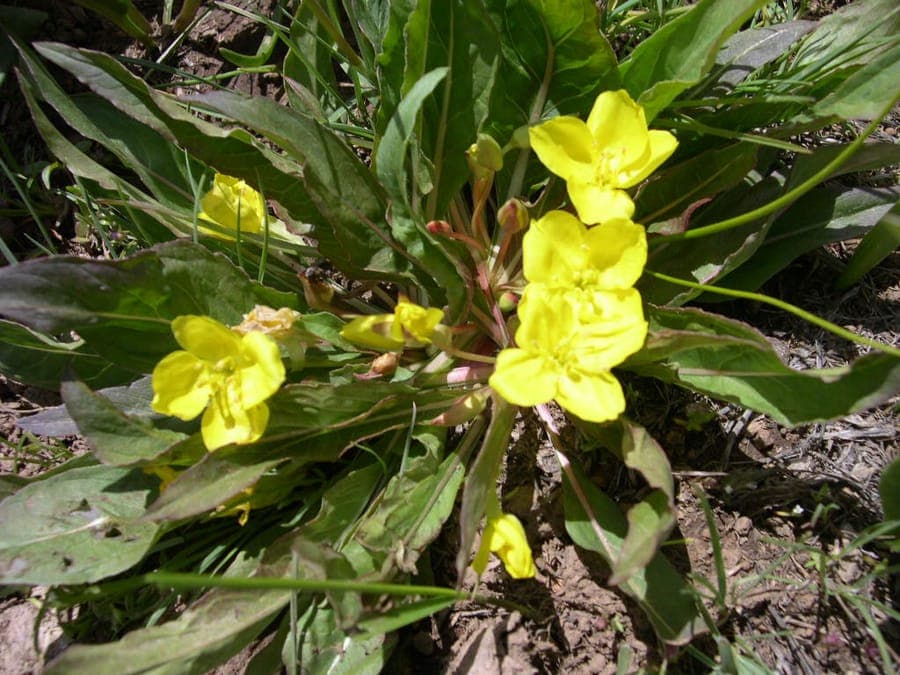
Thayne Tuason / CC BY-SA 4.0, via Wikimedia Commons
Yellow evening primrose: complete guide
Oenothera flava
Want to see Yellow evening primrose: complete guide in your garden?
1 minute, no credit card
Overview
Oenothera flava, commonly called yellow evening primrose or long-tube evening primrose, is a distinctive low-growing biennial or short-lived perennial in the Onagraceae family. Native to a vast range across western and central North America - from Alberta and Saskatchewan in Canada through the Rocky Mountain states to Mexico - it has also been recorded as a naturalised plant in parts of central Europe. Unlike taller evening primroses, Oenothera flava is essentially stemless: its large yellow flowers emerge directly from a flat ground-hugging rosette, giving it an appearance quite different from its upright relatives.
The species name 'flava' is Latin for yellow, a reference to the bright, clear-yellow flowers that open at dusk and release a delicate vanilla-honey fragrance to attract moths and other twilight pollinators. Each bloom lives for only a single night, fading orange-pink by the following morning, but the plant produces a steady succession of new buds from May through July, sometimes into August, maintaining an impressive display over many weeks.
Oenothera flava is a biennial or short-lived perennial. In its first year it forms a flat rosette of deeply lobed leaves; in its second year the flowers appear. After setting seed, the parent plant usually dies, but the species self-seeds freely and maintains itself in suitable conditions. Older botanical literature sometimes refers to this plant under the synonyms Oenothera murdockii or Lavauxia flava, names you may still encounter in specialist references.
The ecological value of yellow evening primrose is considerable: its exceptionally long floral tube provides nectar specifically for long-tongued moths including hawkmoths, and the ripe seed capsules feed seed-eating birds through autumn and winter. Plan a wildlife-friendly garden that includes yellow evening primrose using the tools at gardenworld.app.
Appearance & bloom cycle
Oenothera flava is a remarkably low plant, reaching only 10 to 25 cm in height. The growth form is strongly rosetted, with leaves spread flat to the ground in a pattern resembling a dandelion or chicory - an adaptation to dry, windswept habitats at elevation. The leaves are oblong to lance-shaped, 10 to 30 cm long, with deeply lobed or irregularly toothed margins. They are dark green, nearly hairless on the upper surface, and finely hairy beneath.
The flowers are disproportionately large for the plant's size: 5 to 7 cm across, with four broad, rounded petals of clear lemon-yellow to golden-yellow. The most remarkable structural feature is the floral tube: in Oenothera flava, this can reach 10 to 15 cm in length - among the longest in the genus. The flower itself therefore hovers well above the rosette while the base of the tube is buried deep within the leaf cluster. This long tube is an evolutionary adaptation that restricts pollination to long-tongued moths such as hawkmoths.
Flowers open in the evening from May to August, depending on location, and the vanilla-honey fragrance is most intense around dusk. By mid-morning the following day, the petals have wilted and flushed orange or pink. After pollination, elongated seed capsules of 3 to 5 cm form, anchored partially in the soil. They split open at maturity, releasing numerous small angular seeds that scatter around the parent plant. Birds pick seeds from the open capsules through autumn and winter.
Ideal location
Yellow evening primrose thrives in full sun and is perfectly suited to open, unshaded positions. It comes from open prairies, rocky slopes, and dry meadows at elevations of 1,000 to 3,000 metres in the Rocky Mountain region, which explains its tolerance for intense sun, dry conditions, and cold nights. In the garden, it performs best on south- or west-facing slopes, rock gardens, gravel beds, xeriscaping schemes, and dry sunny borders.
The low rosette form makes Oenothera flava an excellent candidate for filling gaps between rocks and boulders, edging paths in gravel gardens, or providing ground-level interest at the front of a dry border. It also works well in prairie-inspired plantings combined with ornamental grasses and other drought-tolerant species. In a wildlife garden, position it where its evening blooms can be viewed from a path or seating area - the sight and scent of its flowers at dusk is genuinely enchanting.
Avoid positions with standing water or consistently wet soil: yellow evening primrose is highly susceptible to crown rot in poorly drained conditions. A raised bed, slope, or any site with excellent drainage will serve it best. Discover more design ideas for dry and rock gardens on gardenworld.app.
Soil requirements
Oenothera flava is adapted to a wide range of soil types provided drainage is excellent. It grows naturally on calcareous to mildly acidic soils with a pH between 6.0 and 7.8. Rocky, gravelly, sandy, and chalky soils are all suitable. On rich, heavy clay soils the plant performs poorly and waterlogging during wet winters is the main cause of loss.
Free-draining, light to medium-weight soil gives the best results. On heavy clay, improve drainage by working coarse grit or horticultural sand thoroughly into the planting area before planting - a ratio of one part grit to two or three parts soil is a good starting point. On extremely poor, dry sandy soils, the plant grows more compactly but still flowers well; a small amount of garden compost worked in at planting time is beneficial in this situation.
Do not over-fertilise: excessive nitrogen encourages leafy growth at the expense of flowers. A lean to moderately fertile soil produces compact, free-flowering plants with sturdy rosettes that withstand wind and weather far better than soft, overfed specimens. The crucial requirement is drainage - Oenothera flava will not tolerate even short periods of winter waterlogging.
Free design
Want to see Yellow evening primrose: complete guide in your garden? Make a free design now.
Watering
Once established, yellow evening primrose is among the most drought-tolerant plants in the Oenothera genus and requires almost no supplemental watering in temperate European gardens. In the first year after planting, water once a week during dry spells to encourage the roots to establish. Once the rosette is well rooted - typically within six to eight weeks - routine watering can stop.
The species is superbly adapted to the dry summers of the North American interior, where temperatures regularly exceed 35 degrees Celsius and months may pass without significant rainfall. In northwest European gardens it therefore needs far less attention than most ornamental plants. On sandy soils in prolonged drought, one deep watering per month during the flowering period can improve bloom quality, but the plant will survive without.
Avoid watering in cold, wet weather: excessive moisture during winter and early spring is the primary cause of plant loss with this species. If growing in a container or raised bed, ensure water drains freely from the base. A surface mulch of coarse gravel or grit around - but not touching - the rosette crown helps maintain a drier microclimate around the sensitive base of the plant.
Pruning
Oenothera flava requires virtually no pruning. The low, flat rosette form does not need trimming; remove dead outer leaves in early spring if you wish to tidy the plant, though this is entirely cosmetic. The deeply anchored central growing point overwinters safely and does not need cutting back.
To limit self-seeding, remove the ripening seed capsules before they open in late summer. Leave a few capsules for birds and for natural self-renewal. The half-buried capsules can be difficult to remove cleanly without disturbing the root zone; harvest them when still semi-ripe if possible.
After mild winters the rosette typically remains largely intact, with only the outermost leaves showing any dieback. After severe winters, more outer leaves may have died, but the growing centre of the rosette will resume growth in spring. Clear away dead leaf tissue in March when new growth is visible.
Maintenance calendar
March: Inspect the rosette; remove dead outer leaves; thin overcrowded seedling groups to at least 40 cm apart.
April-May: Rapid growth begins; first flower buds appear on early plants; no feeding required; water only if dry.
May-June: Full bloom; enjoy evening flowers and fragrance; seed capsules begin forming after the first flowers.
July: Flowering continues in favourable conditions; seed capsules ripening; remove some if self-seeding is excessive.
August: End of main flowering period; capsules open; birds feed on seeds; no watering needed unless extreme drought.
September-October: Plant enters dormancy; rosette remains intact; new seedlings appear from autumn-shed seed; top-dress around (not on) the rosette with a little compost.
November-February: Plant dormant; keep dry; protect with a light layer of coarse grit on very exposed or cold sites.
Winter hardiness
Oenothera flava is remarkably hardy for a plant originating from high-elevation continental habitats. It tolerates temperatures down to approximately -25 degrees Celsius on free-draining soil and falls within USDA hardiness zones 4 to 8. In the UK, Benelux, northern France, and most of Germany, no winter protection is needed for established plants on dry, well-drained soils.
Winter hardiness is strongly dependent on soil drainage. On heavy, moisture-retentive clay soils, the combination of frost and waterlogging can damage or kill the plant even at relatively mild temperatures. On light, well-drained soil, however, the plant has little to fear even in prolonged cold spells.
In cold continental areas with little insulating snow cover, a light protective layer of coarse gravel or dry leaves around the rosette is prudent. Even if the mother plant is lost over winter, seeds shed in the previous autumn germinate reliably in spring to produce replacement plants. In mild maritime climates and urban gardens, overwintering is virtually guaranteed on suitable soils.
Companion plants
Yellow evening primrose combines exceptionally well with other low-growing, drought-tolerant plants for sunny rock gardens, gravel beds, and dry borders. Excellent companions include:
- Dianthus carthusianorum (Carthusian pink): deep pink flowers in June-August, shares the preference for dry, calcareous soil.
- Pulsatilla vulgaris (Pasque flower): violet-purple blooms in March-April, ornamental seed heads May-June.
- Sedum acre (Biting stonecrop): yellow ground-covering mat, flowers in May-June, identical drainage needs.
- Festuca glauca (Blue fescue): steel-blue grass tufts for textural contrast against the rosettes.
- Stachys byzantina (Lamb's ear): silver-grey woolly foliage, drought-tolerant, handsome contrast.
- Armeria maritima (Sea thrift): rounded pink flower heads May-July, compact and drought-tolerant.
- Erysimum 'Bowles Mauve' (Wallflower): mauve-purple flowers April to September, long season companion.
This combination delivers colourful interest from March through September on dry, sunny sites with minimal watering or maintenance requirements.
Conclusion
Yellow evening primrose is a fascinating and unusually low-maintenance choice for the rock garden, gravel border, or any dry, sunny position. Its ground-hugging rosette, large yellow blooms with their remarkably long floral tube, and willingness to self-seed make it both ecologically valuable and visually distinctive. Once established, it virtually looks after itself.
The ecological contribution is significant: long-tubed Oenothera species are among the few garden plants capable of supporting hawkmoths and other long-tongued nocturnal pollinators that are so important for broader biodiversity. If you garden for wildlife, this plant belongs in your collection. Start planning your dry border or rock garden design at gardenworld.app and discover how yellow evening primrose complements a thoughtfully planted naturalistic scheme.
Want to see Yellow evening primrose: complete guide in your garden? Make a free design now.
Upload a photo, pick a style, and get a photorealistic design with plant list in under a minute.
10,000+ gardens designed already
No credit card required


Similar plants
Shortfruit evening primrose: complete guide
Oenothera brachycarpa
Everything about Oenothera brachycarpa - the shortfruit evening primrose from the American Southwest. Growing tips, placement and care for your garden.
Sundrops (Oenothera tetragona): complete guide
Oenothera tetragona
Everything about Oenothera tetragona - the cheerful daytime-blooming sundrops perennial. Growing tips, placement, pruning and care for a long summer display.
Seabeach evening primrose: complete guide
Oenothera humifusa
Full guide to Oenothera humifusa, the seabeach evening primrose native to the US Atlantic coast. Yellow blooms, silvery foliage, drought-tolerant.