
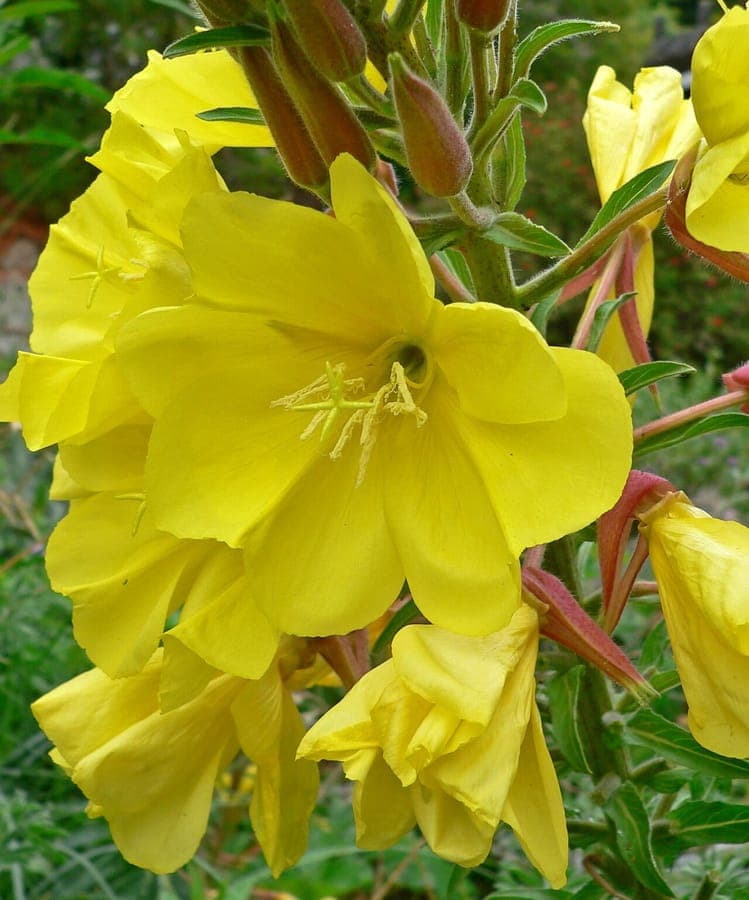
by User:Stan Shebs / CC BY-SA 3.0, via Wikimedia Commons
Hooker's evening primrose: complete guide
Oenothera elata
Want to see Hooker's evening primrose: complete guide in your garden?
1 minute, no credit card
Overview
Oenothera elata, commonly known as Hooker's evening primrose or western evening primrose, is a striking biennial or short-lived perennial herb in the Onagraceae family. Native to the western and central United States and extending south through Mexico to Central America, it has also naturalised in parts of northwestern Europe. It is one of the tallest evening primroses in cultivation, sending up flower spikes of 80 to 180 cm that are studded with large, bright yellow blooms from June through to September.
The evening primrose takes its common name from the habit of opening its flowers in the late afternoon and early evening, releasing a light vanilla fragrance that attracts moths, night-flying bees, and hummingbird hawkmoths. Each individual flower lasts only a night, fading orange-pink the following morning, but the plant continuously produces new buds along the stalk, so the overall display remains impressive for weeks. The blooms of Oenothera elata are particularly large - up to 8 cm across - with four broad, overlapping petals of pure chrome yellow.
In its first year, the plant forms a low-growing rosette of large, grey-green leaves; in its second year, the flowering stalk emerges. After setting seed, the main plant usually dies, but it self-seeds freely, maintaining a self-sustaining colony in the garden. This self-seeding habit makes it ideal for naturalistic plantings where a little informality is welcome. To keep it more contained, remove the seed capsules before they fully open.
Oenothera elata is an ecologically rich plant: its large flowers provide nectar for evening and night-flying insects, and the ripe seed capsules feed birds through autumn and winter. Incorporate it into a wildlife-friendly garden design using the planning tools at gardenworld.app.
Appearance & bloom cycle
In its first year, Oenothera elata produces a bold basal rosette of lance-shaped to oblong leaves, each 15 to 30 cm long, grey-green to mid-green, covered in fine soft hairs that give the foliage a matte, slightly velvety texture. The midrib is prominent and pale, and the leaf margins are gently undulating.
In its second year, the flowering stalk rises to 80 to 180 cm, occasionally reaching 200 cm in rich, moist conditions. The stems are sturdy, tinged reddish, and carry alternate stem leaves that diminish in size toward the apex. Flowers appear at the tips of the main stem and side branches from June through September.
Each flower has four broad, fan-shaped petals of clear lemon to butter yellow, 3 to 4 cm wide apiece, creating a bloom 6 to 8 cm across. The calyx tube is exceptionally long - up to 10 cm - a feature reflected in the species epithet 'elata' (tall, elevated). Flowers open in the late afternoon and evening, attracting moths and other nocturnal pollinators, and close or wilt by mid-morning the following day, sometimes flushing orange or pink as they fade. The fragrance is gentle, sweet, and vanilla-like, most intense at dusk.
After pollination, erect seed capsules of 2 to 4 cm develop along the stem. Each capsule contains dozens of tiny angular seeds and splits into four valves when ripe, dispersing seed around the parent plant. Birds pick at the open capsules through autumn and winter. Selected cultivars such as 'Sunset Boulevard' offer a somewhat more compact habit and slightly intensified flower colour.
Ideal location
Hooker's evening primrose performs best in full sun. On a south- or west-facing border, the plant stays compact, self-supports well, and flowers abundantly. In partial shade, stems elongate and may flop, requiring staking. An open position in a natural garden, a sunny border against a wall, or a wildlife meadow planting are all excellent settings.
The plant tolerates wind reasonably well and does not need shelter in most garden positions. In sheltered spots with poor air circulation, mild powdery mildew may occur on the leaves in humid summers, but this rarely affects the flowering performance. A light breeze also helps distribute seeds across the garden for natural self-renewal.
At 80 to 180 cm, Oenothera elata works well as a mid-to-back-of-border plant or as a dramatic focal point in a naturalistic planting. Its intense yellow contrasts beautifully with blue and purple companions such as Salvia, Geranium, and Perovskia. Explore planting combinations and garden layouts at gardenworld.app to find the ideal setting for this plant.
Soil requirements
Oenothera elata is notably unfussy about soil. It grows well on light to medium-weight, free-draining soils with a pH between 5.5 and 7.5. Dry to moderately moist sandy soil, gravelly soil, and sandy loam are all suitable. On rich, moist clay the plant grows more vigorously but tends to become floppy and is more susceptible to stem collapse in wet weather.
Oenothera elata comes from regions with dry summers and is therefore well adapted to soils that dry out moderately during summer. This makes it particularly suitable for low-water gardens or sites where irrigation is difficult. On heavy, wet clay soils, the plant performs poorly and roots may rot in waterlogged conditions.
Do not over-enrich the soil before planting: fertile conditions encourage excessive leafy growth at the expense of flowers. A lean to moderately fertile soil produces compact, free-flowering plants. Work in at most 5 cm of garden compost into the top layer before planting and allow the plant to fend for itself thereafter. Avoid lime-rich soils above pH 7.5 where micronutrient deficiencies may appear.
Free design
Want to see Hooker's evening primrose: complete guide in your garden? Make a free design now.
Watering
Once established, Hooker's evening primrose is drought-tolerant and requires minimal watering. During the first year, water weekly during dry spells to encourage deep root development. Once the plant has rooted - typically within six to eight weeks - watering can be reduced to periods of genuine prolonged drought.
Mature plants on sandy soils benefit from watering every two weeks during the flowering period in summer, but will survive without. On moisture-retentive loam, extra watering is rarely needed. Waterlogging and standing water are more damaging than drought: always ensure good drainage in the planting area.
Water at the base of the plant in the morning to keep foliage dry. In warm, humid conditions, powdery mildew can affect the leaves, but this is rarely serious on a sunny, open site. Applying a 5 to 7 cm mulch of composted bark around the plants reduces moisture loss and helps maintain some soil moisture without keeping the crown wet.
Pruning
Oenothera elata requires very little intervention. Deadheading spent flower stems during the blooming season is optional - removing them encourages the formation of new buds and keeps the plant looking tidy, but Hooker's evening primrose will continue flowering without attention for the entire season.
To limit self-seeding, remove the ripening seed capsules before they open fully in September. Leave a few capsules intact if you want natural self-renewal in the garden. After seed set in autumn, the stems die back; cut them to the ground or leave them standing as winter ornament for birds to pick over.
In early spring, once new rosettes become visible, cut back any old stems that have not yet been removed. Thin dense clusters of seedlings, leaving individuals at least 60 cm apart for balanced growth and good air circulation. Transplant surplus rosettes to new positions while they are still small.
Maintenance calendar
March: New rosettes emerge; thin overcrowded seedlings; remove previous year's dead stems if still present.
April-May: Rosettes grow vigorously; water if dry; apply a thin mulch layer around plants.
June: Flower stalks rise; first buds appear; add a stake at windy exposed sites if needed.
July-August: Full bloom; optional deadheading; moths and bees visit in the evening; water every two weeks on sandy soils during drought.
September: Flowering declines; seed capsules ripen; remove some capsules to limit spread; leave others for birds.
October-November: Stems die back; remove or leave as winter structure; new rosettes for next year are visible.
December-February: Plant overwinters as a low rosette; no maintenance required; protect on very exposed sites with a light straw mulch.
Winter hardiness
Oenothera elata is reasonably hardy for a plant originating from warmer climates. It tolerates temperatures down to approximately -15 degrees Celsius when planted in free-draining soil and not exposed to prolonged waterlogging combined with frost. In the UK, Benelux, and northern France, the overwintering rosette survives most winters without protection, though severe winters with persistently wet soil may cause losses.
The plant falls within USDA hardiness zones 5 to 8. Winter hardiness is greatest on well-drained, light soils. On heavy or wet clay soils, the risk of winter loss is higher, particularly when frost and waterlogging combine. A protective mulch of straw or composted bark around the rosette in November reduces this risk.
In mild maritime climates, including most of the UK west coast and coastal Benelux, overwintering is very reliable. In more continental areas with severe dry frosts, some protection is advisable. Seeds that have dropped in autumn germinate robustly in spring, providing new plants even if the parent rosette is lost.
Companion plants
Hooker's evening primrose combines beautifully with other summer-flowering plants in sunny, dry-to-moderately moist borders. Consider these combinations:
- Salvia nemorosa (Meadow sage): blue or purple flower spikes in June-August, superb colour contrast with yellow evening primrose.
- Echinacea purpurea (Purple coneflower): pink flowers in July-September, same sun and drainage requirements.
- Rudbeckia fulgida (Black-eyed Susan): yellow flowers with dark centres, August to October.
- Verbascum olympicum (Greek mullein): tall yellow flower spikes reaching 200 cm, similar in scale and visual impact.
- Agastache foeniculum (Anise hyssop): blue flower spikes, attractive to butterflies and bumblebees.
- Stipa tenuissima (Mexican feather grass): fine textural contrast for tall flowering stems.
- Perovskia atriplicifolia (Russian sage): lavender-blue plumes in August-September, complements the yellow blooms.
This combination delivers colourful summer blooms from June through October while providing maximum food and habitat value for bees, butterflies, moths, and seed-eating birds.
Conclusion
Hooker's evening primrose is a bold and rewarding garden plant: impressive height, spectacular large yellow flowers that open at dusk, and outstanding ecological value that few ornamental plants can match. It asks for little - just sunshine and reasonable drainage - and delivers months of colour as well as year-round wildlife interest through flowers, seed, and winter structure.
Whether you are planting a naturalistic border, a wildlife meadow, or a sunny cottage-style garden, Oenothera elata earns its space many times over. Start planning your border at gardenworld.app and discover how this evening primrose fits into a cohesive planting design that works from midsummer through to the first frosts.
Want to see Hooker's evening primrose: complete guide in your garden? Make a free design now.
Upload a photo, pick a style, and get a photorealistic design with plant list in under a minute.
10,000+ gardens designed already
No credit card required


Similar plants
Shortfruit evening primrose: complete guide
Oenothera brachycarpa
Everything about Oenothera brachycarpa - the shortfruit evening primrose from the American Southwest. Growing tips, placement and care for your garden.
Sundrops (Oenothera tetragona): complete guide
Oenothera tetragona
Everything about Oenothera tetragona - the cheerful daytime-blooming sundrops perennial. Growing tips, placement, pruning and care for a long summer display.
Seabeach evening primrose: complete guide
Oenothera humifusa
Full guide to Oenothera humifusa, the seabeach evening primrose native to the US Atlantic coast. Yellow blooms, silvery foliage, drought-tolerant.