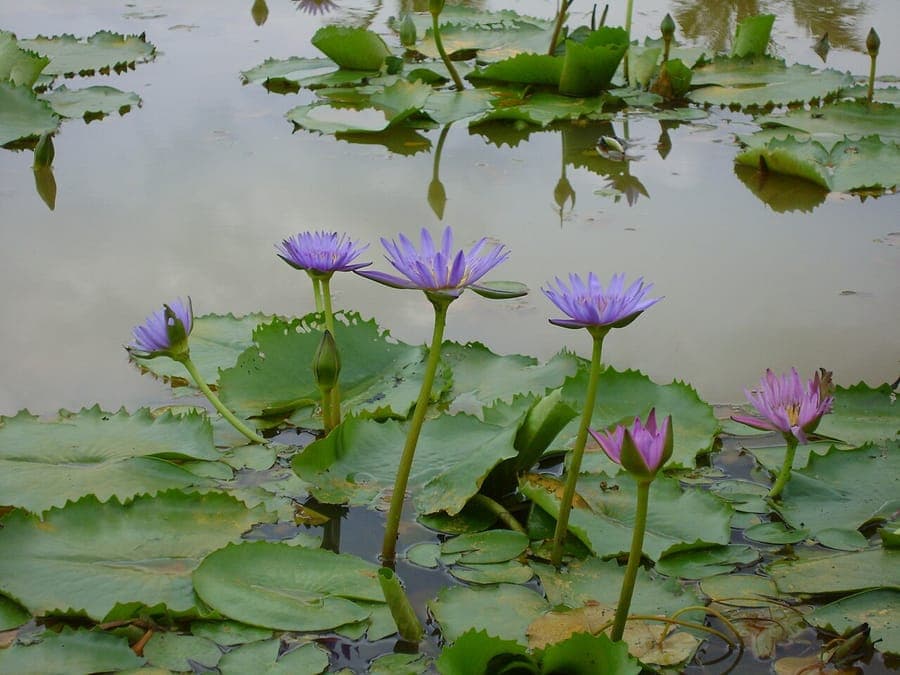
Nguyễn Tấn Phát / CC BY-SA 3.0, via Wikimedia Commons
Red and blue water-lily: complete guide
Nymphaea nouchali
Want to see Red and blue water-lily: complete guide in your garden?
Full design in HD: €7.99
Look after your Red and blue water-lily with the GardenWorld app
Identify plants with your camera and get a care calendar with reminders for this plant.


Overview
The red and blue water-lily (Nymphaea nouchali) is a stunning, exotic aquatic plant originally native to tropical and subtropical regions of Asia. With its large, striking flowers in shades of red and blue, this water-lily is an absolute star performer in any garden pond.
Like all water-lilies, Nymphaea nouchali is an aquatic plant that produces floating leaves and spectacular flowers that emerge above the water.
Appearance and Bloom
The leaves of Nymphaea nouchali are large, round to oval-shaped, with a deep central notch. They float on the water surface. The leaf color is green with often purple or red undersides.
The flowers are the true showstoppers. They are approximately 10-15 cm in diameter and display a wonderful color palette from red to deep red to purple. Some flowers also have blue tints. Flowers appear from June to October in full splendor.
Ideal Location
It is essential for Nymphaea nouchali to be placed where there is ample sunlight. A minimum of 5-6 hours of direct sunlight daily is required. Full sun (8+ hours) is even better.
Water depth: The plant grows best in water 30-60 cm deep. Deeper water is possible but less optimal.
Wind protection: Although the plant itself is wind-resistant, the flowers are delicate. Protection from strong wind is welcome.
Water and Substrate
Water: Nymphaea nouchali grows in clean, stagnant water (pond water). It cannot grow in flowing water.
Temperature: This is a tropical plant. Water between 20-28 degrees Celsius is ideal. Colder water (below 15 degrees) will cause the plant to go dormant or die.
Substrate: Plant the water-lily in a watertight container with clay and compost mixed. The pot must be at least 20-30 liters.
Feeding and Maintenance
Fertilizer: Apply a specialized water-lily fertilizer every two weeks. This stimulates flowering.
Leaf removal: Regularly remove yellowed or damaged leaves to prevent disease.
Algae control: Keep water clean by actively combating algae, for example with plant-eating fish.
Free preview
Want to see Red and blue water-lily: complete guide in your garden? Make a free preview of your design.
Pruning and Maintenance
Leaf removal: Remove dead or damaged leaves as soon as possible.
Flower removal: Remove spent flowers to prevent disease and direct energy to new blooms.
Winter preparation: In autumn, gradually move the plant to cooler water.
Maintenance Calendar
Spring (March-May): Repot when water is warm enough (20+ degrees). Start feeding.
Summer (June-August): Regularly change water, apply fertilizer, remove yellowed leaves.
Autumn (September-October): Reduce feeding, remove dead leaves, prepare plant for dormancy.
Winter (November-February): Plant will go dormant in cold water. Minimal maintenance.
Winter Hardiness and Overwintering
Nymphaea nouchali is not winter hardy in cold climates. In regions with freezing winters, the plant must be overwintered.
Overwintering options:
- Keep the plant indoors in warm water (minimum 15 degrees Celsius)
- In extreme cold, the plant can be stored frost-free until spring
The plant does not grow in winter, so feeding and maintenance can be greatly reduced.
Propagation
Nymphaea nouchali can propagate via seed. Seed can be collected from spent flowers. Seed must be germinated in warm water.
Propagation by division: Sometimes small plantlets form on the stems. These can be separated and planted individually.
Companion Plants
Nymphaea nouchali combines beautifully with:
Other aquatic plants: Lotus, other water-lily species, Nymphoides
Marginal plants: Iris, Pontederia, Sagittaria
Ground covers: Small aquatic plants at the water's edge
Fish: Goldfish and other plant-friendly aquatic fish
Conclusion
The red and blue water-lily is a fantastic addition to any warm-water garden pond. This plant brings elegance, exoticism, and true beauty. Although it requires some care and warmth, the beautiful flowers will be well worth the effort.
Purchase your Nymphaea nouchali from specialized aquatic plant nurseries. Discover more on gardenworld.app for ideas to maximize the enjoyment of your water feature.
Frequently asked questions about Red and blue water-lily
Is Red and blue water-lily winter hardy?
Nymphaea nouchali is not winter hardy in cold climates. In regions with freezing winters, the plant must be overwintered.
When and how do you prune Red and blue water-lily?
Leaf removal: Remove dead or damaged leaves as soon as possible.
Where does Red and blue water-lily grow best?
It is essential for Nymphaea nouchali to be placed where there is ample sunlight. A minimum of 5-6 hours of direct sunlight daily is required.

See it in your garden
See Red and blue water-lily in your garden
One photo of your garden and a few questions. You see the result in about a minute.
Try it with a photoIdentify this plant in your own garden. Identify a plant
Similar plants
Rocky Mountain pond-lily: complete guide
Nuphar polysepala
Everything about Rocky Mountain pond-lily (Nuphar polysepala): pond placement, soil, water care, pruning and winter hardiness tips.
Dotleaf Waterlily: complete guide
Nymphaea ampla
Nymphaea ampla, known as Dotleaf Waterlily, is a tropical aquatic plant from the Americas. Learn how to cultivate and maintain this beautiful water lily in your pond.
Roundleaf Waterlily: complete guide
Nymphaea conardii
Nymphaea conardii is a unique tropical waterlily with distinctive round leaves from Central and South America. Discover care tips for this specialized aquatic plant.
