
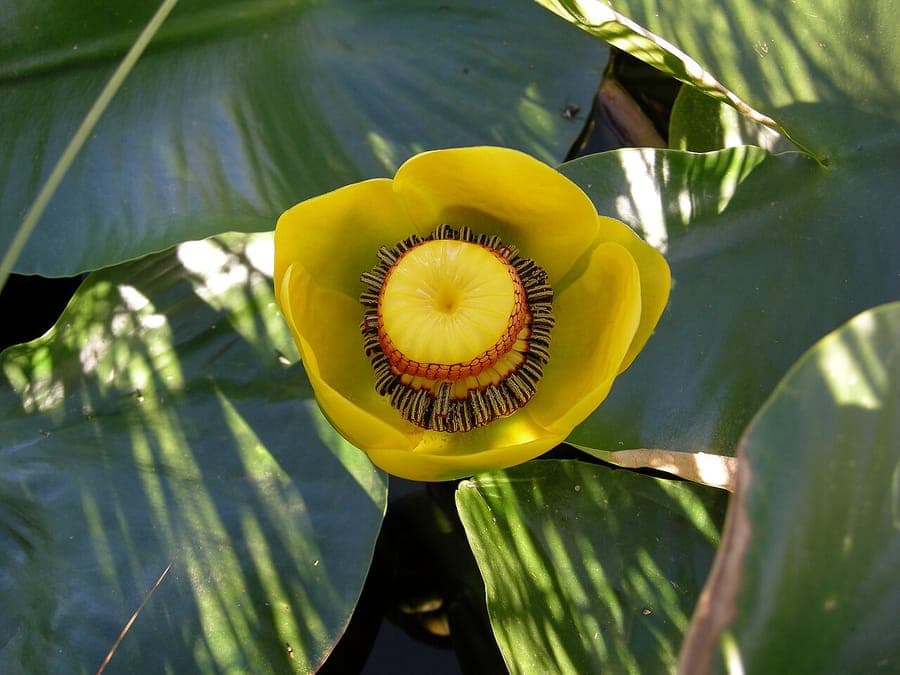
NPS/Diane Renkin / Public domain, via Wikimedia Commons
Rocky Mountain pond-lily: complete guide
Nuphar polysepala
Want to see Rocky Mountain pond-lily: complete guide in your garden?
1 minute, no credit card
Overview
Nuphar polysepala Engelm., known as Rocky Mountain pond-lily or yellow pond-lily, is a native North American aquatic perennial in the family Nymphaeaceae. It was formally described by the botanist Georg Engelmann in 1866 and is indigenous to western North America, from Alaska and the Aleutian Islands in the north to California, Colorado, Arizona, and New Mexico in the south. The natural range also includes British Columbia, the Yukon, the Northwest Territories, and other western Canadian provinces.
The species name polysepala comes from the Greek poly (many) and sepala (sepals), referring to the distinctive characteristic of having multiple sepals per flower. Unlike many related species, Nuphar polysepala typically bears 7 to 12 sepals rather than the usual 5 or 6, giving the flower a fuller, more globular appearance. This botanical feature is the most reliable field character for distinguishing it from its close relative Nuphar lutea (yellow water-lily) of Europe and Asia.
In its native habitat, Rocky Mountain pond-lily grows in shallow to moderately deep mountain lakes, ponds, and slow-moving streams at elevations ranging from sea level to above 3,000 metres. The plant tolerates a broad ecological range and thrives in clear, cool to cold water. For indigenous peoples of western North America, including several First Nations and Native American groups, the seeds and rhizomes held traditional food and medicinal value.
In garden settings, Nuphar polysepala is a compelling choice for larger ponds and water features in cool-climate regions. Its impressive floating leaves, up to 40 cm wide, and bright yellow flowers make it visually striking. On gardenworld.app you can explore how pond plants like Nuphar polysepala integrate into complete garden designs for water features of varying sizes.
Appearance & bloom cycle
Nuphar polysepala is a rhizomatous aquatic perennial with a robust, horizontal, fleshy rootstock anchored to the pond or lake bed. From the rhizome arise long petioles bearing both floating and submerged leaves. The floating leaves are large and impressive: ovate to cordate (heart-shaped), with a deep basal sinus, measuring 20-45 cm long and 15-30 cm wide. The upper surface is glossy dark green; the underside is pale green to yellowish-green. Leaf stalks are thick, spongy, and can reach 2 metres or more in length depending on water depth.
Flowering occurs from May through August, peaking in June and July. Individual flowers are held on separate stalks rising above the water surface. The flowers are large, 5-10 cm across, and distinguished by the numerous sepals (7-12) that are yellow to yellowish-green and create a cup-shaped or globular outline. The true petals are small and nestled within the sepals; they are golden yellow to orange. The centre of the flower features a prominent disc-shaped stigma surrounded by numerous stamens. The fragrance is faint and sweetly attractive to water insects.
After pollination, primarily by beetles, flies, and bees, fruits develop into fleshy, flask-shaped capsules 3-5 cm long. Seeds fall into the water and sink to the substrate where they germinate when conditions are favourable. Botanical synonyms include Nuphar lutea subsp. polysepala (Engelm.) Beal and Nymphaea polysepala (Engelm.) Kuntze, encountered in older literature.
Ideal location
Nuphar polysepala thrives in still to slowly moving water in full sun to light shade. In its natural habitat it occupies shallow mountain lakes and ponds with clear, typically cool to cold water. In the garden, a pond of at least 50-80 cm depth is required to protect the rhizomes from freezing; a depth of 80-150 cm is ideal for stable long-term growth.
The plant can be grown at water depths of 30-150 cm, but the optimal depth for the best leaf coverage and most prolific flowering is 50-100 cm. At greater depths the leaf stalks become proportionally longer and it takes longer for the floating leaves to reach the surface. The plant is suitable for ponds of at least 4-6 m² surface area; in smaller garden ponds it may become too dominant.
Rocky Mountain pond-lily tolerates cooler water better than most other water lily species, making it particularly suitable for ponds in cooler European climates or shaded ponds that warm slowly. Unlike tropical water lilies (Nymphaea), it does not require warm summers and is at home in alpine and subarctic regions with short growing seasons.
Soil requirements
The rhizomes of Nuphar polysepala root into the substrate layer of the pond. Ideal conditions are a heavy, clay-based pond bottom with a 20-30 cm layer of rich pond soil or pond clay. The suitable pH range of water and substrate is 5.0-8.0; the plant performs best in slightly acid to neutral conditions (pH 6.0-7.5).
For planting in a new pond without a natural substrate layer: use specialist aquatic compost or a mixture of heavy garden clay (70%) and untreated sand (30%). Avoid standard compost or fertiliser-enriched potting mixtures, as the nutrients dissolve into the pond water and stimulate excessive algal growth. Plant the rhizome in a hessian sack or wide aquatic basket (minimum 40 x 40 cm) filled with aquatic clay, and cover the surface with a 2-4 cm layer of coarse gravel to prevent clay from clouding the water.
Light, targeted feeding benefits growth: use specialist aquatic plant fertiliser tablets pressed into the root zone once in spring and once in midsummer. Never add liquid fertiliser directly to the water; this inevitably triggers algal blooms.
Watering
As a permanent aquatic plant, Nuphar polysepala requires no supplemental watering. However, attention to water quality and pond level is essential for the plant's health.
Maintain a consistent water level in the pond, particularly during dry summers. A sudden drop of more than 20 cm can leave floating leaves exposed above the water surface, causing them to wilt and die back prematurely. Top up the pond with rainwater where possible; if tap water must be used, allow it to stand for 24 hours in a container so chlorine can dissipate, or add a pond water conditioner.
Water temperature matters: Rocky Mountain pond-lily is more tolerant of cold water than Nymphaea species, performing well at water temperatures of 5-25 °C. It is less suitable for ponds that warm excessively in summer (above 28-30 °C). In cooler conditions, leaf formation begins earlier in spring and the flowering season extends longer into summer.
Maintain adequate dissolved oxygen levels in the water. A healthy balance of aquatic plants, marginal plants, and where necessary a pump or waterfall prevents oxygen depletion, which is harmful to both the plant and pond fauna.
Free design
Want to see Rocky Mountain pond-lily: complete guide in your garden? Make a free design now.
Pruning
Nuphar polysepala requires limited pruning, but regular removal of dead and dying foliage is necessary to keep the pond healthy. Remove any yellowing or dead leaves promptly throughout the growing season, cutting through the leaf stalk close to the rhizome. Do not allow rotting leaf stalks to remain in the water, as decomposition depletes oxygen and clouds the water.
At the end of the growing season, when leaves die back in October and November and the plant enters dormancy, all remaining foliage should be removed. Cut the leaf stalks back to within a few centimetres of the rhizome. This prevents rotting organic material from polluting the pond over winter.
The rhizomes extend progressively each season and can colonise a large area. To contain the plant, partially excavate and remove the surplus rhizome sections in early spring when the water is still clear and cool, then replant the remaining rhizome in its basket or anchor it back in the pond substrate. This is also the best moment to propagate the plant by dividing the rhizomes into sections, each with at least one growth bud.
Maintenance calendar
January-February: Plant is dormant. No action required. Monitor ice cover in severe frost; keep an air hole open in the ice to ensure gas exchange.
March: New growing season begins. Remove any remaining rotting material from the previous year. Insert aquatic fertiliser tablets into the root zone. Check water level and oxygen content.
April-May: New leaves emerge. Monitor water level carefully. Remove any dead or diseased leaves as they appear. First flowers may emerge in May in warmer, sheltered positions.
June-July: Peak flowering. Optimal growth conditions. Weekly inspection of leaves. Remove dead leaves regularly to prevent algal bloom.
August: Flowering draws to a close. Seed capsules ripen. Monitor water level during hot dry spells. Apply a second dose of aquatic fertiliser tablets.
September: Growth slows. Leaves begin to yellow. No special intervention needed.
October: Leaves die back. Remove all dying foliage. Cut leaf stalks close to the rhizome once the canopy has died down completely.
November-December: Plant dormant. Monitor pond level during frost. Keep an air hole open in extended freezing weather.
Winter hardiness
Nuphar polysepala is one of the most cold-hardy water lily species in the world. Its native range extends into Alaska and the Yukon, regions with severe winters, confirming its adaptation to very cold conditions. Botanical sources list its hardiness range as USDA zones 4-10, meaning the rhizomes survive temperatures of -30 °C or below as long as they are not frozen solid through the full root mass.
In Dutch, Belgian, and northern French ponds (USDA zones 8a-8b, average minimum -9 to -6 °C), Nuphar polysepala overwinters reliably provided the rhizomes remain below the ice layer. A pond depth of at least 60-80 cm ensures that the bottom substrate containing the rhizomes does not freeze solid during normal winters.
During extended severe frost, such as prolonged cold spells of -15 °C or below, it is advisable to maintain an open hole in the ice surface, either by floating a rubber ball or using a small pond heater or submersible pump. This serves dual purposes: it protects the rhizomes and ensures gas exchange, which is equally important for overwintering pond fish.
In ponds shallower than 30 cm that are likely to freeze solid, the rhizome cannot survive hard winters. In these cases the aquatic basket should be removed from the water in autumn and stored in a bucket of water in a frost-free but cool location (5-10 °C) over winter.
Companion plants
Nuphar polysepala combines naturally with a range of other pond and marginal plants to create an ecologically rich and visually appealing water feature:
- Iris pseudacorus (yellow flag iris): strong marginal with yellow flowers in May-June that echo the colour of the Nuphar blooms; ideal at the pond edge in shallow water (0-20 cm).
- Pontederia cordata (pickerelweed): emergent or shallow-water plant with blue flower spikes from July to September, providing colour contrast with the yellow water lily.
- Caltha palustris (marsh marigold): early-blooming marginal with golden flowers in March-April; plant at the pond edge as a seasonal forerunner to the Nuphar flowering.
- Menyanthes trifoliata (bogbean): elegant pond-margin plant with white fringed flowers in May, particularly attractive to bees and other pollinators.
- Typha latifolia (broadleaf cattail): structural emergent for the pond edge; do not plant too close to Nuphar to avoid excessive shading of the floating leaves.
- Sagittaria sagittifolia (arrowhead): graceful emergent with arrow-shaped leaves and white summer flowers, complementing the broad floating foliage of Nuphar beautifully.
Avoid planting small, delicate Nymphaea cultivars alongside Nuphar polysepala in a small pond: the dominant leaf canopy of Nuphar can shade and displace smaller plants.
Conclusion
Rocky Mountain pond-lily is an imposing, ecologically valuable aquatic plant that brings a sense of wild, alpine grandeur to larger garden ponds. Its impressive floating leaves, bright yellow many-sepalled flowers, and outstanding winter hardiness make it an excellent choice for gardeners in cooler regions who want a robust, low-maintenance pond plant with real character and ecological value.
Visit gardenworld.app for more ideas about designing ponds and water features, and discover which aquatic plant combinations work best for gardens of different sizes and styles.
Want to see Rocky Mountain pond-lily: complete guide in your garden? Make a free design now.
Upload a photo, pick a style, and get a photorealistic design with plant list in under a minute.
10,000+ gardens designed already
No credit card required


Similar plants
Dotleaf Waterlily: complete guide
Nymphaea ampla
Nymphaea ampla, known as Dotleaf Waterlily, is a tropical aquatic plant from the Americas. Learn how to cultivate and maintain this beautiful water lily in your pond.
Roundleaf Waterlily: complete guide
Nymphaea conardii
Nymphaea conardii is a unique tropical waterlily with distinctive round leaves from Central and South America. Discover care tips for this specialized aquatic plant.
Euryale ferox: complete guide
Euryale ferox
A remarkable aquatic plant with prickly leaves and gorgeous purple flowers. Learn how to grow this Asian water lily in your pond and create something truly unique.