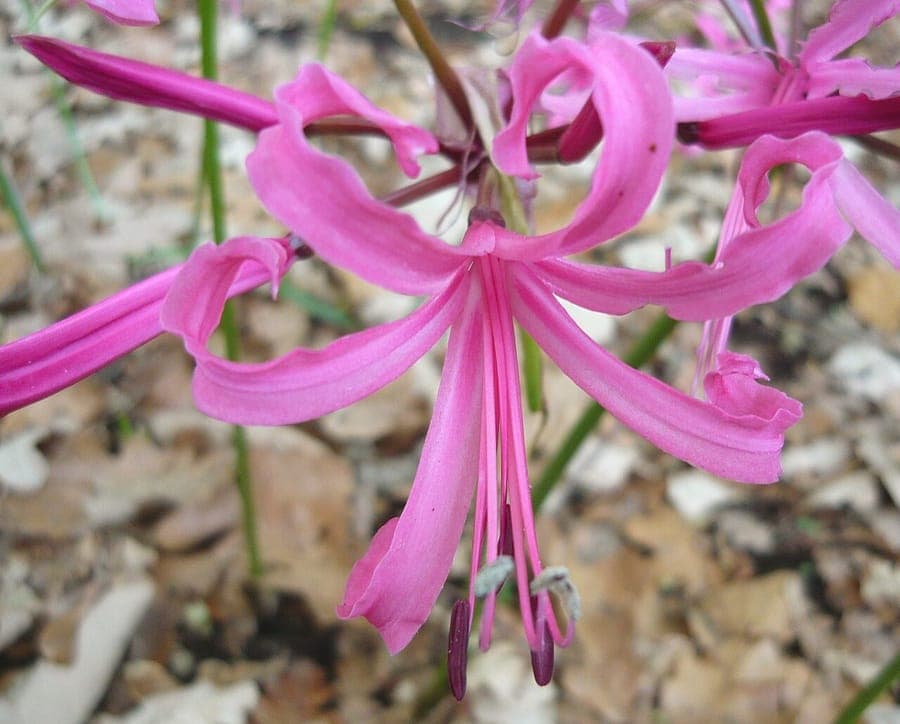
Cillas / CC BY-SA 4.0, via Wikimedia Commons
Bowden lily (Nerine bowdenii): planting, care and overwintering
Nerine bowdenii
Want to see Bowden lily (Nerine bowdenii): planting, care and overwintering in your garden?
Full design in HD: €7.99
Look after your Bowden lily with the GardenWorld app
Identify plants with your camera and get a care calendar with reminders for this plant.


Overview
Nerine bowdenii is one of the last flowers of the gardening year. Just when most plants are winding down in October, this South African bulb suddenly sends up bare stems topped with clusters of vivid pink flowers, their narrow petals wavy and curled back. On a grey autumn day it is a wonderfully cheerful sight.
The species belongs to the daffodil family (Amaryllidaceae) and comes from eastern South Africa, mainly the Drakensberg and the Eastern Cape, where it grows on rocky slopes and among boulders. It is commonly known as the Bowden lily and sometimes as the Cornish lily, names that recall Athelstan Cornish-Bowden, who sent the first bulbs to Britain in the late nineteenth century. It is also sold as Guernsey lily, but that name strictly belongs to the related Nerine sarniensis, which is far less hardy. Nerine bowdenii is the species you can leave outdoors in the ground in our climate.
A plant in flower stands 40 to 60 cm tall. After a few years the bulbs form dense clumps 20 to 30 cm across. If you would like to know which warm spot in your garden suits it best, you can have a garden design made on gardenworld.app that takes account of aspect and soil.
Toxicity
All parts of the nerine are poisonous, the bulb most of all. Like many members of the daffodil family, it contains alkaloids such as lycorine. If eaten, it can cause vomiting, stomach pain and diarrhoea, in people as well as in cats and dogs. The sap may also irritate the skin. Wear gloves when planting or dividing bulbs, keep lifted bulbs out of reach of children and pets, and do not stand cut flowers where a cat might chew them.
Appearance and flowering season
Flowering runs from September into November, depending on the weather and the position. Each stem carries an umbel of six to twelve flowers. The six narrow petals are pink with a darker central stripe, wavy at the edges and strongly recurved. The long stamens project well forward, giving the flower a light, spidery look.
The leaves are strap-shaped, glossy mid-green and 20 to 30 cm long. They appear after or towards the end of flowering, last through winter and spring, and die back in summer. So during flowering you will often see few leaves or none at all. Well-known selections include 'Isabel', with deep pink flowers, and 'Stefanie', in a softer, paler pink. The nerine also makes an excellent cut flower that lasts around two weeks in a vase.
Ideal position
Nerine bowdenii wants the warmest, sunniest spot you have. The classic place is at the foot of a south-facing wall, where the brickwork holds the summer heat and the soil stays dry. That summer warmth ripens the bulbs and leads to generous flowering in autumn. In shade or in a cool, exposed spot it will flower poorly, if at all.
The nerine also does well in a pot on a sunny patio. It actually flowers better when the bulbs are slightly cramped, so do not choose too large a container.
When choosing a spot, think about summer too. The leaves die back then and the bulbs need to bake in full sun. So avoid planting tall, spreading perennials right in front of them, and do not cover them with a thick mulch. A narrow strip along the house, a gravel garden or a rock garden are places where a nerine will feel truly at home.
Soil requirements
Above all, the soil must drain freely. A sandy or gritty soil is ideal, slightly acidic to neutral. On heavy clay, create a raised planting spot or work in plenty of coarse grit and gravel. Go easy on fertiliser: soil that is too rich produces lots of leaves and few flowers.
In a pot, use a mix of compost with a third of coarse grit or fine gravel, plus a drainage layer at the bottom. A pot 15 to 20 cm across is enough for three bulbs.
Free preview
Want to see Bowden lily (Nerine bowdenii): planting, care and overwintering in your garden? Make a free preview of your design.
Planting the bulbs
Plant the bulbs in spring, from March to May, or in late summer, in August. The bulb has a long neck. Plant it shallowly, so that the neck just sticks out of the soil or the tip lies no more than 2 to 3 cm below the surface. Deeply planted bulbs flower poorly. Space them 10 to 15 cm apart, or closer still in a pot.
Expect newly planted bulbs to flower sparingly in their first year. Nerines need time to settle in and flower more freely as the clump becomes more crowded, so leave them undisturbed for years.
Watering
In open ground the nerine hardly needs extra water. Water only in a dry late summer when the buds appear, and in a dry spring when the leaves are growing. In summer, as the foliage dies back, keep the soil on the dry side.
Water pots moderately from late August through to spring, as long as there are leaves. During that time, feed once a month with a high-potassium fertiliser. In June and July, during dormancy, give little or no water.
Pruning and tidying
Cut spent flower stems off at the base. Leave the leaves until they turn yellow and dry naturally in summer; after that you can gently pull them away. No real pruning is needed.
Only when a clump has become so congested after five or six years that flowering declines should you lift it once the foliage has died down and divide it. Replant the bulbs straight away. Keep an eye out for slugs, which enjoy the young leaves.
Maintenance calendar
March to May: Plant bulbs. Let the leaves grow and water in a dry spring.
June and July: The foliage dies back. Dormancy; keep pots dry.
August: Plant bulbs or divide clumps if needed. Start watering pots again.
September to November: Flowering. Cut off spent stems.
December to February: Leaves in growth. Add winter protection during hard frost.
Winter hardiness
The RHS rates Nerine bowdenii H5, which corresponds to about -10 to -15 °C. That makes it one of the hardiest nerines. It survives outdoors in most gardens in Britain and the Low Countries, provided the soil does not stay wet in winter. Cold combined with wet is more dangerous than dry frost.
Overwintering
In hard winters, cover bulbs in the ground with a dry 10 cm layer of straw, bark or conifer branches. Remove it again in March so that the leaves get light. A spot under overhanging eaves, where less rain falls, helps further.
Move pots into a cold, bright and frost-free place when temperatures drop below -5 °C, such as an unheated greenhouse or a light garage. Because the leaves grow in winter, they need light. Water just enough to stop the compost drying out completely.
Companion plants
The pink flowers of the nerine go beautifully with plants that still have colour in autumn. Ice plant (Hylotelephium spectabile) and asters such as Aster amellus and New England aster (Symphyotrichum novae-angliae) flower at the same time and together create a warm autumn border.
At the foot of a sunny wall, combine the nerine with low, drought-loving plants such as blue fescue (Festuca glauca). Lilyturf (Liriope muscari), with its purple spikes, is another lovely autumn partner. Make sure the neighbours do not smother the bulbs, which need summer sun.
Final thoughts
The nerine rewards patience: give it a warm spot, lean soil and years of peace, and it will repay you every autumn with a surprising burst of pink. Just remember that the plant is poisonous.
To know when to plant, divide or protect, have a look at the planting calendar on gardenworld.app. That way you will get the very best from your Nerine bowdenii.
Frequently asked questions about Bowden lily
Is Bowden lily winter hardy?
The RHS rates Nerine bowdenii H5, which corresponds to about -10 to -15 °C. That makes it one of the hardiest nerines.
When and how do you prune Bowden lily?
Cut spent flower stems off at the base. Leave the leaves until they turn yellow and dry naturally in summer; after that you can gently pull them away.
How much water does Bowden lily need?
In open ground the nerine hardly needs extra water. Water only in a dry late summer when the buds appear, and in a dry spring when the leaves are growing.
What soil does Bowden lily need?
Above all, the soil must drain freely. A sandy or gritty soil is ideal, slightly acidic to neutral.

See it in your garden
See Bowden lily in your garden
One photo of your garden and a few questions. You see the result in about a minute.
Try it with a photoIdentify this plant in your own garden. Identify a plant
Similar plants
Showy stonecrop: complete guide
Hylotelephium spectabile
Everything about Showy stonecrop (Hylotelephium spectabile): flowering, cultivation and care. Tips for successful frost resistance, drought tolerance and maintenance in borders and containers.
European michaelmas daisy: complete guide
Aster amellus
A complete guide to growing Aster amellus: care, ideal conditions, bloom time, and companion planting for late-season gardens.
New England aster: complete guide
Symphyotrichum novae-angliae
Learn all about New England aster (Symphyotrichum novae-angliae), a stunning fall-blooming perennial.
