
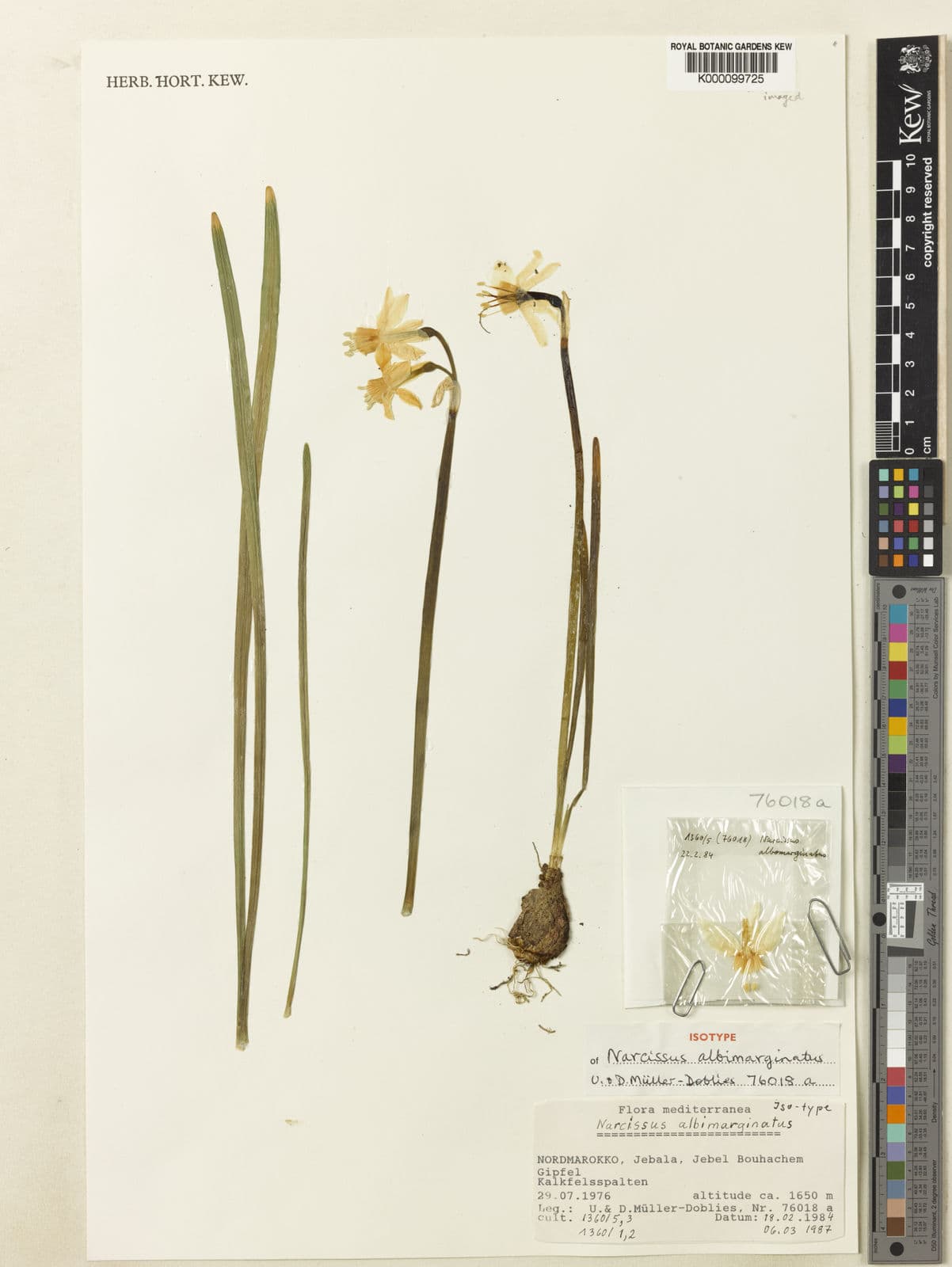
White-margined daffodil (Narcissus albimarginatus): complete guide
Narcissus albimarginatus
Want to see White-margined daffodil (Narcissus albimarginatus): complete guide in your garden?
1 minute, no credit card
Overview
Narcissus albimarginatus, known in French as narcisse, is a rare dwarf daffodil in the amaryllis family (Amaryllidaceae) that occurs only in northern Morocco, on the damp rocky slopes of the Rif Mountains. The species was only scientifically described in 1989 and takes its name albimarginatus, meaning "white-margined," from the narrow white edge along the rim of its small corona, which contrasts sharply with the yellow throat inside. Because its natural range is limited to a handful of rocky slopes at roughly 1200 to 2000 meters in cedar forest, this daffodil remains virtually unknown outside specialist bulb collectors and botanical gardens. Anyone designing a rock garden or alpine border through gardenworld.app is unlikely to see this species suggested as a standard option, but for enthusiasts of rare, small-scale spring bulbs, it is exactly the kind of surprise that completes a collection.
Appearance and bloom
This compact daffodil reaches only 10 to 15 cm in height and typically carries a single small flower per stem, 2 to 3 cm across. The six petals are pure white and form a star-shaped backdrop for the small, trumpet-shaped corona, which is yellow inside and shows a fine, characteristic white rim along its outer edge. The narrow, grey-green leaves appear alongside or just before the flower in early spring, typically in March and April, just as snow in the Rif Mountains begins to melt. After flowering, the plant retreats into its bulb and enters complete dormancy through the dry Moroccan summer, a typical pattern for Mediterranean bulbous plants.
Ideal location
Because this daffodil comes from a narrow, specific high-altitude habitat, it needs an extremely well-drained, sunny spot in the garden that mimics its natural conditions as closely as possible. In the damp, temperate climate of the Netherlands, Belgium, France, and Germany, growing it in open ground is risky due to wet winters; an alpine bed, a raised bed with sharp drainage, or a cold frame with a bulb plunge offers far better odds of survival. Place the bulb among other small, drought-loving bulbs in a sunny, sheltered spot where rainwater drains away quickly. Anyone designing a rockery or gravel garden through gardenworld.app with a focus on rare Mediterranean bulbs can include this daffodil as a special accent among stone features and other small spring bloomers.
Soil
An exceptionally free-draining, mineral soil is essential to this species' success: think of a mix of sharp sand, coarse grit, and a small proportion of humus, with a pH between 6.5 and 7.5. Standard garden soil, and especially heavy clay, is almost always too moisture-retentive for this daffodil and leads to bulb rot. When grown in a pot or bulb frame, use a specialist cactus or alpine mix, supplemented with extra grit for even faster drainage. A thin layer of gravel mulch around the neck of the bulb keeps it dry and significantly reduces the risk of fungal infection.
Watering
During the growing period in winter and early spring, from December to April, the bulb needs moderate watering, roughly every one to two weeks, once the top few centimeters of soil have dried out. As soon as the foliage begins to yellow after flowering, usually from May, cut back on watering entirely, since the bulb then enters a strict summer rest that requires dryness. Too much water during this rest period is the most common cause of death for this species in cultivation. In a bulb frame or alpine house, it is therefore standard practice to keep the bed completely dry from June until the first autumn rains wake the bulb again.
Free design
Want to see White-margined daffodil (Narcissus albimarginatus): complete guide in your garden? Make a free design now.
Pruning
Pruning of this daffodil is minimal, limited to removing spent flower stems so the bulb does not waste energy on seed production, unless you deliberately want to collect seed for propagation. Let the foliage yellow and die back completely after flowering before removing it, since the leaves feed the bulb for next year's bloom. Only cut back wilted leaves once they are fully yellow and limp, usually in May or June, and never earlier, no matter how untidy things look in the meantime. Never remove green leaves, even for tidiness, as this directly reduces the bulb's flowering strength.
Maintenance calendar
From December through February, the bulb develops its first leaf growth as the winter rains fall. In March and April, enjoy the brief but elegant bloom, with its characteristic white flowers and yellow, white-rimmed coronas. From May, the foliage begins to yellow; let this process run its full course. June through August is the period of strict summer rest, during which the bulb must remain completely dry. September and October are good times to check the bulb, repot if needed, or plant new bulbs. November marks the transition into the winter rains, after which the cycle begins again.
Winter hardiness
Narcissus albimarginatus is adapted to winter rainfall and a relatively mild, high-altitude mountain climate, and is estimated to be hardy to roughly USDA zone 8, corresponding to temperatures down to minus 10 to minus 12 degrees Celsius, provided the soil stays bone dry. The greatest threat in the temperate climate of Western Europe is not frost itself, but the combination of cold and prolonged winter rainfall, which quickly causes the bulb to rot. For this reason, specialist growers almost always cultivate this species under glass or in a bulb frame, where temperature and moisture can be precisely controlled, rather than in open ground.
Companion plants
In an alpine trough or bulb frame, this daffodil pairs well with other small, drought-loving bulbs from similar Mediterranean and North African habitats, such as Narcissus cantabricus and Narcissus bulbocodium, which share the same preference for sharp drainage and a dry summer rest. Combine the bulbs further with succulents such as houseleek (Sempervivum) or small saxifrage species (Saxifraga) for an authentic rock garden look year-round. For anyone curious how such a specialist bulb frame or alpine border would look alongside the rest of the garden, gardenworld.app makes it possible to visualize different layouts from a photo of your own garden.
Closing
Narcissus albimarginatus is not a daffodil you will simply stumble across at an ordinary garden center like Intratuin, Gamma, OBI, or Truffaut, where you are more likely to find common large-flowered daffodils; this rare Moroccan mountain species is reserved for specialist bulb growers and alpine plant enthusiasts. With its elegant white flowers, distinctive white-rimmed corona, and fascinating story from the Rif Mountains, this is a bulb that calls for careful, knowledge-driven cultivation under glass or in a bulb frame. For anyone willing to take on the challenge, the reward is a unique, rare spring bloom that few other gardens in the Netherlands or Belgium can match.
Want to see White-margined daffodil (Narcissus albimarginatus): complete guide in your garden? Make a free design now.
Upload a photo, pick a style, and get a photorealistic design with plant list in under a minute.
No credit card required


Similar plants
Narcissus cantabricus: complete guide
Narcissus cantabricus
Narcissus cantabricus is a rare, delicate daffodil from southern Spain with white flowers and a distinctive yellow hoop crown. Perfect for alpine gardens and containers.
Rock narcissus: complete guide
Narcissus rupicola
Narcissus rupicola is a rare, dwarf daffodil from rocky Spanish and Portuguese mountains. Discover how to cultivate this alpine gem in rock gardens and containers.
Petticoat daffodil: complete guide
Narcissus bulbocodium
The petticoat daffodil (Narcissus bulbocodium) is a delicate early-spring bloomer with a distinctive narrow-petaled, trumpet-like flower. Perfect for naturalising and rock gardens.