
Basotxerri / CC BY-SA 4.0, via Wikimedia Commons
Petticoat daffodil: complete guide
Narcissus bulbocodium
Want to see Petticoat daffodil: complete guide in your garden?
1 minute, no credit card
Overview
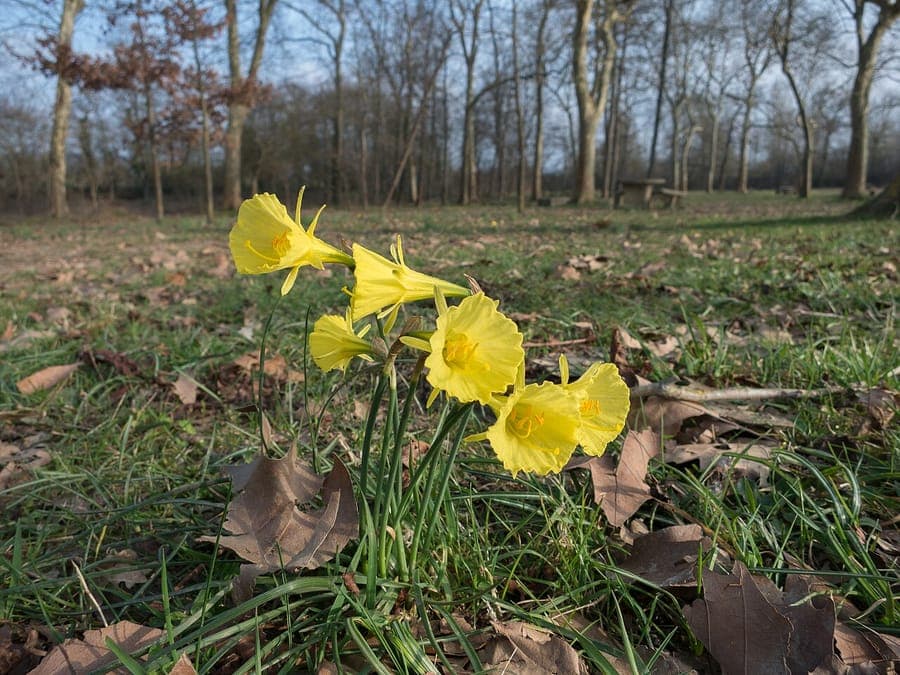
Narcissus bulbocodium, commonly known as the petticoat daffodil, is a charming member of the Amaryllidaceae family native to southwestern Europe - specifically Spain, Portugal, and southern France. Standing just 10–15 cm tall, this petite daffodil brings early spring cheer with its slender stems and unique floral structure. Unlike classic daffodils, its outer petals are tiny, almost inconspicuous, while the central trumpet is large and vibrant yellow. This gives the bloom a whimsical, ruffled appearance - hence the name 'petticoat'. It's a reliable perennial that naturalises well in UK and northern European gardens, thriving in well-drained soils and full sun.
On gardenworld.app, you can create a planting map that integrates petticoat daffodils into meadow-style lawns or gravel beds for a wild, informal look.
Appearance & bloom cycle
The petticoat daffodil blooms from late March to mid-April, depending on local climate and winter severity. Each stem carries a single flower measuring about 3–4 cm across, with a deep yellow, funnel-shaped corona that dominates the bloom. The outer tepals are narrow, reflexed, and pale greenish-yellow, barely extending beyond the trumpet. The foliage is fine-textured, dark green, and grass-like, typically appearing in February.
The plant grows in clumps over time, spreading slowly via bulb offsets and, occasionally, seed. It doesn't self-seed aggressively, making it manageable in mixed borders. The flowers have a faint, sweet scent - just enough to attract early bees but not overpowering in cut arrangements. After blooming, the leaves remain for about six weeks to feed the bulb before dying back completely in June.
Ideal location
This daffodil thrives in full sun (rated 8/10 for light) and performs best in open areas with at least 6–8 hours of direct sunlight daily. It's ideal for rock gardens, raised beds, or the front of sunny borders. It also works beautifully when naturalised in short grass lawns, though avoid mowing until the foliage has yellowed. Plant in groups of 15 or more for visual impact.
Avoid dense shade, especially under deciduous trees, where the soil stays too damp and shaded during its critical growth phase. On gardenworld.app, you can simulate seasonal light patterns to find the best planting spots for your Narcissus bulbocodium.
Soil requirements
Petticoat daffodils prefer acidic to slightly acidic soils with a pH between 4.5 and 5.0. They struggle in alkaline or chalky soils, which can cause nutrient lockout and bulb rot. The soil must be well-draining - sandy loam or gritty mixes are ideal. If your garden has heavy clay, amend it with horticultural grit or coarse sand to improve aeration and prevent waterlogging.
Plant bulbs in autumn (October–November) at a depth of 10 cm and spaced 8 cm apart. Use a low-nitrogen bulb feed at planting time to encourage root development. Reputable garden centres like those across the UK carry quality bulbs, but always inspect for firmness and absence of mould before planting.
Free design
Want to see Petticoat daffodil: complete guide in your garden? Make a free design now.
Watering
During active growth (February to May), water only during prolonged dry spells. These bulbs rely primarily on winter and spring rainfall. Overwatering, especially in poorly drained soils, leads to bulb rot. Once flowering ends and foliage begins to yellow (from May onward), stop watering entirely. The bulbs enter summer dormancy and require dry conditions to survive until the next season.
Pruning
No pruning is needed. Never cut or tie the leaves after flowering - they must photosynthesise to replenish the bulb. Allow the foliage to die back naturally over six weeks. Removing it too early weakens the bulb and reduces next year's blooms. If aesthetics are a concern, plant companion foliage like emerging perennials to hide the fading leaves.
Maintenance calendar
- January: Check for early shoot emergence; protect against rodents with wire mesh.
- February: Begin light watering if dry; monitor for slug damage.
- March: Bloom starts; keep area free of heavy mulch.
- April: Peak flowering; avoid wetting flowers to prevent fungal issues.
- May: Foliage begins to yellow; cease watering and feeding.
- June: Remove dead leaves; bulbs enter dormancy.
- July–August: Dormant period; no care needed.
- September: Assess clump size; plan for division if overcrowded.
- October–November: Plant new bulbs or relocate existing ones.
- December: Bulbs overwinter underground; ensure good drainage.
Winter hardiness
Hardy in USDA zones 5–8, the petticoat daffodil tolerates winter temperatures down to -20°C when planted in well-drained soil. In wet winters, however, persistent moisture can cause bulbs to rot. A light mulch of gravel or pine needles in December helps shed excess water and insulates the soil.
Companion plants
Pair with other spring stars: Anemone blanda, Chionodoxa luciliae, or Scilla siberica. These bloom at the same time and share similar cultural needs. Low-growing thymes (Thymus praecox) or sedums (Sedum acre) make excellent ground cover companions, especially in rock gardens. Avoid invasive spreaders like mint or aggressive ground covers that block light.
For structure, plant behind early tulips or alongside emerging ferns. The contrast in texture enhances the delicate charm of the petticoat daffodil.
Closing
The petticoat daffodil isn't flashy, but it's a quietly resilient performer that brings joy with minimal effort. Its compact size and long-term reliability make it ideal for small gardens, containers, or naturalised plantings. Buy bulbs from trusted garden centres in autumn, plant them deep and in groups, and let them do their thing. Over the years, they'll form gentle colonies that signal the true arrival of spring. Use gardenworld.app to design a seasonal planting scheme that highlights their fleeting beauty alongside complementary plants.
Want to see Petticoat daffodil: complete guide in your garden? Make a free design now.
Upload a photo, pick a style, and get a photorealistic design with plant list in under a minute.
No credit card required


Similar plants
Douglas' Onion: complete guide
Allium douglasii
Douglas' onion is a compact ornamental allium with purple flowers, perfect for rock gardens and sunny borders. Learn care, siting and hardiness.
Oblique onion: complete guide
Allium obliquum
The oblique onion is a hardy ornamental allium with chartreuse flower heads and blue-green foliage. Location, soil and care explained.
False hooded garlic: complete guide
Allium pseudocalyptratum
Discover false hooded garlic (Allium pseudocalyptratum): a rare ornamental onion from Lebanon for rock gardens and alpine troughs.