
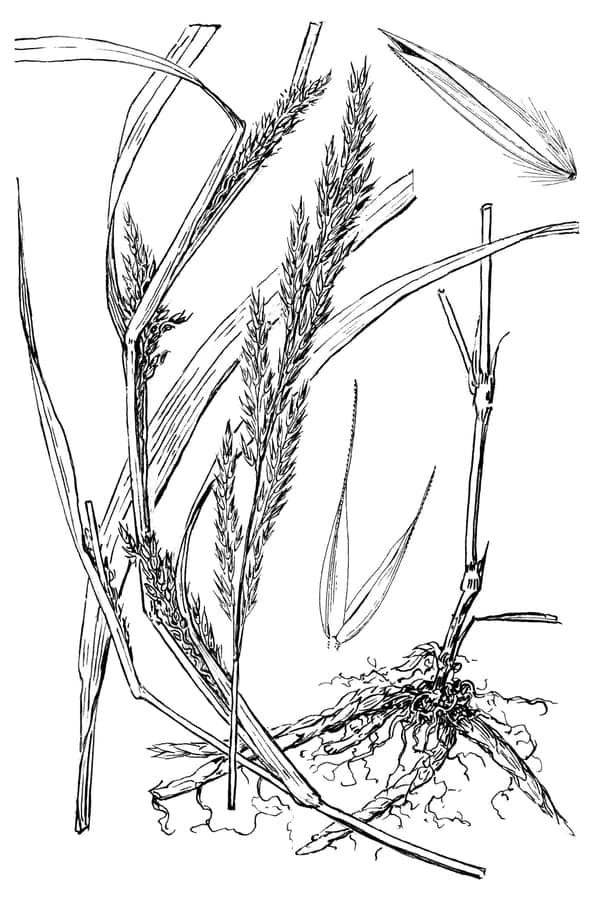
Albert Spear Hitchcock (1865–1935), Mary Agnes Chase (1869–1963), A. H. Baldwin, (Miss) M. D. Baker, Mary Wright Gill (1866-1929), Frank Lamson-Scribner, W. R. Scholl, Theodore Holm, Leta Hughey, Benjamin Y. Morrison, Mrs. George M. Mullett, Frances Carnes Weintraub, Edna May Whitehorn, or possibly another illustrator. / Public domain, via Wikimedia Commons
Wirestem muhly: complete guide
Muhlenbergia frondosa
Want to see Wirestem muhly: complete guide in your garden?
1 minute, no credit card
Overview
Muhlenbergia frondosa, commonly called wirestem muhly or leafy muhly, is a rhizomatous, clump-forming grass in the family Poaceae. Native to eastern North America, it ranges from southern Canada (Ontario, Quebec, New Brunswick) through the central and eastern United States to Texas, Louisiana, and Georgia. In this broad territory it inhabits moist to wet habitats: streambanks, floodplain forests, wet meadows, and ditch margins. The common names reflect two of its most visible traits - the remarkably slender, wire-like stems and the relatively leafy, well-clothed appearance compared to many other grasses in the genus.
In the garden, wirestem muhly fills a genuine niche: it performs well in part shade and on reliably moist soils, conditions that rule out most other ornamental grasses. Whether used as a streamside planting, a filler in a woodland border, or a naturaliser in a shaded section of the front garden, it brings graceful movement and fine texture to situations where few grasses can thrive. Visit gardenworld.app for design ideas on how to use moisture-loving grasses in your outdoor space.
Appearance and bloom cycle
Muhlenbergia frondosa grows in loose, spreading clumps that expand gradually via rhizomes to 30-90 cm or more in width. The stems are remarkably slender and wiry - hence the name wirestem - and reach 30 to 90 cm in length. Initially erect, they arch gracefully under the weight of the foliage, giving the plant a relaxed, flowing character. The leaves are narrow, 2-6 mm wide, and a lively mid-green, giving the plant a leafier, more substantial look than many of its relatives.
Flowering occurs in August and September. The inflorescences are narrow, rather contracted panicles with a purplish cast. Individual flowers are small, but they appear in sufficient numbers above the leaf mass to create a fine, airy display. After flowering, small brown seeds ripen in October and November, providing food for finches and sparrows. In autumn the foliage turns warm yellow-brown, and the dry stems and seed heads persist well into winter, maintaining garden interest through the coldest months.
Ideal location
Unlike most ornamental grasses, which demand sun and good drainage, wirestem muhly is adapted to partial shade and moist conditions. It is well suited to north- or east-facing borders, positions beneath deciduous trees and shrubs, and planting along the shaded margins of ponds and streams. In full sun it will grow, but only if moisture is consistently available; on dry, sun-baked soils it tends to struggle and may die back in summer.
In a typical European garden with moderate rainfall and temperate summers, wirestem muhly performs reliably in light to moderate shade with moderate soil moisture. Good air circulation reduces the risk of fungal leaf spot, which can occasionally appear in very damp, enclosed situations.
The rhizomatous habit means the plant will slowly spread outward. Allow space for this, or cut back the outermost rhizomes each spring with a sharp spade to keep the clump to a manageable size.
Soil
Muhlenbergia frondosa is less demanding about soil structure than many ornamental grasses. In its natural habitat it grows on clay-rich, silty, and sometimes heavy riverbank soils that are periodically waterlogged. The acceptable pH range runs from 5.9 to 7.9, covering slightly acidic to neutral conditions.
In the garden it performs well on moisture-retentive clay loam, garden loam, and rich humus soils. On poor, free-draining sandy soils it needs more attention: regular watering and a generous layer of organic mulch will help maintain adequate moisture. Adding well-rotted compost to the planting hole gives a good start on lighter soils.
Avoid fast-release synthetic fertilisers on heavy, moist soils: these push lush but floppy growth. A modest spring top-dressing of mature compost is usually sufficient.
Watering
Wirestem muhly has a higher moisture requirement than most other members of the genus. In its native habitat it grows on streambanks and in wet woodland, making it poorly suited to prolonged dry conditions without supplemental watering.
In gardens with reliable moderate rainfall and on moist, retentive soils, the plant generally needs little supplemental watering once established. During dry spells lasting more than two weeks in summer, watering twice a week is advisable, especially in the first season. Newly planted specimens need watering every two to three days for the first four to six weeks to aid root establishment.
In sunny, well-drained positions, water more frequently - once a week at minimum, more during prolonged heat. Containers dry out faster than open ground; check moisture levels twice weekly and water when the top 3-4 cm are dry.
Free design
Want to see Wirestem muhly: complete guide in your garden? Make a free design now.
Pruning
Leave the dry stems and seed heads in place through autumn and winter. The tawny, golden-brown foliage provides winter interest, and the seed heads feed finches and sparrows. Cutting back in autumn is unnecessary and removes a useful wildlife resource.
The ideal pruning time is late winter, February to early March, just before new shoots emerge from the base. Cut the entire clump back to 10-15 cm above ground with sharp secateurs or garden shears. If the clump has spread via rhizomes and become too wide, use a sharp spade in early spring to slice off the outer portions and either discard them or transplant them elsewhere in the garden.
For a neater winter look you can remove the spent flower heads after they have stood for six to eight weeks, but try to keep the bulk of the leaf mass in place to protect the crown from winter wet.
Maintenance calendar
Month-by-month care guide for Muhlenbergia frondosa in a temperate European garden:
- January-February: leave undisturbed; dry plumes provide bird food and winter structure.
- March: cut back to 10-15 cm; remove any frost-damaged material; trim unwanted rhizome spread with a spade.
- April: new shoots emerge; apply a light top-dressing of compost; check soil moisture.
- May-June: active growing season; water twice weekly if conditions are dry.
- July: maintain moisture in dry spells; remove any weeds establishing around the clump.
- August-September: flowering period; enjoy the fine panicles; no pruning needed.
- October-November: seeds ripen; leave the plant standing for birds and winter decoration.
- December: fully dormant and hardy; no action required.
Winter hardiness
Muhlenbergia frondosa is native to climates with cold winters and is rated hardy to USDA zone 4, tolerating temperatures as low as -34 degrees Celsius. For European temperate climates, including the Netherlands, Belgium, northern France, and Germany, the species is reliably winter-hardy without any protection.
The rhizomatous root system contributes to winter survival: even if above-ground growth is killed back by sharp frost, the underground rhizomes survive and push up fresh shoots in spring. On permanently waterlogged soils there is a greater risk of crown rot in winter, not from cold but from persistent wet; improving drainage in the planting hole reduces this risk considerably.
Companion plants
Wirestem muhly pairs well with moisture-tolerant shade plants and streamside perennials:
- Lobelia cardinalis (cardinal flower): vivid red flower spikes create a dramatic contrast with the fine green foliage.
- Iris pseudacorus (yellow flag): bold upright foliage gives structure alongside the arching, wiry stems.
- Matteuccia struthiopteris (ostrich fern): the funnel-shaped fern rosette and the open grass architecture make an elegant pairing in part shade.
- Carex pendula (pendulous sedge): the hanging spikes and deep green leaves suit the leafy character of the muhly perfectly.
- Filipendula ulmaria (meadowsweet): white summer plumes and lush foliage echo the plant's woodland-edge character.
- Lysimachia nummularia (creeping Jenny): as a low ground cover beneath the clump, its golden-yellow carpet brings brightness to the understory.
For a visual preview of a moist shade border featuring wirestem muhly and its companions, upload your garden photo at gardenworld.app and receive a personalised planting visualisation.
Closing
Muhlenbergia frondosa is a dependable, understated grass for positions that challenge most ornamental species. Its tolerance of partial shade and reliably moist soils, its gracefully arching wiry stems, and the fine late-summer plumes all contribute to a plant of quiet, year-round value. Whether you are softening a shaded fence line, naturalising a streambank, or filling the margin of a garden pond, wirestem muhly delivers texture, movement, and wildlife benefit with very little effort.
Want to see Wirestem muhly: complete guide in your garden? Make a free design now.
Upload a photo, pick a style, and get a photorealistic design with plant list in under a minute.
10,000+ gardens designed already
No credit card required


Similar plants
Alkali muhly: complete guide
Muhlenbergia asperifolia
Full growing guide for Muhlenbergia asperifolia: location, soil, watering, pruning, winter hardiness and garden design ideas.
Spike muhly: complete guide
Muhlenbergia glomerata
Full growing guide for Muhlenbergia glomerata: site, soil, moisture, pruning, winter hardiness and planting combinations.