
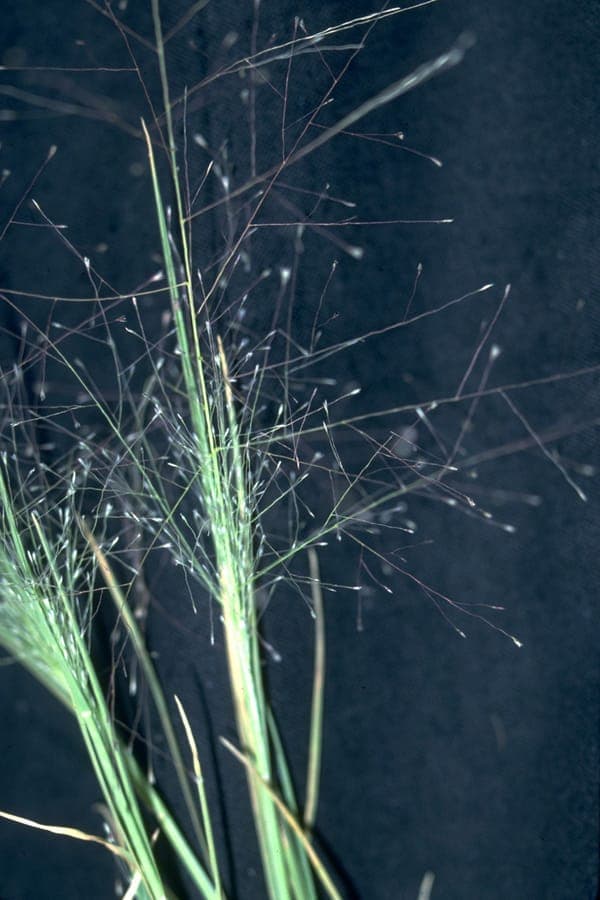
Robert H. Mohlenbrock / Public domain, via Wikimedia Commons
Alkali muhly: complete guide
Muhlenbergia asperifolia
Want to see Alkali muhly: complete guide in your garden?
1 minute, no credit card
Overview
Muhlenbergia asperifolia, commonly called alkali muhly or scratch grass, is a fine-textured, clump-forming grass in the family Poaceae. Its native range is remarkably broad, extending from the Canadian prairies and the western United States south through Mexico, Bolivia, and into Argentina and Chile. This huge geographic span reflects the plant's adaptability: it thrives on alkaline, salt-influenced soils, along stream banks that dry out seasonally, and across open grasslands subject to drought and cold alike.
In garden design, alkali muhly has carved out a niche as a subtle, airy filler for naturalistic borders and contemporary front gardens. Its clouds of fine purplish plumes catch the low light of late summer and early autumn in a way few other plants can match. If you are looking for inspiration on how to incorporate ornamental grasses into your outdoor space, gardenworld.app offers professional garden visualisations at the click of a button.
Appearance and bloom cycle
Muhlenbergia asperifolia grows as a rounded, cushion-like clump reaching 30 to 60 cm in height and about the same in width. The leaves are very narrow and linear, with a noticeably rough texture - a feature recorded in the Latin epithet asperifolia (rough-leaved). Foliage colour shifts from bright yellow-green in spring to a warm gold in autumn.
Flowering occurs from late August through October. The inflorescences are open, diffuse panicles that rise well above the leaf mass. Individual flowers are small with purplish glumes, but it is the long thread-like styles and anthers that give the panicles their characteristic mist-like quality. In low morning or evening sun the plumes shimmer with a soft, almost glassy luminescence. The fruits are small brown caryopses, typical of the grass family, which ripen in October and November and are attractive to seed-eating birds.
Unlike many showier ornamental grasses, alkali muhly is valued for its restraint: the texture is delicate, the movement constant and graceful, and the colour palette muted and sophisticated.
Ideal location
Alkali muhly performs best in a position receiving at least four to six hours of direct sun per day. In light partial shade it will still grow, but stems become lax and flower production drops noticeably. It is ideal for south- or west-facing borders, open driveways, and exposed slopes where other plants might struggle.
The plant tolerates a wide range of climatic conditions. In coastal gardens with salty sea breezes it holds up well, as does it in dry, continental inland settings. In cooler, wetter northern European climates such as those of the Netherlands and Belgium, it performs best when planted in a sheltered but open position with good air circulation to prevent fungal issues.
Avoid low-lying areas prone to waterlogging, especially in winter. The rhizomatous root system needs good drainage to overwinter successfully and to send out the creeping underground stems that slowly colonise surrounding soil.
Soil
One of the most compelling features of Muhlenbergia asperifolia for gardeners is its broad soil tolerance. In the wild it is found on alkaline, even mildly saline soils, but it adapts readily to sandy, loamy, and light clay soils as well. The acceptable pH range runs from 6.0 to 8.4 - far wider than most cultivated garden plants.
Rich, heavily amended soils tend to produce lush but floppy growth that loses the tidy mounded form. A lean, well-drained substrate brings out the best compact habit. If your soil is heavy clay, improve drainage in planting holes by mixing in coarse grit or perlite. A layer of fine gravel mulch around the crown also helps keep the collar dry and reduces winter rot risk.
No special fertiliser regime is needed. A light top-dressing of well-rotted compost in spring is sufficient for most garden soils. Avoid high-nitrogen feeds, which push lush vegetative growth at the expense of flowering and structural integrity.
Watering
Once established, alkali muhly is strikingly drought-tolerant. Its native prairie and streamside habitats experience seasonal dry spells, and the plant's root system is well adapted to extracting moisture from deeper soil layers during these periods. In a garden context, young plants should be watered every two to three days for the first two to three weeks after planting to aid establishment. After that, once-a-week watering during dry spells in the first season is adequate.
In the second year and beyond, supplemental watering is rarely necessary in temperate European climates with their relatively reliable summer rainfall. In prolonged dry spells lasting more than three weeks, a deep, slow watering once a week is beneficial. Avoid frequent shallow watering, which encourages shallow roots and makes the plant more vulnerable to drought stress.
Container-grown specimens need more regular attention because pots dry out faster than open ground. Check the substrate twice weekly and water when the top 3-4 cm feel dry. Ensure pots have drainage holes and do not let saucers collect standing water.
Free design
Want to see Alkali muhly: complete guide in your garden? Make a free design now.
Pruning
Pruning alkali muhly is straightforward. The dry plumes and tawny foliage retain their ornamental quality through autumn and winter, providing structure, movement, and food for seed-eating birds. It is therefore best to leave the plant uncut until late winter or very early spring.
The optimal pruning window is February to early March, just before new growth emerges from the base. Cut all old stems back to about 10-15 cm above ground level using sharp secateurs or garden shears. Remove any blackened or frost-damaged material at the same time. This clean-up takes only a few minutes per clump and is the only regular maintenance task required.
If a tidier appearance is preferred in winter, you can remove the seed heads once they have been standing for six to eight weeks after flowering - but keep as much leaf mass as possible to protect the crown.
Do not cut hard into the crown itself; the growing points of the new season's shoots are clustered just above soil level and can be damaged by overly aggressive cutting.
Maintenance calendar
A practical month-by-month care guide for Muhlenbergia asperifolia in a temperate European garden:
- January-February: leave the plant undisturbed; dry plumes provide bird food and the old stems help protect the crown from sharp frost.
- March: cut back to 10-15 cm; remove dead material; check for new shoot growth at the base.
- April: new growth emerges; apply a light top-dressing of compost if desired.
- May-June: active growing season; water once a week in dry spells; remove any surrounding weeds.
- July: mulch around the clump with fine gravel or bark to conserve moisture and suppress weeds.
- August-September: peak flowering period; enjoy the airy plumes; no pruning needed.
- October-November: seeds ripen; leave the plant standing for birds and winter interest.
- December: fully dormant; no action required except to check drainage is adequate in wet conditions.
Winter hardiness
Muhlenbergia asperifolia is rated hardy to USDA zone 4, meaning it tolerates temperatures as low as -34 degrees Celsius. For northern and western European winters, which rarely drop below -15 to -20 degrees Celsius even in the coldest inland areas, this rating provides a substantial margin of safety. No winter protection is needed in most temperate climates.
In exceptionally cold or prolonged wet winters, a loose mulch of coarse straw or leafmould over the crown offers a modest degree of additional protection. Remove this mulch in early March to prevent the crown from staying damp once temperatures rise.
The rhizomatous growth habit also contributes to winter survival: even if top growth is killed back by severe frost, the underground stems can produce new shoots in spring. This makes alkali muhly a reliable and long-lived garden plant.
Companion plants
Alkali muhly suits a wide range of garden styles and companion plantings. In a naturalistic prairie-style scheme, it combines well with:
- Echinacea purpurea (purple coneflower): the bold daisy flowers contrast beautifully with the fine plumes.
- Rudbeckia fulgida (black-eyed Susan): golden yellow daisies bring warmth alongside the airy green foliage.
- Salvia nemorosa (woodland sage): spikes of blue-violet above compact grey-green foliage sit perfectly next to the delicate grass texture.
- Agastache foeniculum (anise hyssop): tall, fragrant purple spikes and aromatic leaves add height and scent to the planting.
- Penstemon digitalis: white to pale pink tubular flowers suit the muted palette of the Muhlenbergia perfectly.
- Allium sphaerocephalon: the deep burgundy drumstick heads rising through the grass create a striking midsummer picture.
For a more minimalist, low-maintenance front garden, alkali muhly can be planted in generous drifts alongside structural plants such as Festuca glauca or Carex. Visit gardenworld.app to see how these combinations translate into a real design visualisation for your own front garden.
Closing
Muhlenbergia asperifolia is a quiet achiever in the garden - undemanding in its requirements, generous in its seasonal display, and remarkably adaptable to a wide range of soils and climates. From the soft yellow-green cushions of spring through the shimmering purple-misted plumes of late summer to the tawny seed heads of winter, it contributes texture and movement across all four seasons. For any gardener seeking a low-maintenance, long-lived ornamental grass with genuine ecological value, it is an outstanding choice.
Want to see Alkali muhly: complete guide in your garden? Make a free design now.
Upload a photo, pick a style, and get a photorealistic design with plant list in under a minute.
10,000+ gardens designed already
No credit card required


Similar plants
Wirestem muhly: complete guide
Muhlenbergia frondosa
Complete care guide for Muhlenbergia frondosa: ideal site, soil, watering, pruning, winter hardiness and planting combinations.
Spike muhly: complete guide
Muhlenbergia glomerata
Full growing guide for Muhlenbergia glomerata: site, soil, moisture, pruning, winter hardiness and planting combinations.