
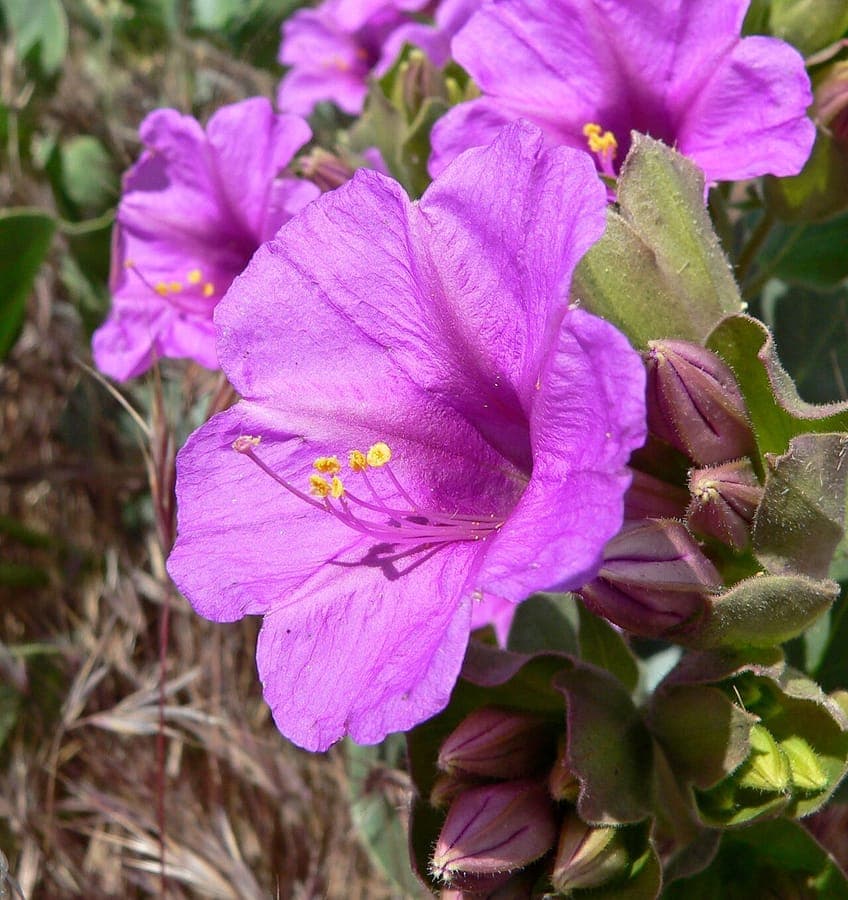
Stan Shebs / CC BY-SA 3.0, via Wikimedia Commons
Colorado four o'clock: complete guide
Mirabilis multiflora
Want to see Colorado four o'clock: complete guide in your garden?
1 minute, no credit card
Overview
Mirabilis multiflora, commonly known as Colorado four o'clock or manyflowered four o'clock, is a spectacular perennial in the four o'clock family (Nyctaginaceae). Native to the American Southwest and northern Mexico - Arizona, California, Colorado, Nevada, New Mexico, Texas, and Utah - it grows naturally on rocky slopes, in dry arroyos, and on poor, sandy soils, often at considerable elevation. Few perennials can match its combination of drought toughness, generous bloom, and sheer visual impact in a warm, sunny garden.
The name four o'clock refers to the characteristic trait shared across the Mirabilis genus: the flowers open in the late afternoon, typically around four to five o'clock, and close again by morning. This makes the Colorado four o'clock particularly valuable for evening gardens and for gardeners who are away during the day and want a spectacular display when they return home. At gardenworld.app you will find inspiration for designing evening-friendly gardens with bold, late-opening perennials like this one.
Mirabilis multiflora differs markedly from the more familiar Mirabilis jalapa (common four o'clock) in its much larger size, deeper root system, and extraordinary flower production. Where the common four o'clock is a compact annual or short-lived perennial, Mirabilis multiflora grows into a substantial, shrub-like mound 60 to 90 centimetres tall and up to 150 centimetres wide. Its individual flowers are somewhat smaller, but are produced in such overwhelming numbers that the overall effect is more impressive.
Appearance and bloom cycle
Mirabilis multiflora is a true perennial that re-emerges each spring from a large, tuberous root. The stems are multiple, lightly branched, and form together a broad, dome-shaped mound. The plant reaches 60 to 90 centimetres in height and can spread to 100 to 150 centimetres or more in diameter. The stems are slightly sticky, which helps deter some crawling insects.
The leaves are broadly heart-shaped to triangular, mid-green, and slightly tacky to the touch due to glandular hairs. They are generously sized relative to the plant and give it a lush, full appearance even when not in bloom.
The flowers are the main event. They are funnel-shaped, vivid magenta-pink to deep reddish-purple, and produced in abundance from late May through August and into September in favourable conditions. Each flower is roughly 3 centimetres across and opens in the late afternoon. They carry a light, sweet fragrance that draws nocturnal hawk moths and other night-flying insects, while large bees and bumblebees visit enthusiastically during the hours immediately after opening. Pollinator activity around a well-established plant on a warm summer evening is genuinely impressive.
Ideal location
Colorado four o'clock thrives in full sun to light partial shade. In its native habitat it occupies open, sun-baked slopes and desert grasslands. In the garden it performs best with at least five to six hours of direct sun per day. It will tolerate light afternoon shade in very hot climates, but flowers most freely in full sun.
It is an outstanding choice as a specimen plant on a sunny border, in a rock garden, on a dry slope, or as part of a xeriscape planting scheme. Its broad, mounding growth habit makes it an attractive structural plant in a mixed border, and its sheer size means it fills large spaces effectively. Allow ample room at planting time - a mature specimen can easily reach 150 centimetres across.
Soil
Mirabilis multiflora is not demanding about soil quality. In nature it grows on sandy, rocky, and very lean soils with a pH of 6.5 to 8.5, tolerating both mildly acid and mildly alkaline conditions. The single non-negotiable requirement is excellent drainage. Standing water, particularly in winter, will rot the tuberous root and kill the plant.
On rich, highly fertile garden soil the plant tends to produce abundant foliage at the expense of flowers. A moderately lean, well-drained soil promotes the most impressive bloom. Improve heavy clay before planting by incorporating coarse sand and grit. On gravel or stony ground it excels. A layer of gravel mulch around the crown helps shed excess moisture and keeps the root zone warm.
Free design
Want to see Colorado four o'clock: complete guide in your garden? Make a free design now.
Watering
Once established, Colorado four o'clock is remarkably drought-tolerant thanks to its large, moisture-storing tuberous root. In its native range it regularly survives months without rainfall. Young plants in their first growing season need more regular irrigation until the root system develops fully.
In the first summer, water every one to two weeks and allow the soil to dry out well between sessions. Established plants in the open ground need very little supplemental irrigation in climates with moderate summer rainfall. During sustained heat and drought, a deep watering every two to three weeks is sufficient. Overwatering is the most common cause of failure: the tuberous root is susceptible to rot in persistently wet conditions. In containers, ensure drainage holes are large and unobstructed.
Pruning
Minimal pruning is required. After the first hard frost, the top growth dies back and can be cut to ground level. This is essentially the only pruning the plant needs. The tuberous root survives underground through winter and pushes up new growth the following spring.
During the growing season, long stems can be lightly trimmed if a more compact form is preferred, though this is rarely necessary. The plant has a naturally rounded, dome-shaped habit that requires no shaping. Removing spent stems for tidiness is optional. Leave the above-ground structure standing until after the first frost has killed it, as this provides some insulation to the crown.
Maintenance calendar
January-February: root is dormant underground; no action needed. March: first shoots may appear; rake back mulch to allow the soil to warm. April: new growth accelerates; apply a light balanced feed if desired. May-June: first flowers appear; watch the plant expand rapidly in volume. July-August: peak of bloom; enjoy the evening flower display. September: flowering continues in warm conditions; seeds begin to ripen. October: cut back top growth after first hard frost. November-December: root dormant; apply extra mulch in cold climates.
Winter hardiness
Mirabilis multiflora is hardy in USDA zones 5 to 9, tolerating minimum winter temperatures of around -28°C in the coldest zones. In its native Colorado and New Mexico range the tuberous root reliably survives hard winters. The large, deep-set root provides considerable insulation from cold.
In temperate European gardens - zones 8 and 9 - it overwinters successfully in well-drained soil. A thick mulch of straw, leaf mould, or bark chippings provides additional protection during cold spells. In heavy clay soils, it is advisable to lift the tuber in November, store it dry in a frost-free space, and replant in April. Explore gardenworld.app for more practical guidance on overwintering tuberous perennials in your climate zone.
Companion plants
Colorado four o'clock integrates beautifully into drought-tolerant planting schemes. Salvia species in blue, purple, or white create elegant colour harmonies with the magenta blooms. Agastache in orange or yellow offers warm contrast and is equally attractive to pollinators. Echinacea purpurea and Gaillardia introduce vibrant warm tones.
For a naturalistic desert planting, pair with Yucca, Agave, Penstemon, and ornamental grasses like Nassella tenuissima or Bouteloua gracilis. Low-growing Calylophus or Oenothera make excellent front-of-border companions. The broad mounding habit of Mirabilis multiflora also makes it a highly effective temporary gap-filler in a new or developing mixed border.
Closing
Mirabilis multiflora is one of the most underrated perennials for the warm, sunny garden. Its evening flower display is genuinely theatrical - the sudden burst of colour from hundreds of magenta flowers opening simultaneously at dusk is a spectacle few other plants can rival. Combined with its toughness, its drought tolerance, and its value to pollinators, the Colorado four o'clock deserves far wider planting than it currently receives. For any gardener seeking maximum colour return for minimum water input, this plant is an outstanding investment.
Want to see Colorado four o'clock: complete guide in your garden? Make a free design now.
Upload a photo, pick a style, and get a photorealistic design with plant list in under a minute.
10,000+ gardens designed already
No credit card required


Similar plants
Sand-verbena: complete guide
Abronia umbellata
Discover sand-verbena, a beautiful pink flower from California perfect for sunny, dry gardens and groundcover with low maintenance needs.
Bougainvillea spectabilis: complete guide
Bougainvillea spectabilis
Great bougainvillea from Brazil with spectacular colored bracts. Climbing plant for warm climates. Care and propagation techniques.
Red spiderling: complete guide
Boerhavia diffusa
Red spiderling (Boerhavia diffusa), also known as spreading hogweed, is a versatile tropical plant with traditional medicinal uses. Discover cultivation and care tips.