
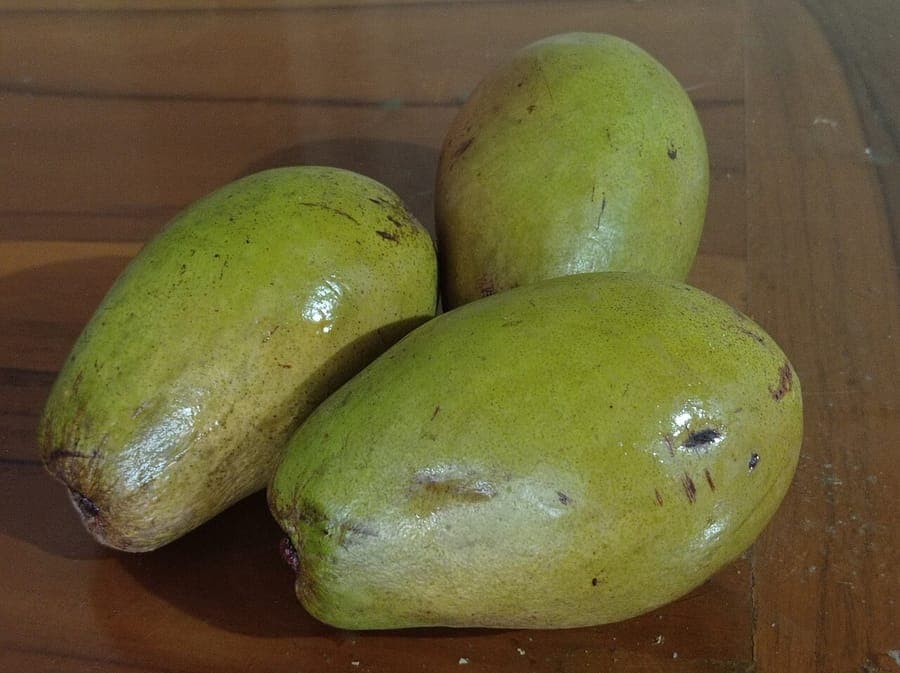
Wikieditor573 / CC BY-SA 4.0, via Wikimedia Commons
Binjai mango: complete guide
Mangifera caesia
Want to see Binjai mango: complete guide in your garden?
1 minute, no credit card
Overview
Mangifera caesia, known as binjai mango or wani, is a tropical fruit tree from Southeast Asia, particularly Thailand, Malaysia, and Sumatra. This tree belongs to the family Anacardiaceae and is prized for its juicy, delicious fruits. In its native habitat it can reach 15 to 25 meters tall, but in container cultivation usually remains much smaller.
This tree is not suitable for outdoor cultivation in the Netherlands but can be interesting for those wishing to cultivate a tropical specimen in a heated greenhouse or winter garden. It requires warmth, humidity control, and patient care.
Appearance and flowering
The leaves of Mangifera caesia are long, lance-shaped, dark green, approximately 15 to 30 centimeters long. The foliage is glossy and decorative. New growth can have pinkish to reddish tints.
The flowers are small, yellow to greenish, appearing in panicles, not very showy. The true attraction is the fruit. These are small to medium, approximately 5 to 8 centimeters, oval, yellow to orange-yellow. The flesh is yellow to orange-yellow, very juicy and sweet. The pit is relatively large.
The fruit quality is less known in Europe, but locally highly valued for richness and flavor. It is considered a primary food in some parts of Asia.
Ideal location
Mangifera caesia thrives best in full sun. For growth, at least 20 to 25 degrees Celsius is needed. Below 15 degrees, growth and flowering stop. In the Netherlands, this means greenhouse cultivation in winter.
The tree appreciates protection from wind, as strong winds damage leaves and young fruits. A south wall in a greenhouse is ideal.
Soil
The tree grows best in well-drained, loose soil. Sandy to sandy loam, slightly acidic to neutral pH is preferable. For greenhouse cultivation, use potting mix enhanced with some peat moss.
The tree is a heavy feeder. Regular feeding during growth is essential for production.
Free design
Want to see Binjai mango: complete guide in your garden? Make a free design now.
Watering
During growth and flowering periods, water regularly, ensuring the soil is moist but not waterlogged. In tropical climates, natural rainfall suffices. In a greenhouse, this means spraying water 2 to 3 days per week.
Once fruits form, consistent water is important. Too much water causes fruit quality problems.
In winter, when growth slows, reduce watering significantly.
Pruning
Pruning is not essential, but light shaping can be done to encourage more compact growth. Remove dead branches or disease symptoms.
In a greenhouse, careful pruning can help limit height and develop better form.
Maintenance calendar
March to May: Feed at growth start, begin misting. June to August: Water regularly, feed every 2 weeks, monitor for flowering. September to October: Monitor flowering, fruit development. November to February: Significantly limit water, no feeding, keep cooler around 15 degrees.
Climate requirements
Mangifera caesia is purely tropical. In the Netherlands it can only grow in a heated greenhouse. Temperature below 10 degrees causes leaf drop. For fruit formation, minimum 20 to 25 degrees day and 15 degrees night is needed.
Air humidity should be between 60 to 80 percent. Spray regularly in dry periods.
Companion plants
In a greenhouse, Mangifera caesia can grow alongside other tropical fruit trees:
- Other mango varieties
- Papaya for diversity
- Passion fruit on espalier
- Tropical herbaceous plants beneath
Final thoughts
Mangifera caesia is a fascinating but challenging plant for advanced gardeners in the Netherlands. It requires greenhouse facilities, temperature control, and patience. But for those who can simulate an Asian tropical climate, it offers the opportunity to cultivate an authentic tropical fruit tree.
The fruits are delicious and unique. Local seeds can be ordered online, or seedlings from specialized greenhouse growers. The project is certainly rewarding for tropical plant enthusiasts!
Those willing to experiment can try seeds in a heated greenhouse with much patience and care.
Want to see Binjai mango: complete guide in your garden? Make a free design now.
Upload a photo, pick a style, and get a photorealistic design with plant list in under a minute.
No credit card required


Similar plants
Skunkbush sumac: complete guide
Rhus trilobata
Everything about Rhus trilobata: siting, soil, autumn colour, pruning, and how this tough ornamental shrub earns a place in any garden.
Winged sumac: complete guide
Rhus copallinum
Everything about Rhus copallinum, the winged sumac with spectacular autumn colour. Location, pruning and garden value in full detail.
Aromatic sumac: complete guide
Rhus aromatica
Full guide to aromatic sumac (Rhus aromatica): planting, soil, care, pruning and companion plants for dry, sunny gardens and slope stabilisation.