
Wikimedia Commons / Public domain, via Wikimedia Commons
Chilean Jasmine: complete guide
Mandevilla laxa
Want to see Chilean Jasmine: complete guide in your garden?
1 minute, no credit card
Overview
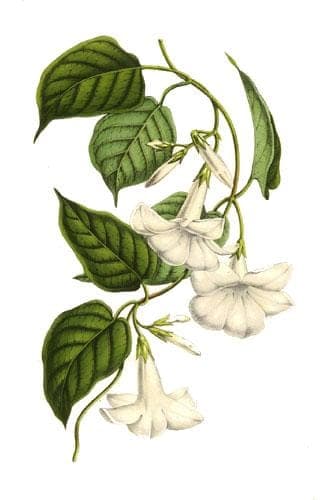
Mandevilla laxa, also known as Chilean Jasmine, is an elegant climbing plant from Peru and Bolivia with beautiful white fragrant flowers. This vine reaches heights of 3 to 5 meters and blooms abundantly from July to October with large white trumpet flowers that are intensely fragrant. It is a perfect choice for pergolas, walls, fences and warm sheltered locations where it can grow and reach its full potential.
Appearance and bloom
The plant has elongated, glossy green leaves that are alternately arranged. The stems grow lean upward or wind around support. The flowers are large, about 5 centimeters in diameter, pure white and have a trumpet-shaped structure. They appear in clusters at the stem tips and are very fragrant, especially in the evening. After flowering, long narrow seed pods form. The entire plant looks elegant and Mediterranean, typical of South American climbing plants.
Ideal location
This plant needs full sun for optimal blooming, at least 6 hours of direct sunlight daily. Plant it on the south side of a wall, against a warm facade or pergola. Protected spots are important because the plant is sensitive to strong wind gusts. The plant grows best against a warm wall or fence where it can fully develop. Avoid cold, damp locations or places with cold night wind gusts.
Soil
The soil must be well-draining and fertile. Add compost to regular garden soil. A mixture of garden soil, compost and sand in proportions 2:1:1 gives ideal conditions. The plant does better in fertile soils but also accepts poorer soil as long as it is well-draining. Avoid heavy clay soils that cause waterlogging. A mulch layer helps retain moisture near the roots.
Watering
Water regularly, especially during the growing and flowering season. Keep the soil moist but not waterlogged. Once established, the plant tolerates short droughts but performs better with consistently moist soil. Water deeper less frequently rather than shallow frequently. Water less in winter. Drip and soaker irrigation works better than overhead watering to prevent leaf disease. Regular checking of soil moisture is essential.
Free design
Want to see Chilean Jasmine: complete guide in your garden? Make a free design now.
Pruning
Mandevilla laxa responds well to pruning. Prune in early spring before new growth begins. Remove dead, damaged or diseased stems. Thin the plant to improve air circulation. After flowering, long climbing stems can be shortened for more compact forms. Annual pruning stimulates more side branches and thus more flowers. Pruning wounds exude sap and should be allowed to dry. Pruning during the growing season promotes branching and flowering.
Maintenance calendar
March-April: Pruning and preparing for growth. May-June: Support new growth, thinning where needed. July-October: Regular watering, enjoy flowering, remove spent flowers. November-February: Water less, light pruning, adjust maintenance conditions.
Winter hardiness
Mandevilla laxa is not hardy in frosty areas. In Northwest Europe it behaves as a tender plant. In frost-free zones it can overwinter. For frost-sensitive areas: dig out in autumn, store in cool greenhouse or replace each year. If you want to save the plant, minimal watering in winter helps. Thicker mulch around base in autumn gives some protection. Otherwise: treat as annual flowering plant to be replaced each season.
Companion plants
Mandevilla laxa can grow well with other climbers that share structural support simultaneously. Soft-growing hydrangeas, clematis and other delicate climbers can grow nearby. Underplanting with low-growing plants like ivy groundcover increases contrast. Avoid strong-growing climbers that could be displaced. Beautiful combination with roses or other flowers at the base. Combine with Mediterranean lavender or rosemary at the base.
Closing
Mandevilla laxa adds elegance, fragrance and tropical appearance to warm sheltered gardens. The white fragrant flowers and glossy green make it attractive year-round. At gardenworld.app you can design warm sheltered garden locations and select growth-supporting plant material. At gardenworld.app you find ideas for all heat zones and climbing plant combinations that grow together harmoniously.
Want to see Chilean Jasmine: complete guide in your garden? Make a free design now.
Upload a photo, pick a style, and get a photorealistic design with plant list in under a minute.
No credit card required


Similar plants
Asclepias speciosa: complete guide
Asclepias speciosa
Showy milkweed: striking pink-white flowers, fragrant blooms. Essential monarch butterfly host plant.
Plumeria obtusa: complete guide
Plumeria obtusa
Discover the Singapore graveyard flower: an exotic evergreen with mesmerizing white blooms and exquisite fragrance. Expert cultivation, care, and maintenance tips.
Wrightia arborea: complete guide
Wrightia arborea
Wrightia arborea, known as doodhi, is an elegant tree from South Asia with delicate white flowers. Discover how to cultivate this exotic plant.