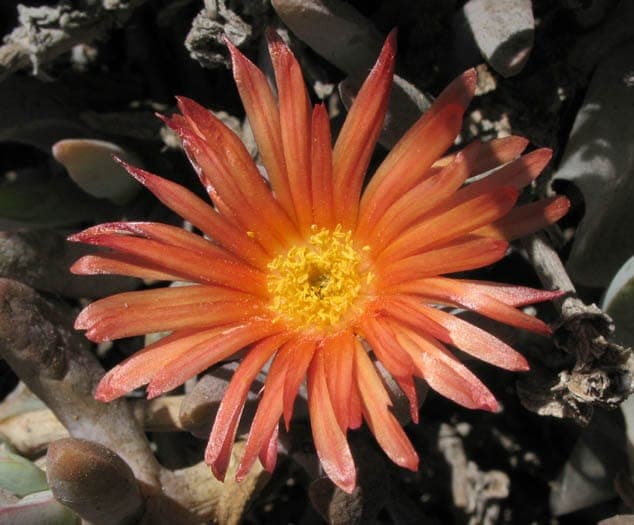
Anthony Valois and the National Park Service / Public domain, via Wikimedia Commons
Crocea Iceplant: complete guide
Malephora crocea
Want to see Crocea Iceplant: complete guide in your garden?
Full design in HD: €7.99
Look after your Crocea Iceplant with the GardenWorld app
Identify plants with your camera and get a care calendar with reminders for this plant.


Crocea Iceplant (Malephora crocea) is a South African succulent from the Aizoaceae family, renowned for exceptional drought tolerance and vibrant coppery-orange flowers. This compact plant thrives in very dry, sunny gardens and rock gardens where ordinary plants struggle.
Malephora crocea is relatively easy to cultivate in temperate climates with proper drainage. The plant forms dense mats of fleshy foliage and produces prolific flowers under sunny conditions.
Appearance and bloom
Crocea Iceplant forms low, spreading mats reaching roughly 15 to 30 centimeters tall. Leaves are extremely fleshy, green to grayish-green, arranged opposite along short stems. This leaf structure allows the plant to store water for extended drought periods.
Flowers emerge on short stems above foliage in coppery to orange-red tones. The flowering season extends from late spring through autumn, with numerous blossoms produced sequentially for prolonged visual interest.
Ideal location
Choose the sunniest garden position - full sun is essential. Minimum six to eight hours daily direct sunshine is rarely adequate; nine to ten hours is preferable. Shade reduces flowering dramatically and may cause etiolation.
Position on slopes, in raised beds, or elevated areas where water drains freely. Mixed rockery settings are ideal. The plant tolerates saltwater exposure, making coastal locations suitable.
Soil
Malephora crocea demands exceptional drainage. Standard garden soil is far too moisture-retentive. Mixtures of sand, gravel, small stones, and minimal organic matter create ideal growing medium. Rocky soils are perfect.
PH is less critical; the plant grows in acidic through alkaline environments. Add perlite, potshards, and limestone to amended beds. Mulch with fine gravel around plant bases.
Watering
Water extremely sparingly. Once established, supplemental watering is rarely needed in most climates. Water only during extreme drought. Excess moisture is the primary cause of Malephora failure.
In container cultivation, water deeply but infrequently - possibly monthly during growing season only. In winter, provide minimal to no watering. Ensure perfect drainage of all pots and beds.
Free preview
Want to see Crocea Iceplant: complete guide in your garden? Make a free preview of your design.
Pruning
Minimal pruning is needed. Remove only dead foliage or damaged portions. In containers, occasional removal of sprawling stems maintains full form.
Never use heavy pruning. Allow natural spreading growth. The plant self-directs to achieve optimal shape.
Maintenance calendar
January to February: Minimal activity. Check drainage. No watering. March to May: Growth begins; supplemental water only in extremes. Favor high temperatures. June to August: Full flowering. Extreme heat is beneficial. Sparse water. September to October: Flowering slows. Minimize watering. Prepare for dormancy. November to December: Plant resting. No water. Protect from heavy rain and frost.
Winter hardiness
Crocea Iceplant is moderately cold-hardy, tolerating about -2 to -5 degrees Celsius during brief periods. In northern regions, container cultivation with indoor overwintering is recommended.
Severe freezing damages foliage. Cover plants with dry leaves or straw during extreme winters. Ensure dry dormancy - wet feet during frost periods prove fatal.
Companion planting
Pair Malephora with other South African succulents like Echeveria, Sedum, and Aeonium. Drought-tolerant grasses like Festuca provide textural contrast. Dwarf shrubs like Gaura complement well.
Compositions with gray-leaved plants like Senecio and Artemisia create striking visual effects. For naturalistic arrangements, group identical species together.
Closing remarks
Crocea Iceplant is excellent for those avoiding moist conditions. The plant requires minimal care, usually no feeding, and tolerates neglect well. With proper drainage, it's a true "set-and-forget" succulent.
Gardenworld recommends: Source Malephora through specialized succulent nurseries and online retailers. Shipping during dry months prevents adaptation problems. For inspiration on succulent gardens and dry borders, visit gardenworld.app and discover pre-designed arrangements with drought-loving flora. Create your own water-wise, copper-flowering succulent garden today!
Frequently asked questions about Crocea Iceplant
Is Crocea Iceplant winter hardy?
Crocea Iceplant is moderately cold-hardy, tolerating about -2 to -5 degrees Celsius during brief periods. In northern regions, container cultivation with indoor overwintering is recommended.
When and how do you prune Crocea Iceplant?
Minimal pruning is needed. Remove only dead foliage or damaged portions.
How much water does Crocea Iceplant need?
Water extremely sparingly. Once established, supplemental watering is rarely needed in most climates.
Where does Crocea Iceplant grow best?
Choose the sunniest garden position - full sun is essential. Minimum six to eight hours daily direct sunshine is rarely adequate; nine to ten hours is preferable.
What soil does Crocea Iceplant need?
Malephora crocea demands exceptional drainage. Standard garden soil is far too moisture-retentive.

See it in your garden
See Crocea Iceplant in your garden
One photo of your garden and a few questions. You see the result in about a minute.
Try it with a photoIdentify this plant in your own garden. Identify a plant
Similar plants
New Zealand spinach: sowing, harvesting and use
Tetragonia tetragonioides
New Zealand spinach (Tetragonia tetragonioides) does not bolt in summer heat. Advice on soaking, sowing, planting out, harvesting and cooking this summer green.
Carpobrotus glaucescens: complete guide
Carpobrotus glaucescens
Pigface or angular sea-fig is a succulent from Australia. Learn cultivation, care, and use for coastal and container gardens.
Delosperma nubigenum: complete guide
Delosperma nubigenum
Everything about Delosperma nubigenum: a prolific-flowering succulent from South Africa with orange blooms. Growing tips, care and design ideas for your garden.
