
Ghislain118 http://www.fleurs-des-montagnes.net / CC BY-SA 3.0, via Wikimedia Commons
Hairy dewflower: complete guide
Drosanthemum hispidum
Want to see Hairy dewflower: complete guide in your garden?
1 minute, no credit card
Overview
Drosanthemum hispidum, commonly known as hairy dewflower, is a beautiful succulent plant native to the arid regions of Namibia and the South African Cape. This compact succulent is renowned for its distinctive hairy leaves and bright purple flowers that appear early in the growing season. It represents an ideal choice for gardeners seeking a drought-tolerant, low-maintenance plant that delivers visual drama during the growing months.
The hairy dewflower belongs to the Aizoaceae family, the same family as many well-known succulents and ice plant relatives. This plant is frequently used in xeriscaping - a gardening style focused on water conservation - because once established, this botanical jewel requires virtually no water.
Appearance and Bloom
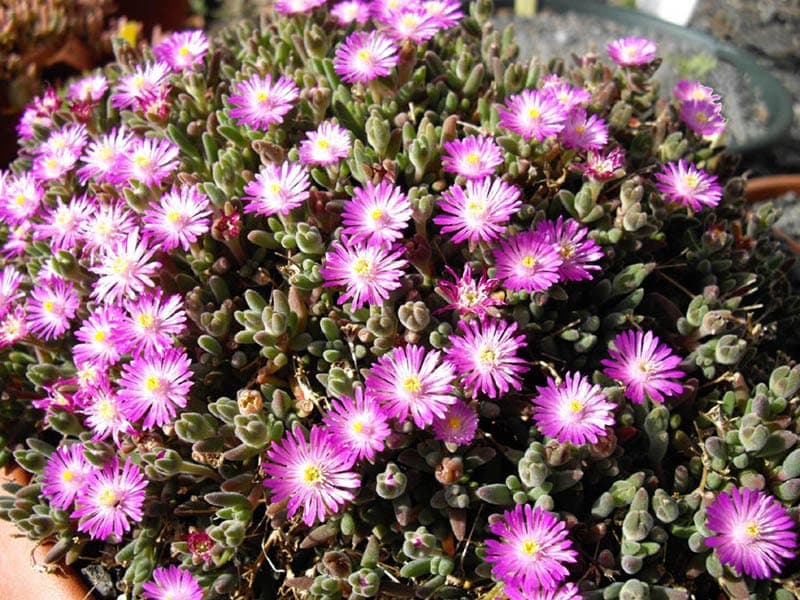
The hairy dewflower forms itself into a low, spreading mat or cushion, typically not exceeding 15-20 centimeters in height. The leaves are small, rounded, and densely covered with fine hairs that give the plant a soft, almost woolly appearance. This characteristic hairiness serves as a water-saving mechanism, allowing the plant to better withstand drought and intense sun exposure.
The flowers are undoubtedly the highlight of this plant. They appear in spring and early summer (April through June in the northern hemisphere) and are bright magenta to purple in color. Though individual flowers are small, they are remarkably abundant and cover the plant almost entirely, resulting in a spectacular floral display that can last for weeks. After blooming, small seed pods form that are equally decorative.
Ideal Location
The hairy dewflower flourishes in full sun. Plant this succulent in a location receiving at least 6-8 hours of direct sunlight daily. South-facing and southwest-facing walls are ideal spots. In regions with extremely hot summers, light afternoon shade may be beneficial, particularly where temperatures regularly exceed 35 degrees Celsius.
Under insufficient light, the plant becomes leggy and sparse, and flower production diminishes significantly. Therefore, it is crucial not to place this plant in shade or partial shade. Even on a sunny windowsill indoors, it will thrive, though outdoor cultivation always produces superior flowering.
Soil
Like all succulents, hairy dewflower demands well-draining soil. Heavy, moisture-retaining clay soils are the enemy of this plant and will lead to root rot. Use a quality cactus potting mix or prepare your own mixture by combining regular garden soil with coarse sand in a ratio of 1:2.
The ideal pH for this plant ranges between 6.0 and 7.5 (neutral to slightly acidic). The plant accepts poor soils exceptionally well - in fact, it thrives better in nutrient-poor soil than in rich, organic matter-laden earth. This reminds us of its natural habitat in rocky, sparse savannas.
For containers, always use good drainage material or terracotta pots with multiple drainage holes at the bottom.
Free design
Want to see Hairy dewflower: complete guide in your garden? Make a free design now.
Watering
This may well be the most critical aspect of cultivating drosanthemum hispidum: restrained watering. This plant is adapted to dry climates and can survive extended periods without water. Excessive water is far more damaging than insufficient water.
During the growing season (spring and summer), water only when the soil is completely dry. A good rule is to water thoroughly and then wait at least two weeks before watering again. In winter, this interval can extend considerably - sometimes four to six weeks between waterings.
With container cultivation, ensure all excess water drains immediately from the bottom holes. Never place a pot in a water-filled saucer. For garden plants, withhold water entirely during rainy periods.
Pruning
The hairy dewflower requires very little pruning work. The plant grows naturally compact and forms attractive clumps without harsh intervention. You may, however, gently remove dead leaves and spent flowers after blooming to keep the plant tidy.
If the plant becomes too wide or grows out of shape, you can gently trim back some stems after flowering. These cut stems can be used as cuttings to propagate new plants. Simply allow them to dry, then insert into dry seed compost - they will root without assistance.
Maintenance Calendar
March-April: The growing season begins. Start watering cautiously as temperatures rise.
May-June: Peak flowering period. Ensure regular (but minimal) watering. Monitor for pests.
July-August: The warmest season. Water may still be needed, but much less frequently. Provide adequate air circulation.
September-October: Growing season declines. Gradually reduce watering.
November-February: Rest period. Water very sparingly, only if the plant shows severe wilting. No feeding necessary.
Winter Hardiness
The hairy dewflower is moderately frost-sensitive. The plant can tolerate temperatures down to around -3 to -5 degrees Celsius if kept completely dry, but this is not ideal. In climates with regular frost, it is prudent to cultivate the plant in containers and move them indoors during winter.
In milder regions, this plant can remain outdoors, but ensure it stays absolutely dry and does not remain in shade where moisture might condense.
Companion Plants
The hairy dewflower pairs beautifully with other drought-tolerant succulents:
- Other drosanthemum species for color variation
- Sedum species for textural contrast
- Echeveria varieties for form diversity
- Hardy geranium species for non-succulent contrast
- Lavender for color and fragrance
Complementary plants such as agapanthus or ornamental grasses can also be attractive, provided they do not receive excessive water.
Closing Thoughts
The hairy dewflower is an underrated gem for the modern garden. With its minimal maintenance requirements and spectacular spring flowering, it deserves far more attention from gardeners. Whether you are creating a xeriscape garden or simply seeking a low-maintenance alternative to traditional plantings, drosanthemum hispidum is an excellent choice.
For this plant, visit reputable plant nurseries where you can regularly find succulents in stock. You may need to order the plant specially, but it is worth the wait. With the right location (plenty of sun), well-draining soil, and moderate watering, you will enjoy years of pleasure from this striking South African beauty.
For more gardening advice and plant guides, visit gardenworld.app, where you will find extensive information about cultivating beautiful gardens.
Want to see Hairy dewflower: complete guide in your garden? Make a free design now.
Upload a photo, pick a style, and get a photorealistic design with plant list in under a minute.
No credit card required


Similar plants
Carpobrotus glaucescens: complete guide
Carpobrotus glaucescens
Pigface or angular sea-fig is a succulent from Australia. Learn cultivation, care, and use for coastal and container gardens.
Delosperma nubigenum: complete guide
Delosperma nubigenum
Everything about Delosperma nubigenum: a prolific-flowering succulent from South Africa with orange blooms. Growing tips, care and design ideas for your garden.
Crocea Iceplant: complete guide
Malephora crocea
Discover Crocea Iceplant (Malephora crocea), a South African succulent with coppery-orange flowers. Perfect for dry, sunny gardens and rock gardens.