
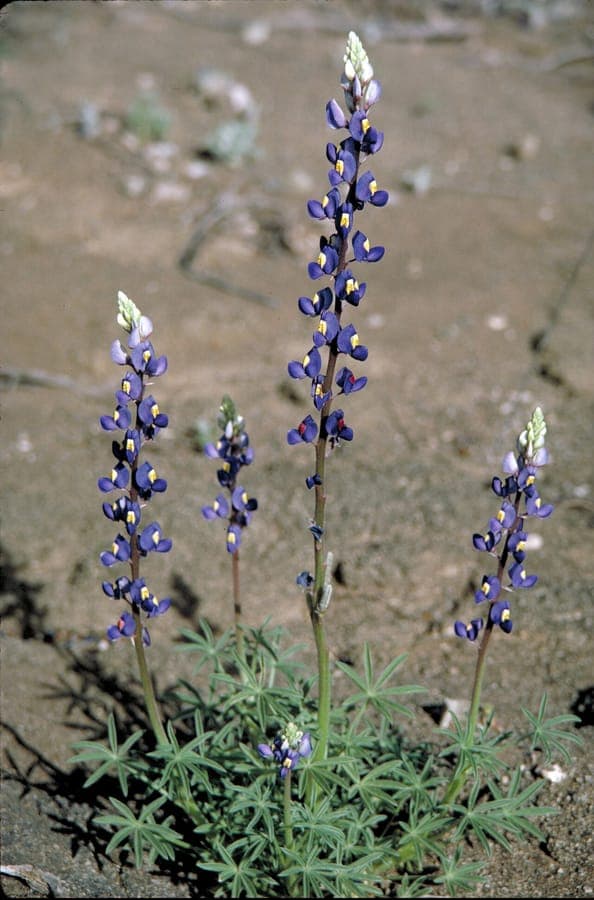
Dr. Thomas G. Barnes. / Public domain, via Wikimedia Commons
Big Bend bluebonnet: complete guide
Lupinus havardii
Want to see Big Bend bluebonnet: complete guide in your garden?
1 minute, no credit card
Overview
Lupinus havardii, commonly known as the Big Bend bluebonnet or Chisos bluebonnet, is a remarkable lupine species native to the rocky slopes and limestone flats of West Texas, particularly around the Big Bend region. Described by botanist Sereno Watson in 1882, this plant is named after Valery Havard, an army surgeon and plant collector who conducted extensive botanical surveys in the Texas military districts during the 1880s.
What sets this species apart from virtually every other lupine in North America is its extraordinary height. In optimal conditions, flower spires can reach 90 to 150 cm, making it the tallest native lupine on the continent. For gardeners seeking dramatic vertical interest and an unusual plant with genuine botanical heritage, the Big Bend bluebonnet delivers something truly special. Detailed growing advice tailored to your garden situation is available at gardenworld.app.
Appearance and bloom cycle
The visual impact of Lupinus havardii is immediate. Tall, slender flower spires rise from a low basal rosette of palmate leaves, carrying densely packed blossoms in a vivid azure-blue. Each individual flower has a classic pea-flower shape typical of the Fabaceae family, with a banner petal that starts white and gradually shifts to purple as the flower ages. This color change gives the spike a naturally gradient appearance, with younger blooms at the top showing fresh blue and older lower flowers showing purple tones.
The leaves are compound, with seven to nine narrow leaflets arranged in a palmate pattern. The undersides of the leaflets are finely hairy, giving a silvery sheen when the sun catches the foliage at low angles. The long leaf stalks give the plant an open, airy quality between flowering periods.
In its native Texas habitat, bloom time falls between February and April, triggered by winter rainfall patterns. In garden settings outside Texas, the bloom timing depends on when seeds are sown and how the plant is managed. Early sowing indoors yields the earliest blooms, typically in May in northern European gardens. The flowers attract early-season bumblebees and solitary bees.
Ideal location
The Big Bend bluebonnet is a full sun plant without compromise. At least six hours of direct sunlight daily is the minimum; in partial shade, the plant stretches awkwardly toward the light and loses its characteristic upright posture. A south-facing border position in northern European gardens gives the best results.
Given its impressive height, wind shelter is important. The slender spires can topple in strong winds unless staked or positioned behind a low wall or hedge. The plant is naturally a colonist of open, stony limestone plains - conditions that translate well to gravel gardens and low-water planting schemes. Avoid heavy clay soil and any position with poor drainage.
Soil
Lupinus havardii has specific soil requirements that reflect its chalky Texas homeland. The ideal pH range is 7.5 to 8.0, which is considerably higher than for most cultivated lupines. In acid soils below pH 7, the plant quickly shows iron and magnesium deficiency through yellowing leaves.
If your soil is naturally acid, incorporate ground limestone before planting to raise the pH. Good drainage is equally critical - waterlogged conditions cause root rot very rapidly in this drought-adapted species. On heavy clay soils, incorporate coarse sand or fine gravel to improve drainage significantly. Avoid overly rich, humus-heavy soils; on fertile ground the plant produces lush foliage at the expense of flowering.
As a member of the legume family, Lupinus havardii forms a symbiotic relationship with nitrogen-fixing Rhizobium bacteria in root nodules. On impoverished or previously uncultivated soils, inoculating seeds with an appropriate rhizobium product is recommended to establish the nitrogen-fixing partnership from the start.
Free design
Want to see Big Bend bluebonnet: complete guide in your garden? Make a free design now.
Watering
For a plant adapted to the semi-arid landscapes of West Texas, watering requirements are more nuanced than you might expect. During germination and the early seedling stage, regular moisture is needed to encourage strong root establishment. Once the plant is established, water requirements drop substantially.
Mature plants handle dry periods well and actually perform best when the soil dries out almost completely between waterings. Overwatering in combination with poor drainage is the most common cause of failure with this species. During the flowering period, slightly more generous watering is acceptable, but the soil should never remain wet for extended periods. In average northern European summers, supplemental irrigation is rarely needed; extended heat waves without rainfall are the exception.
Pruning
As an annual or short-lived herbaceous plant, Lupinus havardii manages its own life cycle without much pruning intervention. After the flowers fade and seed pods form, the plant naturally declines. To encourage self-seeding, leave the spent stalks standing until the pods turn brown and begin to split open, releasing seeds onto the ground below.
If you want to prevent self-seeding or maintain a tidy border, remove the flower stalks promptly after blooming. There is no cutting-back for regrowth as with perennial lupines - once this plant has set seed, its annual cycle is complete.
For an extended display across the season, sow seeds in two batches three weeks apart. The first batch will bloom earlier, the second extending the show into summer.
Maintenance calendar
January-February: Sow seeds indoors on a light, frost-free windowsill at 15-18 degrees Celsius. Use lime-rich seed compost. Soak seeds for 24 hours in warm water to improve germination rates.
March: Plant out seedlings when soil has warmed and night frost is no longer expected. Space plants 30-40 cm apart. Water in well after planting to settle roots.
April-May: Peak flowering period. Monitor for aphids and other pest insects. Water only when the soil is almost completely dry. Enjoy the tall blue spires.
June: Flowering ends. Leave stalks for seed setting or remove promptly, depending on your preference. Collect ripe seeds for storage or next season's sowing.
July-September: Remove dried plant material. Loosen the soil and add lime if needed for the following season.
October-November: In mild, well-drained garden spots, direct autumn sowing is possible - seeds overwinter in the soil and germinate early the following spring.
December: Store dried seeds in a cool, dry paper envelope until sowing time.
Winter hardiness
Lupinus havardii is not winter-hardy in northwest European conditions. The plant tolerates light frost down to -3 to -5 degrees Celsius for short periods, but sustained freezing temperatures combined with wet winter conditions are fatal. In USDA hardiness zones 8 and above with dry winters, the plant can sometimes overwinter outdoors on well-drained sheltered spots.
In British and northern European gardens, the best approach is to treat it as an annual, sowing fresh each year. Seeds overwinter well in dry, cool storage. Alternatively, young plants can be overwintered in small pots on a light, frost-free windowsill.
Companion plants
The slender vertical form of Lupinus havardii works beautifully alongside plants with contrasting growth habits. Low spreading ground covers such as Phlox subulata or Sedum species create striking contrast with the tall flower spires. In a Texas-themed planting, combine with Salvia greggii, Penstemon species, and ornamental grasses such as Nassella tenuissima.
In a more classic border setting, Mexican sage (Salvia leucantha) and lavender make good companions. Avoid neighbours that hold moisture in the soil or compete aggressively for nutrients - lupines fix their own nitrogen but need clean, uncompacted roots.
At gardenworld.app you can upload a photo of your garden and receive personalised advice on companion plant combinations that suit the Big Bend bluebonnet in your specific space.
Closing
Lupinus havardii is a genuine collector's plant for adventurous gardeners. The combination of extraordinary height, vivid blue flowers, and early bloom time makes it a true standout in any border. Success requires the right conditions - full sun, chalky well-drained soil, and restrained watering. Gardeners who respect these needs will be rewarded with one of the most dramatic lupine displays possible. Seeds are available from specialist garden centres; for best results in the UK and Europe, look for suppliers experienced with North American natives.
Want to see Big Bend bluebonnet: complete guide in your garden? Make a free design now.
Upload a photo, pick a style, and get a photorealistic design with plant list in under a minute.
10,000+ gardens designed already
No credit card required


Similar plants
Texas bluebonnet: complete guide
Lupinus texensis
The iconic Texas bluebonnet captivates with its deep blue flower spikes and resilience. Learn how to cultivate this wildflower beauty in your front yard.
Lupinus subcarnosus: complete guide
Lupinus subcarnosus
Texas bluebonnet is the state flower of Texas and a spectacularly beautiful perennial. Learn how to grow this iconic lupine in your front yard on gardenworld.app.
San Jacinto lupine: complete guide
Lupinus hyacinthinus
Everything about Lupinus hyacinthinus, the San Jacinto lupine from Southern California with hyacinth-like flower spikes and rapid growth.