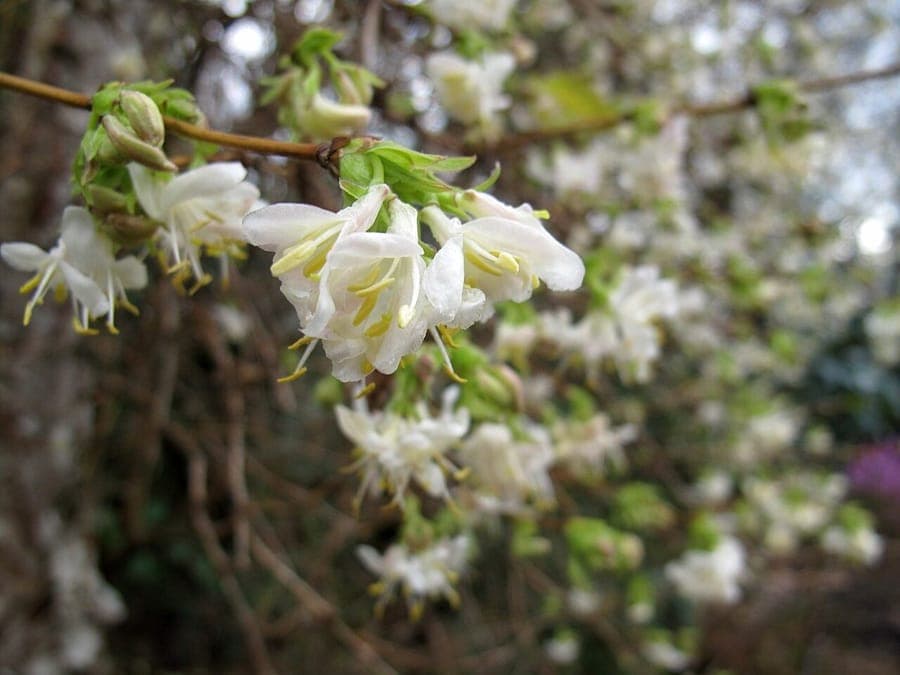
Megan Hansen from Portland, OR, US / CC BY-SA 2.0, via Wikimedia Commons
Winter honeysuckle (Lonicera × purpusii): complete guide
Lonicera × purpusii
Want to see Winter honeysuckle (Lonicera × purpusii): complete guide in your garden?
Full design in HD: €7.99
Look after your Winter honeysuckle with the GardenWorld app
Identify plants with your camera and get a care calendar with reminders for this plant.


Overview
Winter honeysuckle (Lonicera × purpusii) is the kind of shrub you can walk past all summer without a second glance, then suddenly notice on a mild January afternoon because the air around it smells of lemon and honey. The flowers are small and creamy white, but they open when almost nothing else in the garden is doing anything at all: from December into March, on bare or half-bare twigs.
Lonicera × purpusii is a cross between two Chinese winter-flowering species, Lonicera fragrantissima and Lonicera standishii. It arose around 1920 at the botanic garden in Darmstadt and is named after the Purpus brothers who worked there. Unlike the familiar climbing honeysuckles, this one is a shrub: loose, slightly arching, 1.5 to 2 m tall and at least as wide. The most widely grown form is 'Winter Beauty', which flowers more freely and over a longer season than the original hybrid, and it is the one you are most likely to find at a garden centre.
Not sure where a winter-scented shrub would work best in your plot? At gardenworld.app you can have a garden design drawn up that places fragrant shrubs along the path to the front door or under the kitchen window, exactly where you pass them every day in winter.
Appearance and bloom cycle
The flowers are carried in pairs in the leaf axils of the previous year's shoots. Each one is about 1.5 cm long, two-lipped like every honeysuckle, creamy white with conspicuous yellow anthers. They do not all open together. In mild spells new flowers keep appearing; during hard frost flowering pauses and then simply resumes. In a gentle winter a single shrub can therefore offer something for three months, with the peak usually in January and February.
The leaves are oval to elliptic, 4 to 8 cm long, matt green and arranged in opposite pairs. In a mild winter some foliage hangs on, so the shrub looks semi-evergreen; after a cold snap it is bare. It leafs out early and freshly in spring. Red berries sometimes follow the flowers, though this hybrid rarely produces many.
The habit is loose and a little untidy, with long arching stems rising from the base. Outside winter, Lonicera × purpusii is a modest green shrub with little ornamental value of its own. Keep that in mind when choosing its spot: put it where you will see and smell it in winter, and where it can blend into the back of a border or a mixed hedge in summer.
For pollinators the early flowers are precious. Bumblebee queens and honeybees that venture out on a sunny winter day find nectar and pollen here when there is almost nothing else on offer.
Ideal location
The shrub flowers most freely in full sun or partial shade. It will grow in deeper shade, but becomes thinner and flowers less. More important than hours of sunshine is its position relative to you: plant it beside a path, near the front door, at the edge of a patio or below a window you sometimes open. The scent carries furthest in a sheltered, still spot where the warmth of a wall or hedge lingers.
Shelter also protects the flowers. They cope with light frost, but a bitter easterly wind can brown the open blooms. A south- or west-facing position with a wall or taller shrubs behind it gives the best results. Allow about 2 m of width; squeezing it into a tight space forces you to prune hard, and you lose exactly the stems that should flower.
Soil requirements
Lonicera × purpusii is not fussy. Any ordinary, well-drained garden soil will do, from light sand to loam and chalky clay. Acid, neutral or slightly alkaline conditions are all fine. What it dislikes is ground that stays waterlogged for long periods in winter.
When planting, fork a few spadefuls of compost or well-rotted manure into the planting hole. Dig the hole twice as wide as the root ball and set the plant at the same depth it was growing in its pot. On poor sandy soil an annual spring mulch of compost helps the ground hold moisture. Chemical fertiliser is unnecessary; too much nitrogen produces long, soft growth and few flower buds.
Autumn and early spring, when the soil is not frozen, are the best times to plant. Container-grown shrubs can go in almost any time of year as long as you water them through dry spells.
Free preview
Want to see Winter honeysuckle (Lonicera × purpusii): complete guide in your garden? Make a free preview of your design.
Watering
In the first year after planting, regular watering matters. In dry weather give each shrub a good soak once a week, around 10 litres, so the water reaches deep into the soil. A mulch of bark chips or leaf mould keeps moisture in and weeds down.
Once established, winter honeysuckle usually looks after itself. Only during long summer droughts, especially on sandy soil, does it need an extra drink. That also pays off in flowers: the buds are formed in summer and early autumn, and a shrub that goes thirsty in August will flower less the following winter. Plants in containers should never dry out completely, not even in winter.
Pruning
Flowers appear on the previous year's wood, so always prune straight after flowering, in March or early April, and never in autumn, or you will remove next winter's buds.
A young shrub needs little pruning for its first few years. From about the fourth year, renew it gradually: each spring cut a fifth to a quarter of the oldest, thickest stems right down to the ground. This keeps a steady supply of young, free-flowering shoots and an open structure. Also remove crossing branches, dead wood and anything hanging over the path. Never shear it into a ball; you end up with a dense outer shell and few flowers.
If an old shrub has got completely out of hand, you can cut it back hard in March to 30 to 40 cm above ground. It will regrow vigorously, though you will miss one or two winters of flowers.
Cut a few stems in bud in December or January for a vase indoors; they open within days and fill a room with scent.
Maintenance calendar
December to February: Main flowering in mild weather. Cut a few stems for the house. No feeding or pruning.
March to April: Prune right after flowering. Remove the oldest stems and dead wood. Spread compost around the base.
May to June: Strong growth. Water young plants in dry spells. Keep an eye out for aphids on soft shoot tips; natural predators usually deal with them.
July to September: Flower buds are forming. Water during prolonged drought. Do not prune.
October to November: A good time to plant new shrubs. Leave fallen leaves under the shrub as a natural mulch.
If you would rather not keep track of all this yourself, the plant calendar at gardenworld.app reminds you when to prune, plant and water.
Winter hardiness
Lonicera × purpusii is fully hardy throughout Britain and north-west Europe. The RHS rates it H6, which corresponds to frost down to about -20 °C. It comes through any normal winter without protection.
The flowers themselves are a little more vulnerable. Hard frost below about -8 to -10 °C can brown open blooms, but buds that are still closed open normally once the cold has passed. A sheltered position limits the damage.
On toxicity: honeysuckle berries are considered mildly toxic and can cause stomach upsets if eaten, in people as well as in pets. This hybrid sets few berries, but it is still worth teaching young children not to eat them.
Companion plants
The best pairings are with other winter flowerers, so that there is something to enjoy from December to March. Chinese witch hazel (Hamamelis mollis), with its spidery yellow flowers, and Viburnum farreri flower at the same time and are scented too. Wintersweet (Chimonanthus praecox) completes the line-up of fragrant shrubs.
Beneath and in front of it, plant Christmas rose (Helleborus niger), snowdrops (Galanthus nivalis), winter aconites (Eranthis hyemalis) and Cyclamen coum. They flower in the same weeks and cover the bare soil under the shrub. For evergreen structure add Skimmia japonica, whose red buds stay decorative all winter.
Because winter honeysuckle is unremarkable in summer, a late-flowering clematis such as Clematis viticella can scramble through it. It flowers from July to September, is cut back low in February and so never gets in the way of the winter display.
Final thoughts
Lonicera × purpusii will never steal the show in June. Its moment comes in the depths of winter, when you walk to the door with your hands in your pockets and catch a sudden waft of sweetness. For that alone it deserves a place in almost any garden. Plant it where you pass in winter, prune after flowering and give it room: it asks for little else.
Frequently asked questions about Winter honeysuckle
Is Winter honeysuckle winter hardy?
Lonicera × purpusii is fully hardy throughout Britain and north-west Europe. The RHS rates it H6, which corresponds to frost down to about -20 °C.
When and how do you prune Winter honeysuckle?
Flowers appear on the previous year's wood, so always prune straight after flowering, in March or early April, and never in autumn, or you will remove next winter's buds.
How much water does Winter honeysuckle need?
In the first year after planting, regular watering matters. In dry weather give each shrub a good soak once a week, around 10 litres, so the water reaches deep into the soil.
Where does Winter honeysuckle grow best?
The shrub flowers most freely in full sun or partial shade. It will grow in deeper shade, but becomes thinner and flowers less.
What soil does Winter honeysuckle need?
Lonicera × purpusii is not fussy. Any ordinary, well-drained garden soil will do, from light sand to loam and chalky clay.

See it in your garden
See Winter honeysuckle in your garden
One photo of your garden and a few questions. You see the result in about a minute.
Try it with a photoIdentify this plant in your own garden. Identify a plant
Similar plants
Chinese Witch Hazel: complete guide
Hamamelis mollis
Chinese witch hazel blooms in January-February with fragrant yellow flowers even in deep winter. Master care, site selection, and pruning to enjoy 30+ years of winter color.
Chimonanthus praecox: complete guide
Chimonanthus praecox
Wintersweet brings fragrance and color during the coldest months. Learn how to grow this Asian shrub for early spring charm.
Viburnum farreri: complete guide
Viburnum farreri
Discover fragrant Viburnum farreri, winter-blooming shrub with white flowers and compact growth. Perfect for wildlife gardens.
