
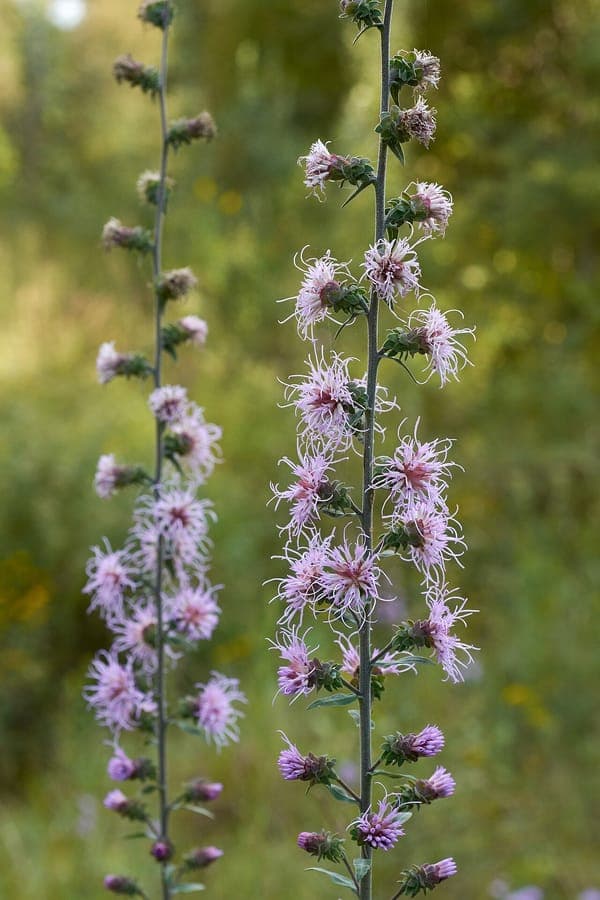
Eric Hunt / CC BY-SA 4.0, via Wikimedia Commons
Appalachian blazing star: complete guide
Liatris squarrulosa
Want to see Appalachian blazing star: complete guide in your garden?
1 minute, no credit card
Overview
The Appalachian blazing star (Liatris squarrulosa) is a striking native perennial in the aster family (Asteraceae), native to the central and eastern United States from West Virginia and Virginia south through Georgia, Alabama, and Louisiana, and west to Texas, Missouri, and Illinois. In its natural habitat it grows on dry, open prairies, along woodland edges, and on sandy to loamy slopes that may experience significant summer drought. In Europe it is sometimes confused with the better-known Liatris spicata, but Liatris squarrulosa has larger, showier flower heads with distinctively reflexed bracts - the characteristic that inspired the species name "squarrulosa," meaning rough or scaly.
Like all Liatris species, the Appalachian blazing star has an unusual flowering habit: the flowers open from the top of the spike downward, rather than from the bottom up as in most spike-flowering plants. This makes it endlessly interesting to watch through the flowering season and a valuable garden plant for late summer colour. The purple-pink flower spikes are irresistible to butterflies, bees, and bumblebees. On gardenworld.app you will find design inspiration for prairie-style and wildlife gardens where Liatris and other native perennials take centre stage.
Appearance and bloom cycle
The Appalachian blazing star grows as an upright, unbranched perennial from a corm-like base, reaching seventy to one hundred and sometimes one hundred and twenty centimetres in height. The leaves are linear and narrow, six to twenty centimetres long, reducing in size towards the top of the stem. The lower leaves are the broadest; the stem leaves become progressively smaller and bract-like. The stem is stiff and sturdy with no need for staking.
The flowers are the plant's main attraction: large, purple-pink flower heads of two to four centimetres across appear in August and September, arranged in a dense spike. The phyllaries - the small bracts surrounding each flower head - are distinctly reflexed and spreading, giving a slightly shaggy or scaly appearance that is characteristic of this species. The fragrance is light and sweet, attractive to pollinators. After flowering, small achenes with feathery plumes develop and persist through winter, providing food for seed-eating birds. The fleshy corm at the base survives even cold winters reliably underground.
Ideal location
Liatris squarrulosa thrives in full sun. In its native habitat it grows on open prairies and woodland margins with unobstructed sunlight. In the garden, a south- or west-facing position receiving at least six hours of direct sun a day is ideal. It tolerates light dappled shade in the afternoon but flowers most prolifically and produces sturdier stems in full sun.
The plant is particularly well suited to prairie-style, wildlife, or naturalistic gardens, but it also fits comfortably into more formal mixed borders. It makes an excellent cut flower - the long, straight stems are prized by florists. It tolerates heat and some air pollution, making it a good choice for gardens in urban environments as well as rural and suburban settings.
Soil
Liatris squarrulosa is undemanding in its soil requirements: it grows well in average to dry, well-drained soil with a pH between 5.4 and 7.5. Sandy or light loamy soils are perfectly suited, and average garden soil also performs well. The plant has a strong dislike of heavy, wet, waterlogged clay, especially in winter, when the corm is most vulnerable to rotting.
When planting in heavier garden soil, work some coarse grit or sharp sand into the planting area to improve drainage. Overly rich, humus-heavy soil is not necessary and actually leads to lush, floppy stems that fall over. A degree of soil leanness keeps the plant compact and upright. A light mulch helps retain moisture balance, but avoid piling thick mulch directly over the corm, as this can encourage rotting in wet conditions.
Watering
Once established, the Appalachian blazing star is genuinely drought tolerant. In its native habitat it survives periods of summer drought thanks to the moisture-storing corm. In the garden, young plants in their first growing season benefit from regular watering, but from the second year onwards supplemental watering during dry periods is rarely needed.
For established plants the rule is: less is more. Overwatering leads to corm rot and weak, disease-prone plants. During drought, a deep watering every two weeks is far preferable to shallow watering every few days. In winter when the plant is dormant, additional watering is not needed and can actually be harmful. Always ensure that rainwater can drain freely away from the root zone.
Free design
Want to see Appalachian blazing star: complete guide in your garden? Make a free design now.
Pruning
Care of Liatris squarrulosa after flowering is simple. The dried flower spikes can be removed in October or November if a tidy appearance is preferred, but they can equally well be left standing through winter - the feathery seed plumes provide attractive winter structure and the seeds are an important food source for finches and other seed-eating birds.
In early spring, as new shoots become visible, cut the remaining stems back to just above ground level and clear away the previous season's dead foliage. A light tidying with a rake or by hand is all that is needed to refresh the planting area. No further care is required: the plant regenerates each year from its corm and needs no reshaping. After several years, the clump can be divided to propagate new plants or to rejuvenate the parent plant.
Maintenance calendar
January to February: the plant is dormant; the corm overwinters in the ground; no action needed; enjoy any remaining seed plumes as winter decoration. March: new shoots begin to emerge; remove last year's remaining stems; no fertiliser needed at this stage. April: growth accelerates; leaves grow quickly; watch for slugs that can damage emerging shoots. May to June: active growth; stems reach their full height; no special maintenance. July: the first flower buds become visible at the top of the spikes. August to September: peak bloom; the purple-pink flowers open from the top downward; enjoy the visiting butterflies and bees. October: flowers fade; feathery achenes appear; leave the spikes standing for birds if desired. November to December: dormant period; the corm overwinters safely in the ground; no action needed.
Winter hardiness
Liatris squarrulosa is rated for USDA hardiness zones 5 to 8, meaning it withstands temperatures as low as approximately -26 degrees Celsius. In the United Kingdom, the Low Countries, and most of northern Europe, the plant overwinters in the ground without any problems. The fleshy corm is frost-resistant and reliably re-sprouts each spring even after hard winters.
A mulch layer over the corm during the first winter is a worthwhile precaution for young plants, but for established specimens it is barely necessary. Container-grown plants are best moved to a frost-free space or brought indoors if the pot is smaller than thirty centimetres in diameter, since small containers freeze through much faster than open ground. At gardenworld.app you can also discover other winter-hardy prairie perennials that combine beautifully with the Appalachian blazing star in a seasonally robust border.
Companion plants
The Appalachian blazing star is an excellent partner in a prairie or summer border. Good companions available from garden centres include:
- Rudbeckia (Rudbeckia fulgida, R. hirta): bright yellow cone flowers alongside the purple-pink of the Liatris provide a vibrant, summery contrast.
- Purple coneflower (Echinacea purpurea): the daisy-pink flowers bloom in the same period and attract the same pollinators.
- Agastache: honey-blue flowers for a warm blue accent in the prairie border.
- Penstemon: tubular flowers in red, pink, or purple that hold their own alongside the Liatris.
- Salvia nemorosa: blue flowers blooming earlier in the season but a beautiful complement to the late-summer stars.
Avoid tall, fast-growing neighbours that could shade the blazing star, which needs full sun for the best floral display.
Closing
The Appalachian blazing star is a remarkable perennial that brings generous purple-pink colour and abundant wildlife interest to the summer border in August and September. It is frost-hardy, drought tolerant, nearly maintenance-free, and a magnet for butterflies, bees, and bumblebees. Its unusual top-down flowering habit makes it endlessly fascinating to watch through the bloom season. With the right position - full sun, well-drained soil, no wet feet - Liatris squarrulosa will reward you year after year. Anyone who has once seen this tall, beautiful spike in full bloom understands why it is a cherished native prairie perennial in its homeland, and why it deserves a permanent place in every wildlife-friendly garden.
Want to see Appalachian blazing star: complete guide in your garden? Make a free design now.
Upload a photo, pick a style, and get a photorealistic design with plant list in under a minute.
10,000+ gardens designed already
No credit card required


Similar plants
Goldenball leadtree: complete guide
Leucaena retusa
Everything about the goldenball leadtree (Leucaena retusa): location, soil, watering, pruning, hardiness and companion plants.
Drooping leucothoe: complete guide
Leucothoe fontanesiana
Everything about drooping leucothoe (Leucothoe fontanesiana): shade tolerance, soil, watering, pruning, hardiness and companion plants.